
Shipping
NSW: SEREC Recomemds Way Forward Against Stakeholders Push Back

BY GBOGBOWA GBOWA
It is no longer news that Nigeria’s ambitious National Single Window (NSW) project designed to streamline trade documentation, reduce cargo dwell time, and align the country’s ports with global best practices has hit turbulence.
The rollout, executed simultaneously across all ports, is believed to have triggered severe operational disruptions, including cargo declaration paralysis, escalating demurrage charges, and widespread congestion. While policymakers weigh suspension as a corrective measure, industry stakeholders are mounting strong opposition, warning that halting the project could undo years of reform momentum.
Amid the apparent chaos, the Sea Empowerment and Research Center (SEREC), in a memo to the Presidency and the Ministry of Marine & Blue Economy, highlighted the root causes of the crisis as follows:
*Absence of phased implementation: No pilot testing or incremental validation was conducted.
*Breakdown in port functions: Cargo clearance and declaration systems collapsed.
*Weak stakeholder integration: Shipping companies, terminal operators, and customs agents were sidelined.
*Economic impact: Rising costs for importers/exporters, inflationary pressure on goods, and potential revenue leakages.
Despite the chaos, stakeholders argue that suspension would be a step backward. While shipping companies fear reverting to opaque legacy systems will erode transparency gains, terminal operators warn that suspension will prolong inefficiencies and discourage investment; even as customs agents insist that stabilisation, not abandonment, is the only viable path forward.
So far, SEREC is of the opinion that rathan than abandon the reform, there should be an urgent redesign of its implementation pathway. The memo outlines a stabilisation strategy that resonates with industry voices:
Immediate Crisis Containment
Hybrid operations: run NSW in testing mode while legacy systems remain active.
Temporary relief: suspend demurrage and storage charges linked to system delays.
Multi-agency crisis centre for real-time resolution.
Short-Term Stabilisation
Pilot NSW at low-volume ports (Calabar, Warri);Conduct a comprehensive system audit; Re-engage stakeholders with mandatory onboarding; Medium-Term Rollout; Gradual expansion to high-volume ports only after stability benchmarks are met; the strengthening of legal frameworks to enforce compliance.
Long-Term Sustainability
SEREC in additon recommended independent audits, continuous upgrades, and benchmarking against global trade systems; in additon to institutionalised stakeholder collaboration.
The memoir signed by its Head of Research, Fwdr Eugene Nweke cautioned that suspending the NSW project could trigger the following:
Prolonged congestion and inefficiencies, inflationary spikes in imported goods, loss of investor confidence in Nigeria’s trade ecosystem; and a damaging reversion to outdated, opaque systems.
The NSW remains a transformative reform with the potential to reposition Nigeria as a competitive trade hub in Africa. But its success hinges on methodical execution, stakeholder alignment, and adaptive implementation.













Business Focus1 hour ago
Customs CGC Says ‘The World Is Connected, Not Borderless’

Customs Report23 hours ago
Nigeria Customs Mulls Reviews of Complaints Arising from Recruitment

Politics2 days ago
Edo-Delta Journalists Forum Challenges Political Leaders on Regional Development

Business Maritime3 days ago
Nnadi Urges Nigerian Importers to Shift from Finished Goods to Manufacturing

Business Maritime3 days ago
WMD: Oyetola Recommit to Unlock CVFF Pursuant to Indigenous Operators Financing

Business3 days ago
Customs FOU Zone ‘A’ Hands Over Seized ₦511.4m Pharmaceuticals, Illicit Drugs to NDLEA, NAFDAC

Uncategorized4 days ago
Oyetola Unveils NPERA, Corporate Logo Amid Quiet Enthusiasm

News5 days ago
Nigeria, Benin Urged to Deploy Culture and Traditional Diplomacy to Defuse Border Tensions

Business Maritime5 days ago
Nigeria’s Ports: How Foreign Capital Took the Dinner, While Indigenous Businesses Got the Crumbs (3)

Business5 days ago
FOU Zone A, Police, Army, DSS, Others Strengthen Security Alliance Ahead of Elections

Business Maritime7 days ago
Nigeria’s Ports: How Foreign Capital Took the Dinner, While Indigenous Businesses Got the Crumbs (2)

Politics1 week ago
Former Senatorial Candidate, Hajia Nike AbdulRahman Dumps NDC, Defects to APC

Customs Report6 years ago
ANLCA Board is intact, cannot be wished away by anybody’-Elochukwu

Maritime2 years ago
B-R-E-A-K-I-N-G: Effedua, Rector MAN Oron, Resigns

Features2 years ago
EFCC’s Probe: Okowa Plots Sheriff’s Removal Despite London Accord
Business2 years ago
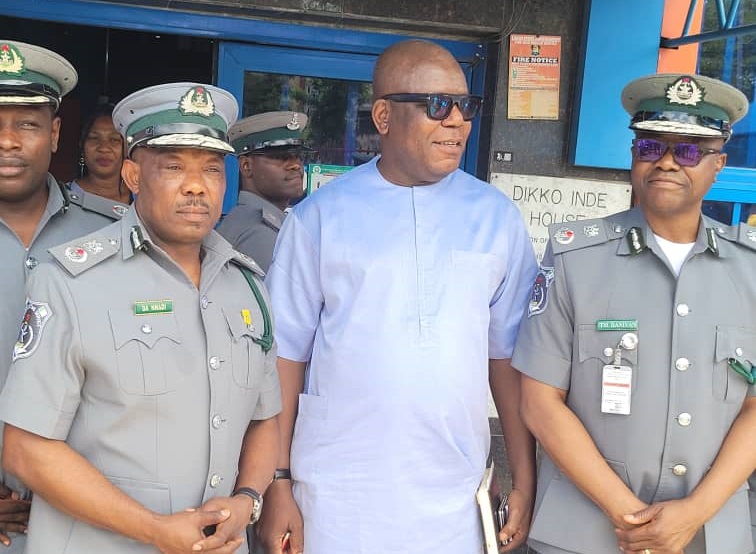
Customs Trains ANLCA Members, Others on B’Odogwu Portal

Analysis2 years ago
NPA’s Alleged Executive Management Fight: The Half Truth & Truth
Features2 years ago
ANLCA Board Election: Know Your Candidates
Interview2 years ago
‘Why We Launched B-Odogwu Pilot Scheme With Webb Fontaine Still Running’ – Adeniyi

Maritime2 years ago
Onyemekara Promoted GM, Appointed NPA’s New Spokesperson

Customs Report2 years ago
Nigeria Customs: Trust, Competence And The Oramalugo Factor

Customs Report1 year ago
Onyeka Makes History As Tin-Can Customs Hit ₦16.4bn A Day

Uncategorized2 years ago
‘Rush To Break News Can Lead To Brush With Cybercrime’- Police

Customs Report1 year ago
Kebbi Is Hub of Hard Drugs Smuggling In Northern Region’ – Oramalugo
Enter ad code her