Analysis
Coastal Fuel Transport vs. Dangote’s Gantry Push

BY EGUONO ODJEGBA
Nigeria’s long-standing struggle with efficient fuel distribution has resurfaced in the wake of Dangote Refinery’s recent caution against coastal evacuation of petroleum products. While the refinery argues that gantry loading is more cost-effective, critics warn that this position risks undermining safer, cheaper, and more sustainable transport alternatives that could benefit the wider economy.
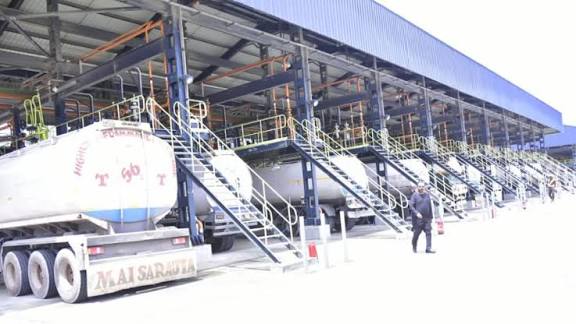
Dangote Refinery emphasizes its investment in a state-of-the-art gantry system with 91 loading bays, capable of evacuating over 50 million litres of petrol daily. The company insists that coastal logistics would add unnecessary costs, estimating an additional ₦75 per litre, potentially pushing pump prices close to ₦1,000. It further claims that reliance on coastal delivery could impose an annual burden of ₦1.7 trillion on the economy.
Those whose business it is to know however defers and says that coastal transport matters, further noting that coastal transportation is more safer and efficient. According to this school of thought, coastal shipping reduces the risks associated with Nigeria’s over-reliance on road tankers, which contribute to accidents, congestion, and environmental hazards.
Those opposed to the Dangote suggestion who spoke in confidence with our reporter and expressed the desire not to be named alluded to the element of cost neutrality via what is known as X-factory price, in fuel depot cost analysis. They argued that the principle of X-factory pricing already mitigates cost differentials in product distribution nationwide. If depots and plants across Nigeria operate under this system, there is no justification for excluding coastal logistics from the same framework; they noted.
They also argued that Dangote’s opposition to coastal transport is less about consumer welfare and more about consolidating its dominance in trucking logistics. This entrenched interest could stifle competition and prevent Nigeria from diversifying its transport infrastructure.
Nigeria cannot continue to ignore global best practices if our economy must thrive. In many oil-producing nations, coastal and pipeline transport are prioritized to reduce costs, enhance safety, and strengthen energy security. Nigeria’s excessive reliance on road tankers is an anomaly that perpetuates inefficiency.
The danger in conceding more and more to unhelpful situations pushed by individuals’ scheme to warehouse the national economy under their apron is already hurting the commonwealth. It bears repeating that private ownership of oil blocs has been a major disservice to the law of balance and equity. To contemplate extending that madness to other sectors of the economy will amount to overkill.
Nigeria’s railway and pipeline systems have long been incapacitated by narrow economic interests. Allowing a single conglomerate or few individuals’ to dictate logistics choices risks repeating history. The state must resist excessive concessions to Dangote Group and instead champion policies that prioritize national economic stability, competition, and public safety.
Let us be clear, Dangote Refinery’s gantry investments are commendable, but its dismissal of coastal logistics appears self-serving, misleading, and inappropriate. Nigeria cannot afford to let corporate interests override broader national goals. Coastal transport, alongside pipelines and rail, must remain central to the country’s fuel distribution strategy.
Nigeria should say no to monopolistic posturing and yes to safer, cheaper, and more inclusive transport solutions.

Simplified Trade Regime: Nigeria Customs Engages AfCFTA Secretariat

The ‘License to Lie: How Nigeria’s New Electoral Act Shields the Forger

CGC Adeniyi Leads Historic WCO Enforcement Dialogue

Special Report: The Long Journey to Securing Nigerian Ports’ Repairs Loan (2)
The Long Road to Nigeria’s £746m Ports Loan (1)

Alhaji Ahmad Wanka Steals The Show At The Bauchi Sallah Celebration

PORT MODERNIZATION: Repairing The Leaking Bucket of Nigeria’s Trade

Sanwo-Olu, Ministers, Key Stakeholders Set for GTP Multimodal Roundtable

Freight Forwarders Fault NSC Over Shipping Charges Hike, Issue Ultimatum

ANLCA Board Felicitates Oduntan As He Marks 60

Prince Oduntan Bask Industry Euphoria At 60th Birthday Celebration

Alma Mater Honours DG NIMASA, Mobereola

ANLCA Board is intact, cannot be wished away by anybody’-Elochukwu

B-R-E-A-K-I-N-G: Effedua, Rector MAN Oron, Resigns

EFCC’s Probe: Okowa Plots Sheriff’s Removal Despite London Accord

Customs Trains ANLCA Members, Others on B’Odogwu Portal

NPA’s Alleged Executive Management Fight: The Half Truth & Truth
ANLCA Board Election: Know Your Candidates
‘Why We Launched B-Odogwu Pilot Scheme With Webb Fontaine Still Running’ – Adeniyi

Onyemekara Promoted GM, Appointed NPA’s New Spokesperson

Nigeria Customs: Trust, Competence And The Oramalugo Factor

‘Rush To Break News Can Lead To Brush With Cybercrime’- Police

Kebbi Is Hub of Hard Drugs Smuggling In Northern Region’ – Oramalugo

Maritime Industry At 64: Oyetola Versus Oyetola