
Analysis
MT SKIPPER: NIMASA Sails into Trouble Waters as Stakeholders Kick


The Nigerian Maritime Administration and Safety Agency (NIMASA) is facing growing scrutiny following its public denial of any regulatory link to MT SKIPPER, a vessel reportedly intercepted by United States authorities over alleged crude oil theft and transnational trade violations.
It would be recalled that the agency in a press statement asserted that the vessel is not Nigerian flagged and that its purported owners, Thomarose Global Ventures Limited, are not registered with NIMASA, a position intended to distance itself from the unfolding international investigation. But the statement has instead triggered a wave of criticism from maritime stakeholders who argue that the agency’s response was hasty, defensive, and potentially misleading. In this report, Gbogbowa Gbowa takes a peep at these developments, and the potential distrust it may yet generate.
NIMASA’s Position: “The Vessel Is Not Ours”
In its official communication, NIMASA emphasized that MT SKIPPER (IMO 9304667) is not listed under the Nigerian flag and that the alleged owning company is not on its registry. The agency further disclosed that the vessel last sailed through Nigerian waters on 1 July 2024 before continuing its international voyage pattern through Asia and the Caribbean, where U.S. authorities eventually intercepted it.
However, NIMASA’s Director General, Dr. Dayo Mobereola, reaffirmed the agency’s willingness to cooperate with international partners and insisted that criminality would not be tolerated in Nigerian waters.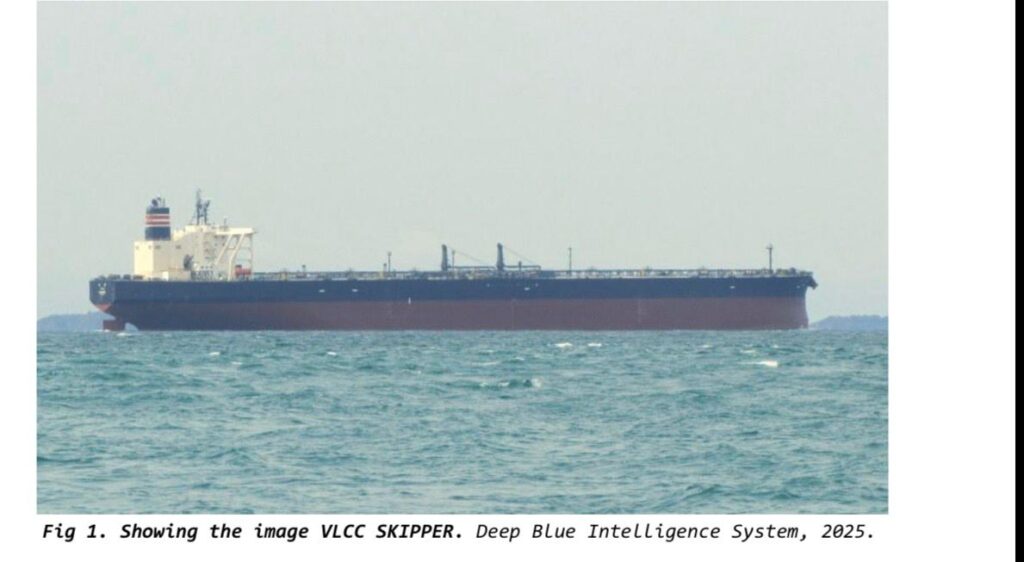
Industry Pushback: “This Response Misses the Point”
In a public statement, a maritime operator and industry advocate, Emmanuel Maiguwa, sharply criticized NIMASA’s approach, describing the agency’s tone as unhelpful and disconnected from the realities of shipping development. Maiguwa argued that the allegations against MT SKIPPER relate to trade violations, not safety or environmental breaches, areas where NIMASA traditionally exercises oversight. Therefore, he questioned the relevance of the agency’s attempt to absolve itself by highlighting the vessel’s registry status.
He further faulted NIMASA for failing to first engage the vessel’s operators privately before issuing a public statement, saying such engagement could have provided clarity and prevented reputational damage to Nigerian shipping interests. According to him, this was a moment for the maritime administration to have demonstrated support for indigenous operators, and not a time to distance itself from them.
Maiguwa who is the president, Alumni of Maritime Academy of Nigeria Oron (AMANO) further urged industry bodies such as the Shipowners Association of Nigeria (SOAN) and the Nigerian Chamber of Shipping (NCS) to reach out to the vessel’s owners for clarity and support, warning that the current media frenzy risks further damaging Nigeria’s fragile maritime image.
Adding to the controversy, another industry observer who preferred anonymity challenged NIMASA’s claim that the vessel’s owners are not registered in Nigeria. According to this source, a Corporate Affairs Commission (CAC) search shows that the company is indeed registered, except that currently, it is inactive. The observer questioned how a company could be classified as “inactive” if it did not exist in the first place, suggesting that NIMASA’s statement may have been crafted to deflect responsibility, rather than clarify facts.
He also noted that many Nigerian shipowners routinely register their vessels under foreign flags such as Liberia for operational convenience, a common global practice. Therefore, the fact that MT SKIPPER is not Nigerian flagged does not automatically negate its Nigerian ownership, he argued.
A Growing Perception Problem
The convergence of these viewpoints paints a picture of an industry uneasy with the regulator’s communication strategy. Other critics who spoke off record on the matter argue that NIMASA’s response appears more concerned with protecting institutional image than supporting Nigerian maritime interests at a time when the sector’s reputation is already fragile.
For Maiguwa and others, the issue is not whether the vessel is guilty or innocent, but whether NIMASA is fulfilling its broader mandate of shipping development, which includes constructive engagement, diplomacy, and support for indigenous operators; even when controversies arise.
What This Means for Nigeria’s Maritime Image
The MT SKIPPER incident has now evolved beyond the alleged trade violations into one of inappropriate diplomacy and a growing crisis of confidence. The stakeholder described NIMASA’s response as “maritime diplomacy of denial,” suggesting that the agency may be more concerned with public perception than with providing clarity. The contrasting positions, that is, NIMASA’s categorical denial, Maiguwa’s call for a more supportive regulatory posture, and the anonymous stakeholder’s challenge of factual inconsistencies have collectively placed the agency under renewed scrutiny.
While NIMASA insists it is cooperating with U.S. authorities and remains committed to combating criminality in Nigerian waters, stakeholders argue that the agency’s communication strategy may have inadvertently deepened public confusion and cast doubt on its responsiveness to industry realities.
The unfolding situation underscores broader concerns about the relationship between Nigerian regulators and indigenous shipowners, particularly in moments of international controversy.
As investigations into MT SKIPPER continue, the maritime community is watching closely to see whether NIMASA will recalibrate its engagement with stakeholders or maintain its current stance.
Conclusion
For external observers, especially foreign governments and shipping interests, this can look like a system that struggles to speak coherently for itself. Much more worrisome is the fact that it reinforces old stereotypes about Nigerian shipping.
Especially in the area of her long battle with negative narratives around crude oil theft, opaque vessel ownership structures, weak enforcement, and inconsistent regulatory communication.
This controversy, even if Nigeria is not at fault, risks reinforcing those stereotypes because the public messaging appears reactive, defensive, and internally contradictory.
Like it was already stated, it also creates the impression of poor maritime diplomacy. In global shipping, where diplomacy and perception matter, this can make Nigeria appear uncoordinated and unsure of its own processes. It suggests weak support for indigenous shipowners.
Internationally, maritime administrations are expected to stand by their national fleet, even when allegations arise. Failure to do so can make Nigeria appear unsupportive and unpredictable.













NSW Mgmt Opens Dedicated Support Centre in Apapa

NIMASA Management Engages National Assembly On Budget Implementation

Nigeria’s Maritime Sector Bleeding Trillions Amid Policy Gaps- Says SEREC

AfCFTA Implementation: Customs Launch 3-Day Training Programme

Adeniyi Commissions Project at Government Secondary School Wuse

ANLCA President, Nwokeoji Honoured as Customs Broker of the Year

Godfrey Bivbere Decorated Best Maritime Reporter of the Year

Clearing Agents Protests Police Continued Disruption of Activities

Customs Auctions Seized Petrol Worth ₦14.8 Million

Jonathan, George, Alaibe, Gwandu, Diri Others Speak On Efficient Modern Ports System

Deleting the Gatekeepers: How Dantsoho is Coding-Out Corruption at Nigeria’s Ports

President Tinubu Government Sensitive To Community Development – Okonna, MAN Rector

ANLCA Board is intact, cannot be wished away by anybody’-Elochukwu

B-R-E-A-K-I-N-G: Effedua, Rector MAN Oron, Resigns

EFCC’s Probe: Okowa Plots Sheriff’s Removal Despite London Accord

Customs Trains ANLCA Members, Others on B’Odogwu Portal

NPA’s Alleged Executive Management Fight: The Half Truth & Truth

ANLCA Board Election: Know Your Candidates
‘Why We Launched B-Odogwu Pilot Scheme With Webb Fontaine Still Running’ – Adeniyi

Onyemekara Promoted GM, Appointed NPA’s New Spokesperson

Nigeria Customs: Trust, Competence And The Oramalugo Factor

‘Rush To Break News Can Lead To Brush With Cybercrime’- Police

Kebbi Is Hub of Hard Drugs Smuggling In Northern Region’ – Oramalugo

Maritime Industry At 64: Oyetola Versus Oyetola