Business
‘NSW Implementation Not Disorderly’ – FG

BY GBOGBOWA GBOWA
Against the backdrop of worries that the federal government may have unintentionally set out to weaken the implementation of the National Single Window (NSW) project already penciled down for implementation by March 2026 with the further establishment of the National Single Window Committee, those involved have dismissed worries as misplaced, assuring that the planned implementation would sail smoothly; adding the Nigeria Customs Service (NCS) is fully involved.
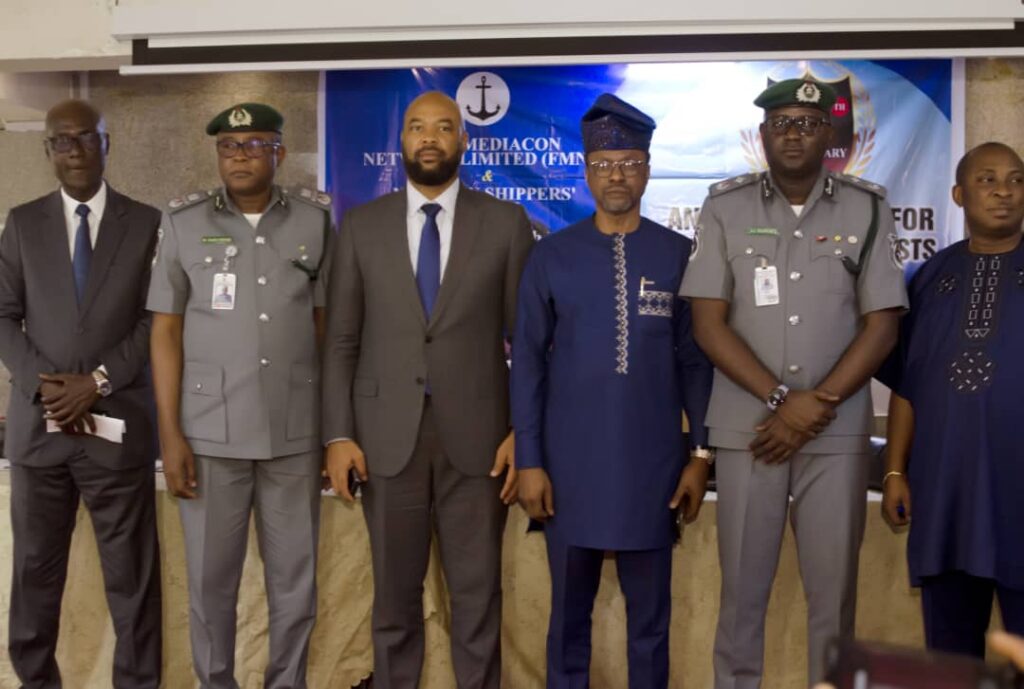
L-R: CEO, First Mediacon Nigeria Limited, Mr. Sedan Onileimo; Zonal Coordinator, Customs Zone A headquarters, ACG Mohammed Babandede; Senior Partner, Akabogu and Associates, Dr. Emeka Akabogu SAN; Director, Special Duties, Nigerian Shippers’ Council (NSC), Mr. Moses Abere; Customs National Spokesman, Dr. Abdullahi Maiwada; and a former Acting President, ANLCA, Dr. Kayode Farinto; during the 10th Annual Seminar for Maritime Journalists in Lagos on Wednesday.
Clarifying misconceptions in certain quarters that NSW Committee, the National Public Relations Officer of Customs, Deputy Comptroller Abdullahi Maiwada PhD, stated that the service is fully involved. This is even as he explained further that the service is also engaging stakeholders on the use of its trade facilitation tools in order to make their cargo clearance seamless under the NSW platform.
“The Nigeria Customs Service is fully involved in the National Single Window Project, the Chairman of FIRS has visited Customs more than twice, there is a high level of collaboration and engagement.
“The National Single Window is not working in isolation of the Nigeria Customs Service; we are working together as a team to make sure that the vision of Mr. President is achieved by first quarter of 2026. We are part of it, we are fully embedded in it, and we would continue to support the project”, he said.
Representative of KPMG, consultants to the NSW, Mr. Duben Onuora, also speaking, noted that the NCS is critical to the policy thrust and hence the position of the NCS remains unalterable and sancrosant. This is even as stakeholders in Nigeria’s Marine and Blue Economy have urged the Federal Government to establish a robust legal framework to support the rollout of the NSW) platform.
The stakeholders who were speaking at the 10th Annual Seminar for Maritime Journalists and the unveiling of the Centre for Maritime Media and Capacity Development in Lagos stressed that the NSW, designed to unify multiple government agencies under one digital umbrella, must be backed by legislation to ensure seamless operations, in addition to prevent loopholes.
Firing the first salvo, former Acting President of the Association of Nigerian Licensed Customs Agents (ANLCA), Dr. Kayode Farinto, emphasized that without a binding legal instrument, the platform risks inefficiency. Farinto expressed concerns that industry CEOs are in the habit of deliberately seeking to delay cargo clearance just so to encourage extortion; and canvassed sanctions for such behaviour within the policy framework of the NSW.
This is even as he noted that recent tax reforms signed by President Bola Ahmed Tinubu, which introduced a Tax Ombudsman, could strengthen accountability in the NSW rollout.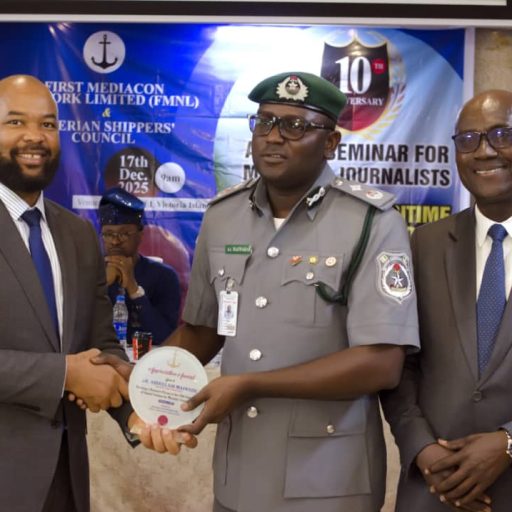
“Any agency CEO that flouts the process can be reported to the Ombudsman,” he said, urging regulators to embrace attitudinal change alongside freight forwarders, even as he expressed satisfaction about the level of improved compliance in recent years.
Farinto criticised the growing role of the Port Police in cargo clearance, stressing that whereas they are meant to participate essentially on observer status, he lamented that the Maritime Police Command have instead “gradually turned themselves into a revenue generation agency at the port.” According to him, about three percent of cargoes are now stopped by Police “for no reason but extortion.”
Corroborating, Mr. Charles Ubah, lamented the alleged complicity of the Nigerian Shippers’ Council (NSC) in the extortion scheme. He explained that Police obtain container reference numbers, transmit them to the Shippers’ Council, which then passes them to terminal operators to block cargoes.
“Shippers’ Council is supposed to protect the interest of shippers and stakeholders, but now, they are helping Police to extort us,” Ubah said. He revealed that depending on bargaining power and cargo type, agents are forced to pay between ₦150,000 and ₦300,000 to secure release.
“The moment you part with money, the so-called concealment and economic sabotage disappears,” he added.
Stakeholders further cautioned that unresolved structural weaknesses, absence of a legal framework, and persistent inter-agency conflicts could undermine the effectiveness of the NSW, potentially resulting in financial losses for importers and the wider economy.
ANLCA Vice President, Prince Segun Oduntan, noted that despite the NSW concept, operators still contend with numerous regulatory platforms and overlapping systems. Represented by the Senior Special Adviser to the President on Media, Suleiman Ayokunle, he recalled past digital rollouts that led to weeks-long shutdowns of cargo evacuation, warning that similar disruptions could occur without proper coordination.
Chairman of the occasion, Dr. Emeka Akabogu SAN, stressed that Customs sits at the heart of the NSW framework but warned that without alignment among Customs, importers, and exporters, the project may struggle to achieve its objectives.
Comptroller General of Customs, Bashir Adewale Adeniyi, represented by ACG Mohammed Babandede, reaffirmed that Customs is fully integrated into the NSW project and will commence implementation in line with President Tinubu’s directive for first-quarter 2026.
He urged operators to embrace trade facilitation tools such as the Authorized Economic Operator (AEO) and Advance Ruling Programme, lamenting low uptake, despite their potential to ease cargo clearance.
Contributing, the Executive Secretary of the Nigerian Shippers’ Council, Dr. Pius Akutah, represented by Moses Abere, highlighted the media’s role in promoting transparency and accountability as the maritime sector navigates digitalization and regulatory reforms.
The seminar also featured a training session on Data Journalism in Maritime Trade, delivered by Customs spokesperson Dr. Abdullahi Maiwada, who encouraged journalists to embrace analytics and info-graphics to tell their stories in bigger and broader dimensions.
The NSW is designed to allow traders to submit all regulatory information through a single electronic platform for imports, exports, and transit, with the goal of reducing delays, cutting costs, and improving trade facilitation.
However, stakeholders warn that unless structural gaps, inter-agency overlaps, and extortion practices are addressed, the promise of a unified, efficient trade window may remain elusive.
FMNL CEO and convener of the Annual Seminar for Maritime Journalists, Sesan Onileimo, explained that the newly launched Maritime Journalists Capacity Development Centre was created to help journalists remain relevant in the era of AI and digitalization era.
Onileimon who announced the official discontinuation of the seminar after a 10 year of eventful edition described the newly created centre as a bold move to bridge knowledge gaps and to strengthen collaboration for impactful maritime reporting and capacity building.

NSW Mgmt Opens Dedicated Support Centre in Apapa

NIMASA Management Engages National Assembly On Budget Implementation

Nigeria’s Maritime Sector Bleeding Trillions Amid Policy Gaps- Says SEREC

AfCFTA Implementation: Customs Launch 3-Day Training Programme

Adeniyi Commissions Project at Government Secondary School Wuse

ANLCA President, Nwokeoji Honoured as Customs Broker of the Year

Godfrey Bivbere Decorated Best Maritime Reporter of the Year

Clearing Agents Protests Police Continued Disruption of Activities

Customs Auctions Seized Petrol Worth ₦14.8 Million

Jonathan, George, Alaibe, Gwandu, Diri Others Speak On Efficient Modern Ports System

Deleting the Gatekeepers: How Dantsoho is Coding-Out Corruption at Nigeria’s Ports

President Tinubu Government Sensitive To Community Development – Okonna, MAN Rector
ANLCA Board is intact, cannot be wished away by anybody’-Elochukwu

B-R-E-A-K-I-N-G: Effedua, Rector MAN Oron, Resigns

EFCC’s Probe: Okowa Plots Sheriff’s Removal Despite London Accord
Customs Trains ANLCA Members, Others on B’Odogwu Portal

NPA’s Alleged Executive Management Fight: The Half Truth & Truth
ANLCA Board Election: Know Your Candidates
‘Why We Launched B-Odogwu Pilot Scheme With Webb Fontaine Still Running’ – Adeniyi

Onyemekara Promoted GM, Appointed NPA’s New Spokesperson

Nigeria Customs: Trust, Competence And The Oramalugo Factor

‘Rush To Break News Can Lead To Brush With Cybercrime’- Police

Kebbi Is Hub of Hard Drugs Smuggling In Northern Region’ – Oramalugo

Maritime Industry At 64: Oyetola Versus Oyetola