Business
Nigerian Police Says Cargo Blocking Is A Legitimate Duty


BY GBOGBOWA GBOWA
At a stakeholders’ meeting in Apapa, the Maritime Police Command of the Nigerian Police Force (NPF), brazenly declared that it will not stop the arbitrary blocking of containers at Lagos Ports, despite widespread condemnation of the practice as a tool of extortion and disruption of trade.
While admitting that containers already cleared by all relevant agencies including the Nigerian Customs Service, National Agency for Food and Drug Administration Control, Nigerian Immigration Service, National Drug Law Enforcement Agency, Nigerian Port Police and the Nigerian Agriculture and Quarantine Service were been intercepted by the police, the Command’s spokesperson, ASP Adebayo Rasheed, claimed that the action is based on “intelligence.”
This is even as he cited alleged recent seizures of arms and tramadol which he claimed were hidden in shipments that had passed through official clearance, without however showing any evidence of the said seized items.
The declaration nevertheless exposes the deeper rot of Nigeria’s governance system and a showcase of a failed state where institutions operate without restraint, accountability, or moral compass. The police openly boasted that cargo blocking will continue indefinitely, unless countermanded by the President and Commander-in-Chief or the Inspector General of Police; revealing a system where legality is secondary to brute institutional power.
Stakeholders have long accused the Maritime Police of using container blocking as a tool for extortion, with reports of officers demanding bribes to release shipments. Complaints abound of demurrage costs piling up while containers remain trapped in bureaucratic limbo. Yet, rather than addressing these grievances, the police dismiss them as “rumors” and in its trademark official bravado demanded that those alleging extortion should file petitions, despite that such petitions rarely yield justice.
Shipping companies, too, are implicated and accused of illegally releasing cargo manifests to the police, enabling further harassment of importers. Sadly, the Nigerian Shippers’ Council, apparently caught between defending stakeholders and appeasing the police, insisted during the town hall meeting called by it, it is not complicit, despite its inability to stop the practice which underscores the impotence of regulatory agencies in a compromised system.
Among other things, the meeting revealed the grotesque dysfunction of Nigeria’s maritime sector such as police arrogance declaring container blocking “cannot be stopped,” even when clearance has been completed.
The rot also clearly manifested regulatory impotence such as the Shippers Council which is forever reassuring stakeholders of mitigating abuses but admits it cannot prevent police interference.
It has degenerated into a parlous systemic complicity in which multiple agencies present during examinations fail to act, leaving the maritime police command to hijack the process of cargo documentation and clearance. Despite that freight forwarders, customs agents, and truck owners condemn the practice, yet, their voices are drowned in a system designed to serve itself.
The saga of container blocking is not merely about ports, it is a mirror of Nigeria’s broader collapse. Institutions act as they please, unchecked by law or morality. Agencies overlap, contradict, and undermine one another, while citizens and businesses bear the cost of a system that thrives on chaos and extortion.
In a country where cleared cargo can still be seized, where extortion is thinly disguised as “intelligence,” and where accountability is perpetually deferred, the maritime sector becomes a microcosm of national failure. Nigeria’s ports, once envisioned as gateways of trade and prosperity, now stand as monuments of dysfunction, where every actor, from police to regulators to shipping companies, plays by their own rules in a system rotten to the core.












NIMASA To Host Webinars on Automation of Nigerian Ship Registry

NPA Moves To Cut Export Bottlenecks, Targets Forex Inflows

NPA Congratulates ANLCA on 72nd Anniversary, Reaffirms Support for Port Modernisation

Afeni Lands at FOU Zone ‘A’ in Acting Controller Capacity

NPA Mulls Specialised Fishing Port to Deepen Nigeria’s Blue Economy

Industry Stakeholders Applaud ANLCA at 72nd Anniversary Celebration

Port Regulation Critical To Fisheries, Blue Economy – NPERA DG, Akutah

ANLCA @ 72: FG, Stakeholders Laud Association’s Leading Role in Trade Facilitation

Apapa Customs: Comptroller Mu’azu Takes Over, Pledges Strict Revenue Integrity And Seamless Trade

Stakeholders Demand Immediate Action To Convert Nigeria’s $1 Trillion Blue Economy Potential Into Reality

Afeni’s Parting Query: Why Evade Duty on a ₦417m Range Rover?

ANLCA@72: As All Roads Lead to Marriott Hotel lkeja

ANLCA Board is intact, cannot be wished away by anybody’-Elochukwu

B-R-E-A-K-I-N-G: Effedua, Rector MAN Oron, Resigns

EFCC’s Probe: Okowa Plots Sheriff’s Removal Despite London Accord
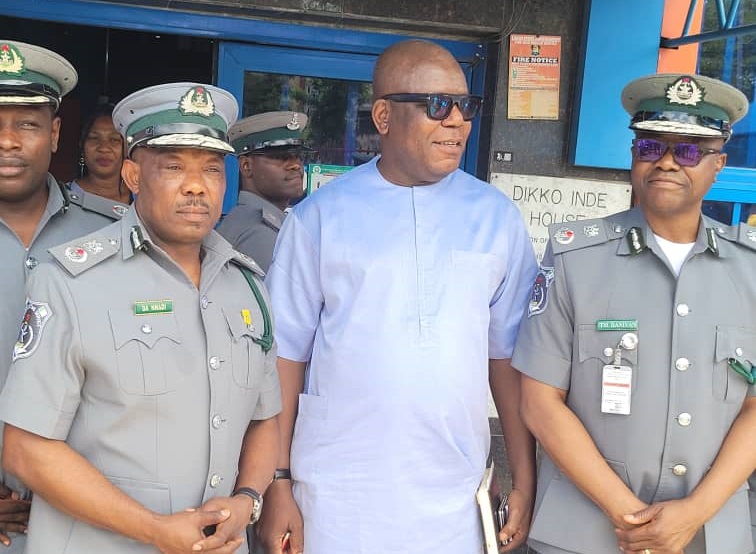
Customs Trains ANLCA Members, Others on B’Odogwu Portal

NPA’s Alleged Executive Management Fight: The Half Truth & Truth
ANLCA Board Election: Know Your Candidates
‘Why We Launched B-Odogwu Pilot Scheme With Webb Fontaine Still Running’ – Adeniyi

Onyemekara Promoted GM, Appointed NPA’s New Spokesperson

Nigeria Customs: Trust, Competence And The Oramalugo Factor

‘Rush To Break News Can Lead To Brush With Cybercrime’- Police

Kebbi Is Hub of Hard Drugs Smuggling In Northern Region’ – Oramalugo

Apapa Customs Collects ₦161b On B’Odogwu Platform In 3 Weeks