
Maritime
Nigeria’s $748m UK Port Infrastructure Loan: Many Questions Begging for Answer

BY EGUONO ODJEGBA
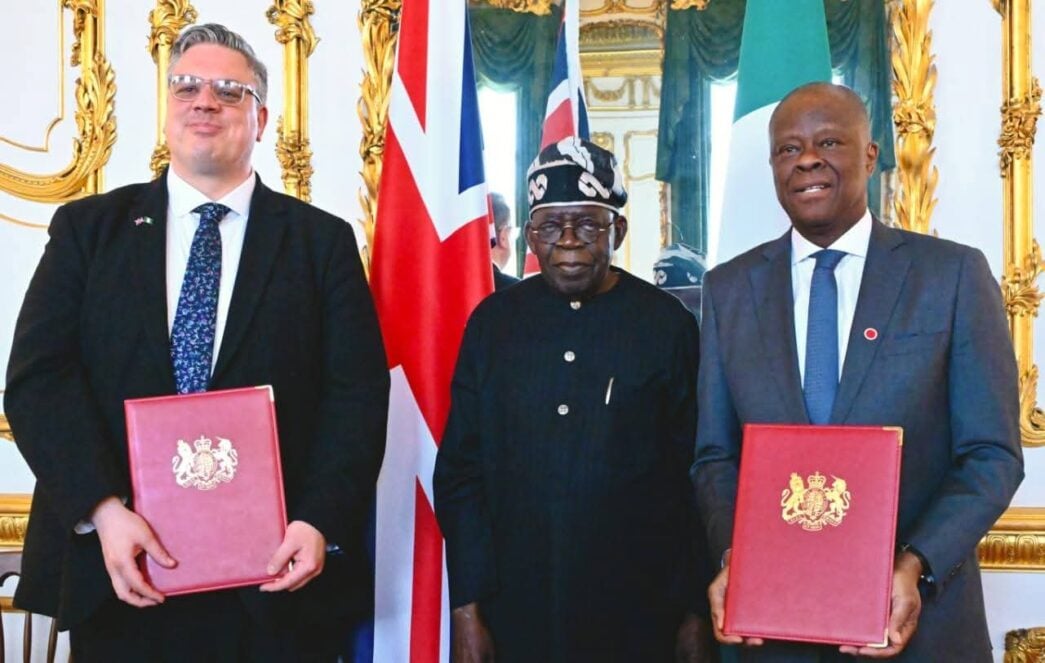
The Presidency recently celebrated with fanfare a £746 million infrastructure financing agreement reached between Nigeria and the United Kingdom. The fund, secured during President Bola Ahmed Tinubu’s official visit to the United Kingdom according to official statement was meant for the modernisation of Apapa and Tin Can Island ports, both located in Lagos.
The fund, according to government would be used for the long-overdue rehabilitation of Nigeria’s busiest maritime gateways, long plagued by congestion and inefficiency. On paper, the deal looks good and promising, but beneath the headline lies a troubling narrative about debt, industrial contradictions, and the persistent over concentration of port activities and infrastructure in Lagos.
For decades, Nigeria’s maritime economy has been disproportionately centred in Lagos, despite the existence of viable ports in Delta, Rivers, and Calabar. This imbalance has created perennial bottlenecks, as ports outside Lagos have been starved of cargo traffic.
Unfortunately, the UK loan, instead of bringing solution to this age long problem, rather compounds it, while also entrenching imbalance, doubling down on a flawed policy that sidelines regional economies and perpetuates congestion. Recent tensions on the economic front underscore the problem, with Lagos State openly resisting efforts to increase cargo traffic at Delta and Eastern ports.
Such resistance reveals the parochial interests that continue to shape port policy, often at the expense of broader national economic rationality. A critical scrutiny of the financing arrangement in the UK deal reveals a troubling spectre and shows that it is not without strings.
As a tied loan, it obliges Nigeria to spend a significant portion on British goods and services, including a £70 million contract to import steel from British Steel. This is particularly jarring given Nigeria’s vast iron ore deposits and the dormant Ajaokuta Steel Company. In effect, Nigeria is borrowing to stimulate another country’s industrial base while neglecting its own. With debt servicing already consuming over 60 per cent of the country’s total annual budget, adding another £746 million in sovereign borrowing for ports that are proven revenue-generating assets raises questions of prudence.
Apapa and Tin Can ports, which together generated over N1 trillion in Q1 2025 alone, are ideal candidates for concessionary financing or private capital investment. Instead, what we have is government opting for a model that externalises benefits and deepens liabilities.
The League of Maritime Editors (LOME) views this arrangement unfavorable and against Nigeria’s local content and indigenization drive. Also, the concentration of project execution among a narrow circle of contractors linked to entrenched business interests undermines transparency and competition.
For one, the chosen contractor for the project has his hands in many cookies in Nigeria and is alleged to be a long business partner of the sitting President. This, arrangement lacks transparency and good governance ethos.
Again, the League notes that physical upgrades alone will not resolve Nigeria’s port crisis. Without addressing dysfunctional access roads, poor rail connectivity, and entrenched ports inefficiencies, refurbished ports risk becoming more efficient bottlenecks rather than engines of growth. The League believes that revitalising Delta, Rivers, and Calabar ports would decongest Lagos, stimulate regional economies, and foster balanced national growth.
The current loan, as structured, represents a reckless leadership attitude that prioritizes narrow interests over national progress.
The League of Maritime Editors is worried and condemns government’s failure to explain what became of the billion-dollar port modernization loan announced in 2025 by Marine and Blue Economy Minister, Adegboyega Oyetola before President Tinubu went ahead to secure the fresh UK deal.
A transparent government would clarify the position of the two different loans and display openness in project handling. As the 2027 elections approach, the Federal Government must come out clean to explain the imperative of multiple borrowing amid the fog covering their exact purposes and implementations.
At this stage, we must not feel shy to say that Nigerian governments at all levels have a propensity for misappropriation and mismanagement of loans. We, in the League, consider the official explanation by the Minister of Marine and Blue Economy, Adegboyega Oyetola during the ministry’s organized quarterly stakeholders engagement on Thursday, Wednesday, April 2, 2026 that other ports in the country are receiving equal attention as an afterthought and intended to mislead.
The League is aware that the Presidency specifically tied the UK loan to Apapa and Tin Can Island ports. While dismissing public concerns as misplaced, what this government has done is a resort to denial instead of taking the honourable path to admitting its faults and outlining corrective measures.
It is also disheartening to observe how Aso Rock elects to throw anything it desires at any sector with the arrogant attitude of knowing better, or that nothing will happen. A scenario where a supervising Minister is apparently not carried along in the negotiations of an international loan that affects his ministry only for him to have the unenviable duty of explaining it to worried stakeholders, speaks volumes of the nonchalant attitude of this government.
If neither Oyetola nor his Permanent Secretary were present at the UK loan deal, but the president and his minister of finance, it tells the world the manner government in Nigeria runs its business.
It is worrisome that while the Nigerian Ports Authority earns significant revenues from port operations, yet government does not utilize this huge funds for port repairs, rather wait until port infrastructure has completely collapsed before seeking corrective actions, going cap in hand for loans. The League is concerned that while the NPA regularly remits humongous amounts to the federal purse, the Authority has also become an ATM where scandalous figures are believed to be diverted to political party causes.
With Nigeria’s port economy standing at crossroads, the UK loan would offer an opportunity for renewal, but its narrow focus on Lagos and other untoward attachments to it, risks perpetuating the very problems it seeks to solve.
This League’s state of the nation review will not be complete without recommending a more balanced approach, one that leverages private capital, embraces transparency, and distributes development across all ports that would better serve the national interest. Anything less, would amount to the betrayal of Nigeria’s maritime future.






NIMASA Unveils National Innovation Hackathon, Open Young Innovators Por

Ogun 1 Customs Intercepts N417m Range Rover

Operator Raises Alarm Over Foreign Control, Cartelisation of Maritime Supply Chain

Tin-Can Customs Generates ₦137.298bn in August

DG NIMASA, Mobereola Reasserts Cabotage Implementation Key To Maritime Development

Tribute to a Colossus: The Eternal Legacy of Alhaji Bamanga Tukur (1935–2026)

Stakeholders To Re-Examine Blue Economy Imperatives

ANLCA@72: From Founders’ Dream to Indispensable Pillar of Nigeria’s Port Economy

ANLCA’s 72nd Anniversary: NECOM Reels Out Programme, Says Peace Worth Celebrating

US Coast Guard, Nigeria and the Politics of a Maritime Victory

Wasiu, Seme ANLCA Chairman Calls for Review of Vehicle Restriction

Seme-Krake: Nigeria, Benin Launch Joint Assessment to Revive One-Stop Border Post
ANLCA Board is intact, cannot be wished away by anybody’-Elochukwu

B-R-E-A-K-I-N-G: Effedua, Rector MAN Oron, Resigns

EFCC’s Probe: Okowa Plots Sheriff’s Removal Despite London Accord
Customs Trains ANLCA Members, Others on B’Odogwu Portal

NPA’s Alleged Executive Management Fight: The Half Truth & Truth
ANLCA Board Election: Know Your Candidates
‘Why We Launched B-Odogwu Pilot Scheme With Webb Fontaine Still Running’ – Adeniyi

Onyemekara Promoted GM, Appointed NPA’s New Spokesperson

Nigeria Customs: Trust, Competence And The Oramalugo Factor

‘Rush To Break News Can Lead To Brush With Cybercrime’- Police

Kebbi Is Hub of Hard Drugs Smuggling In Northern Region’ – Oramalugo

‘Our Trade Security Is More Protected Under B’Odogwu’ – Daniyan