Business Focus
Maritime Sector Bleeds $4.5bn Annually to Foreign Transport Interests – Akabogu


BY FUNMI ALUKO
Nigeria’s ambition of becoming a $1 trillion economy by 2030 could be undermined by a maritime sector that continues to surrender billions of dollars in economic opportunities to foreign shipping and transport interests, while struggling with inadequate indigenous fleet capacity, inefficient ports and weak supporting infrastructure.
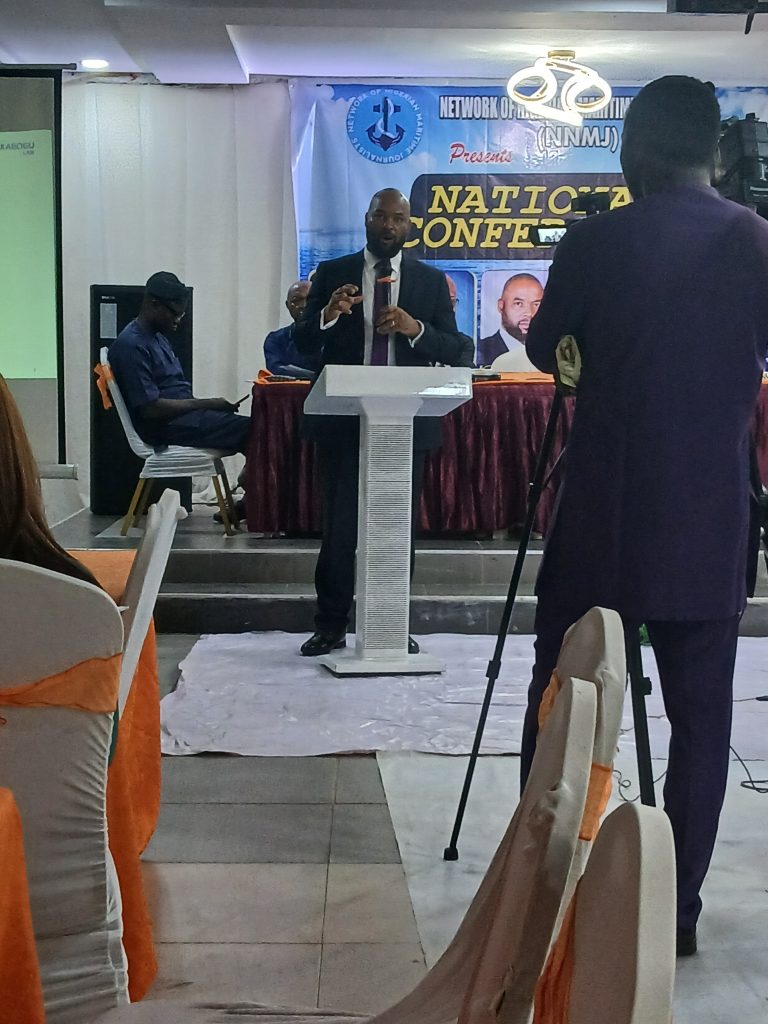
Dr Akabogu during the presentation
Maritime lawyer and Senior Advocate of Nigeria (SAN), Dr Emeka Akabogu, gave this warning at the 2026 National Conference of the Network of Nigeria Maritime Journalists (NNMJ) in Lagos, where he challenged the country to confront the structural weaknesses preventing its maritime industry from becoming a major contributor to national economic growth.
Akabogu, who delivered the keynote address at the conference themed “Seaport Modernisation, Trade Facilitation and Revenue Generation,” argued that Nigeria could not realistically pursue a trillion-dollar economy while its maritime infrastructure, shipping capacity and cargo-handling systems remained inadequate for the scale of economic activity required.
His presentation simply exposed a troubling economic paradox, such that despite Nigeria’s enormous trade volumes, strategic coastline and expanding port infrastructure, the country continues to lose substantial value through foreign transportation services, operational inefficiencies and inadequate local participation in maritime commerce.
He estimated Nigeria’s net transport payments abroad at approximately $4.5 billion annually, with war-risk insurance premiums accounting for another $1.5 billion over the past three years.
The figures he noted represents more than balance-of-payments statistics, and reflects the economic consequences of Nigeria’s failure to build sufficient domestic capacity to participate competitively in the international shipping business.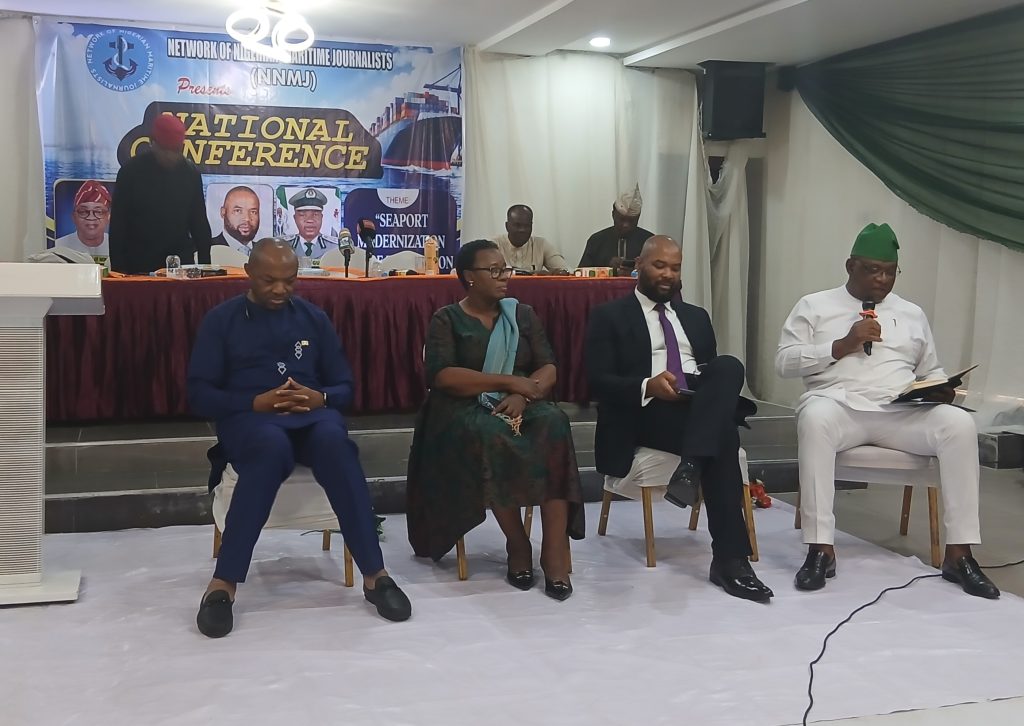
A major manifestation of this weakness according to him is the country’s indigenous shipping fleet. According to his presentation, Nigeria had approximately 307 Nigerian-owned vessels in 2025, compared with 284 in 2022. Yet, the country would require about 920 vessels to support the maritime demands of a $1 trillion economy.
At the current growth trajectory, the fleet could reach only about 348 vessels by 2030, leaving a substantial capacity deficit. The implication, he explained, is that Nigeria would continue to depend heavily on foreign shipping interests to transport its international trade, with freight earnings and associated economic opportunities accruing outside the country.
He therefore called for deliberate policies to expand indigenous ship ownership, improve access to financing and strengthen the capacity of Nigerian shipping companies to participate in international and domestic maritime trade.
But shipping capacity is only one dimension to the challenges as he also questioned the capacity of existing seaports to accommodate the volume of cargo traffic required to sustain a trillion-dollar economy.
He explained that cargo throughput increased from 103.6 million metric tonnes in 2024 to 129.3 million tonnes in 2025, while container traffic rose from 1.745 million TEUs to approximately 2.193 million TEUs within the same period.
Although these increases indicate growing port activity, his projections suggest that cargo throughput could reach only 230 million tonnes by 2030, against an estimated requirement of between 313 million and 442 million tonnes.
Similarly, container traffic could rise to 3.6 million TEUs, significantly below the projected requirement of between 5.3 million and 7.5 million TEUs. He also highlighted the inadequacy of vessel traffic, arguing that the country’s present capacity would be insufficient to support the projected expansion of international trade.
The maritime expert consequently maintained that increasing cargo volumes should not be mistaken for evidence that the country’s port system is adequately prepared for the future.
On operational efficiency, he disclosed that cargo dwell time in Lagos was approximately 13 days, against the four-day benchmark he considered necessary for a competitive maritime economy.
He recommended an immediate target of reducing cargo dwell time to not more than seven days by the end of 2027, through coordinated inspections, faster documentation and more effective collaboration among regulatory agencies.
This is even as he argued that vessel turnaround time also requires urgent attention. His presentation showed that the average increased from five days in the first half of 2025 to 5.3 days in the corresponding period of 2026, against a target of 3.3 days.
He argued that delays increase shipping costs, undermine vessel productivity and ultimately make Nigerian ports less attractive to international shipping businesses.
Akabogu identified the successful implementation of the National Single Window (NSW) as critical to eliminating repetitive documentation and reducing regulatory bottlenecks.
In addition, he advocated a functional Port Community System (PCS) to integrate shipping companies, terminal operators, freight forwarders and government agencies into a more coordinated operational framework.
Beyond imports, he said Nigeria must pay greater attention to non-oil exports, noting that the country recorded 6.1 million tonnes of seaborne non-oil exports in 2024.
He argued that a maritime economy built predominantly around imports would continue to expose the country to external economic pressures, while limiting opportunities for domestic production, export earnings and employment.
The keynote speaker equally raised concerns about the continued collection of container deposits by shipping lines despite provisions of Section 203 of the Nigerian Insurance Industry Reform Act 2025, which he said abolished the practice.
Similarly, he identified bunkering as an underexploited opportunity, particularly with the country’s expanding domestic refining capacity. Concerned, Akabogu noted that Nigeria’s maritime challenge is ultimately a question of economic sovereignty, wondering whether the country will continue to facilitate international trade for foreign interests or build the capacity to retain a greater share of the wealth generated by its own commerce.
Instructively, he maintained that the $1 trillion ambition could not be achieved through economic pronouncements alone but required measurable improvements in shipping capacity, port productivity, logistics infrastructure and export competitiveness.
His presentation has placed an important question before our political leaders and policymakers as to whether our maritime industry can efficiently move its present volume of trade to support the much larger economy the country hopes to build by 2030.








Onileimo Challenges Maritime Journalists to End Fragmentation, Embrace One Professional Voice

Maritime Sector Bleeds $4.5bn Annually to Foreign Transport Interests – Akabogu

Denmark Backs Nigerian Cadets, NIMASA Innovation Drive

Alumanah Takes Over Seme Customs as Kaila Handover A Staggering 233% Revenue Surge

Oyo/Osun Customs Generates ₦81.88bn in 10 Months, Posts 5.3% Revenue Growth

Onne Customs: Adigun Reads Riot Act on Revenue Leakages, Demands Operational Discipline

Egunjobi Assumes Command at Kebbi Customs, Pledges Tighter Border Security

NNMJ Unity Conference Today: All Roads Lead to Lagos Airport Hotel

ANLCA @72 Celebrations: Prince Oduntan Led LOC Returns N33m Surplus

Lagos NUJ Council Election: Innocent Anaba Steps Down, Alleges Voters’ List Manipulation

Nigeria Customs Highlights Anti-Money Laundering Efforts

Revenue Drive: Beyond Seizures, Afeni Moves to Tighten FOU Zone A’s Customs Collection Machinery

ANLCA Board is intact, cannot be wished away by anybody’-Elochukwu

B-R-E-A-K-I-N-G: Effedua, Rector MAN Oron, Resigns

EFCC’s Probe: Okowa Plots Sheriff’s Removal Despite London Accord

Onyeka Makes History As Tin-Can Customs Hit ₦16.4bn A Day
Customs Trains ANLCA Members, Others on B’Odogwu Portal

NPA’s Alleged Executive Management Fight: The Half Truth & Truth
ANLCA Board Election: Know Your Candidates

FOU Zone A Intercepts Drugs Worth Over ₦5.5Bn
‘Why We Launched B-Odogwu Pilot Scheme With Webb Fontaine Still Running’ – Adeniyi

Apapa Customs Collects ₦161b On B’Odogwu Platform In 3 Weeks

Again, Apapa Port Command Intercepts Cannabis Indica Worth ₦26.5b

Customs, NAFDAC, Strengthen Inter-Agency Ties with Landmark ₦20.5bn Drug Bust in Onne