Business Focus
Lagos-Calabar Highway: Whose Investments, Livelihoods and Coastal Communities Count? (3)

BY EGUONO ODJEGBA
The Lagos–Calabar Coastal Highway has generated two distinct but connected anxieties: the destruction and disruption of established economic activities along the Lagos beachfront, and the fear that subsequent route changes could leave some coastal communities outside the benefits promised by the project.
Both raise an essential question about public infrastructure: can a development initiative be considered successful if its wider economic benefits are achieved without adequately accounting for the businesses, livelihoods and communities displaced or bypassed along the way?
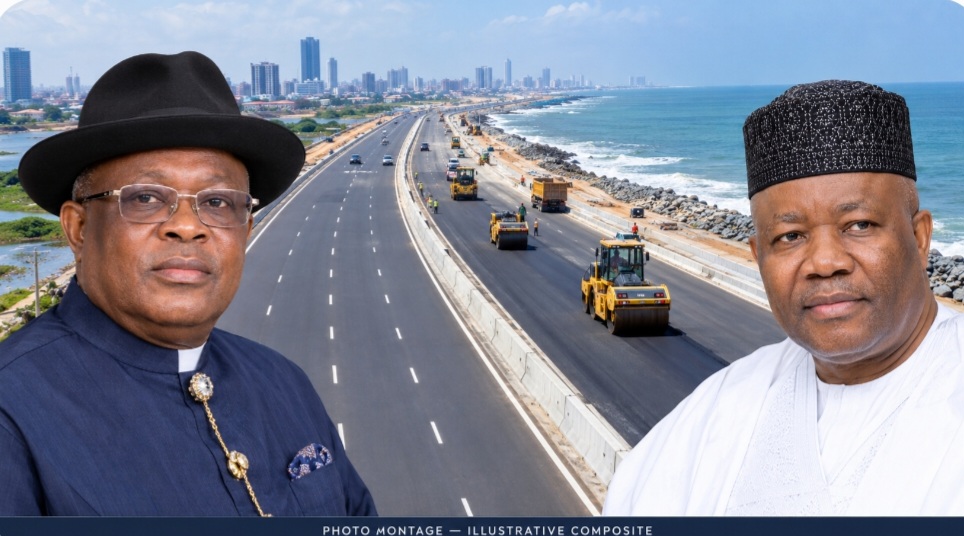
The latest controversy emerged recently when Works Minister David Umahi announced that part of the proposed highway route would be redirected through the existing East–West Road from the Ondo–Edo axis. The government cited difficult terrain, unsuitable soil and flooding risks, while subsequently insisting that the wider 750-kilometre coastal highway had not been abandoned.
The clarification notwithstanding, the route controversy has renewed demands for transparency over the project’s design, costs and distribution of benefits; as would be shown presently.
Lagos: The Economic Cost Beyond Demolished Structures
The consequences of the highway’s Lagos construction corridor were visible from the project’s early stages in 2024, when beachside businesses were cleared to make way for the road.
A May 18, 2024, investigation by The Cable documented the disruption to enterprises around Landmark Beach, Oniru Beach, The Good Beach and Sol Beach. It reported that the affected beachfront ecosystem included leisure operators, restaurants, vendors and other businesses, with consequences for employment and associated services.
Some operators complained that the compensation process focused on physical structures rather than the full economic value of their businesses, including customer relationships, advance bookings, outstanding financial obligations and the investments required to establish specialized facilities.
The report also documented concerns about employment losses and reduced patronage at businesses whose operations depended on the beachfront environment.
These accounts illustrate an important distinction in public compensation: being that the value of a demolished structure is not necessarily equivalent to the economic loss suffered by a functioning enterprise.
However, global best practice entails that each claim must be assessed on its merits. Property rights, valid development approvals, statutory shoreline restrictions, compensation eligibility; while the evidence of actual losses differ from one business to another. The government must therefore publish clear criteria and provide accessible procedures for resolving legitimate disputes.
The issue is not that every affected business is automatically entitled to every amount claimed. It is that compensation decisions must be transparent, consistently applied and open to review.
Ondo: Could Coastal Communities Lose Out?
The dispute over the Ondo–Edo alignment has introduced a different dimension to the debate. Stakeholders representing Ilaje coastal communities have questioned whether using the existing East–West Road would undermine the original ambition of improving access to coastal settlements and their economic activities.
In an October 13, 2026, report, The Guardian documented concerns that an inland route could reduce the direct benefits available to communities dependent on fishing, coastal transport and related livelihoods. Senior Advocate of Nigeria Ebun-Olu Adegboruwa called for the government to identify the communities that would be served or bypassed and to explain the revised alignment.
The concerns do not establish that the proposed route is technically unworkable or that the government has deliberately excluded any community. They do, however, make a strong case for a published comparison of the original and revised routes.
That assessment should examine construction and maintenance costs, flood resilience, travel times, access to markets, environmental effects, employment and the distribution of economic benefits.
If the original alignment is impracticable, the government should explain why. If viable alternatives can preserve access to affected coastal settlements without imposing disproportionate engineering or environmental costs, those alternatives should be transparently considered.
Environmental Assessment Must Inform Decisions, Not Merely Document Them
The coastal environment is central to the project’s identity and its risks. Route selection can affect wetlands, shoreline stability, drainage, local ecosystems and settlements that depend on coastal resources.
The Federal Ministry of Environment published draft environmental and social impact assessment reports for the first two Lagos sections in 2024. The ministry’s public-display notice for Section One, dated August 27, 2024, invited public comments over a 21-working-day period.
That record matters: it would be inaccurate to claim that no assessment documents were ever published for any part of the project. But the publication of draft reports for the first two sections does not, by itself, answer every question about when the relevant approvals were issued, whether construction sequencing complied with applicable requirements, or whether subsequent route changes were accompanied by the necessary additional assessments.
The government should make the relevant final assessments, approvals, mitigation plans and monitoring reports publicly accessible for the affected sections.
The Chagoury Question: Disclosure Is The Appropriate Answer
The contract awarded to Hitech Construction Company Nigeria Limited, associated with the Chagoury Group, has attracted public concern because of the reported longstanding relationship between the group’s owners and President Tinubu.
That association is a legitimate reason for demanding clear procurement records and safeguards against conflicts of interest. It is not, by itself, proof that the contract was corruptly awarded or that any official acted unlawfully.
The appropriate response is full disclosure of the applicable procurement approvals, financing arrangements, contractual obligations and mechanisms for verifying value for money.
Public confidence cannot be secured simply by dismissing questions as political opposition. Nor can allegations substitute for documentary evidence. The principles of developmental journalism, whether public and civil service inclined, espouses this just and equitable balancing in project reports.
A Road Must Connect People, Not Merely Places
The coastal highway’s ultimate value will depend on whether it improves national connectivity while protecting public resources, respecting lawful rights and providing meaningful economic opportunities.
For the sake of probity and good governance, the Federal Government should publish an integrated social and economic impact review covering affected Lagos businesses, compensation outcomes, employment consequences, coastal communities in Ondo and the distribution of benefits under the revised route.
It should also provide a transparent mechanism for affected citizens and businesses to submit evidence, challenge decisions and obtain reasoned responses.
A national highway can justify difficult choices. It cannot justify making those choices without accountability. For Lagos businesses, the issue is whether the losses they suffered were properly assessed and addressed.
For Ondo’s coastal communities, it is whether the project will deliver the access and opportunities they were led to expect. And for taxpayers nationwide, it is whether public money is being spent on a route that is technically sound, environmentally responsible and economically defensible.
Those are not peripheral concerns. They are central measures of whether the Lagos–Calabar Coastal Highway will fulfil its promise of national development.
For an administration that is primed for a renewed hope, no well-meaning Nigerian is in doubt that President Tinubu will continue to encourage his appointees to take concerns about full disclosure and accountability in critical projects such as this seriously; and without any reservation.

Nigeria Customs Commission Rehabilitated Modakeke Healthcare Centre

Lagos-Calabar Highway: Whose Investments, Livelihoods and Coastal Communities Count? (3)

Again, Customs FOU Zone ‘A’ Rescues Five Live Pangolins in Ogun State
Lagos-Calabar Highway: When a Presidential Legacy Project Collides with Accountability (2)
Lagos-Calabar Highway: Did Nigeria Pay the Price for Inadequate Planning?

ANLCA Airport Crisis: Police Raid Raises Questions Over IGP’s Respect For Court Orders

‘We Arrested Several Vessels Violating Cabotage Trade’ – NIMASA

Customs CGC Says ‘The World Is Connected, Not Borderless’

Nigeria Customs Mulls Reviews of Complaints Arising from Recruitment

Edo-Delta Journalists Forum Challenges Political Leaders on Regional Development

Nnadi Urges Nigerian Importers to Shift from Finished Goods to Manufacturing

WMD: Oyetola Recommit to Unlock CVFF Pursuant to Indigenous Operators Financing
ANLCA Board is intact, cannot be wished away by anybody’-Elochukwu

B-R-E-A-K-I-N-G: Effedua, Rector MAN Oron, Resigns

EFCC’s Probe: Okowa Plots Sheriff’s Removal Despite London Accord
Customs Trains ANLCA Members, Others on B’Odogwu Portal

NPA’s Alleged Executive Management Fight: The Half Truth & Truth

ANLCA Board Election: Know Your Candidates
‘Why We Launched B-Odogwu Pilot Scheme With Webb Fontaine Still Running’ – Adeniyi

Onyeka Makes History As Tin-Can Customs Hit ₦16.4bn A Day

Onyemekara Promoted GM, Appointed NPA’s New Spokesperson

Nigeria Customs: Trust, Competence And The Oramalugo Factor

Apapa Customs Collects ₦161b On B’Odogwu Platform In 3 Weeks

‘Rush To Break News Can Lead To Brush With Cybercrime’- Police