Business Maritime
Jonathan, George, Alaibe, Gwandu, Diri Others Speak On Efficient Modern Ports System

BY KESIENNA SHEPHERDS
Top Nigerian leaders and industry chieftains have noted with concerns that the nation’s maritime sector is still at a crossroads with global shipping rapidly evolving and neighbouring countries positioning themselves as competitive hubs.
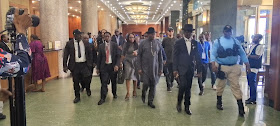
Former President Jonathan on arrival at the conference
They warned that Nigeria risks losing its place in the international trade arena unless urgent reforms are undertaken being the central message at the 1st International Deep Sea Port Investment Forum (IDSIF), convened by Elder Asu Beks of Maritime Media Limited, at the Oriental Hotel, Lagos on Monday.
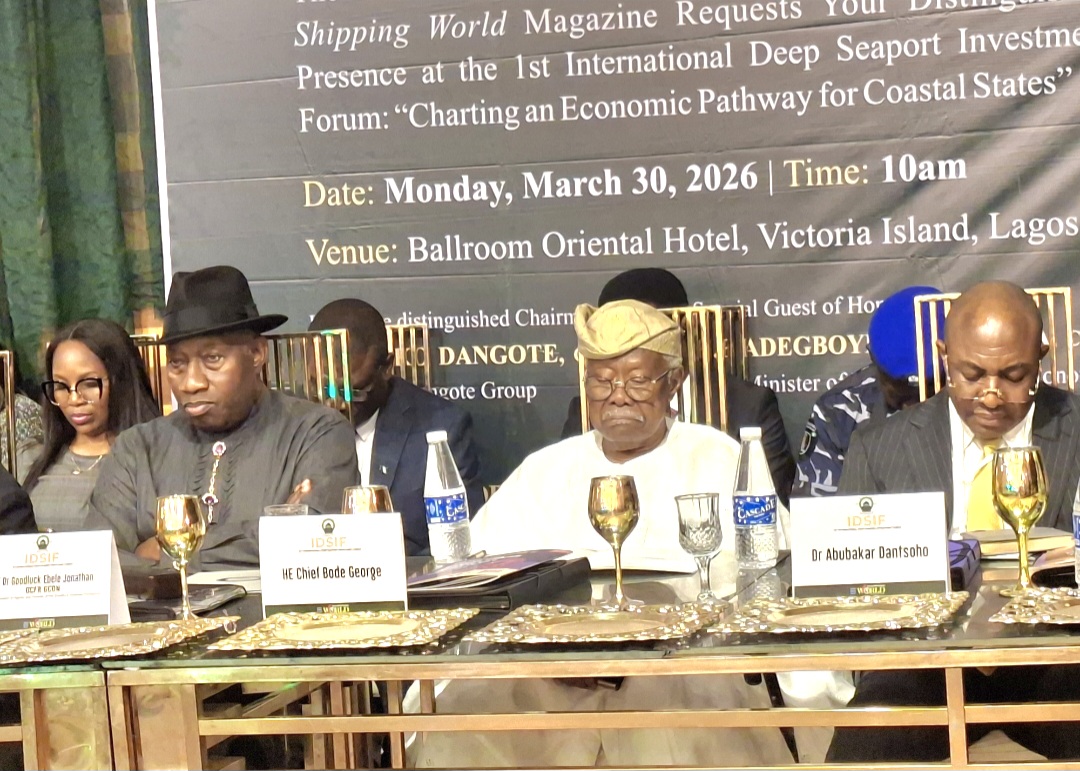
The forum brought together a distinguished line-up of stakeholders, including former President Goodluck Jonathan, former Nigerian Ports Authority (NPA) Chairman Chief Bode George, former NDDC Managing Director Timi Alaibe, former NPA Managing Director Bello Gwandu, Bayelsa State Governor Douye Diri (represented by Dr Faith Zibs), and senior government officials. Together, they interrogated Nigeria’s port development trajectory and charted a vision for modern, efficient, and globally competitive maritime infrastructure.
Former President Goodluck Jonathan set the tone with a sobering historical reflection. He recalled the collapse of the Nigerian National Shipping Line (NNSL), attributing it to costly strategic missteps during a critical transition in global shipping.
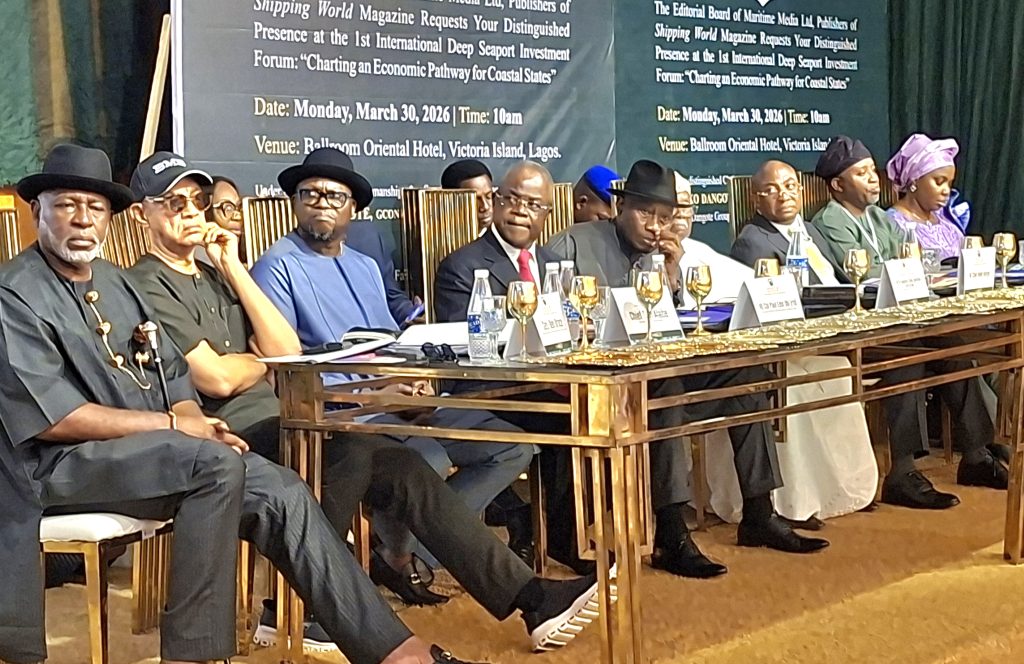
L-R: A stakeholder, Senator Ben Bruce, Chief Timi Alaibe, Dr Goodluck Jonathan, Lagos Politician and former Chairman of NPA, Chief Bode George and Manager, Corporate and Strategic Communications of NPA, Ikechukwu Onyemekara, representing NPA MD and Dr. Faith far right at the 1st International Deep Seaport Investment Forum held in Lagos on Monday.
“When the world was migrating to container shipping, which required deeper vessels, Nigeria invested in outdated ships that other countries were discarding. After acquiring them, they could not operate effectively, and the Nigerian Shipping Line collapsed,” Jonathan said.
He stressed that the mismatch between Nigeria’s investment decisions and global industry realities weakened the viability of the national carrier. The lesson, he argued is that Nigeria must ensure that future maritime investments align with international shipping practices or risk repeating the same mistakes.
Jonathan urged that subsequent editions of the forum should move beyond rhetoric to action, with bankable projects on the table and the inclusion of critical stakeholders such as littoral states and the banking sector.
This is even as Chief Bode George, former Chairman of the NPA, warned against the dangerous concentration of port infrastructure in Lagos. “It cannot be right to concentrate all your infrastructure and resources in one place. What is happening in the Strait of Hormuz now is a wake-up call. Who knows what could happen tomorrow?” he cautioned.
George pressed the federal government to diversify port development across the country and called on President Bola Tinubu to sign the Nigerian Ports and Regulatory Authority (NPERA) Bill. He also insisted that the rehabilitation loan secured from Britain should be deployed beyond Lagos, ensuring balanced growth across Nigeria’s maritime landscape.
Representing the Minister of Marine and Blue Economy, Adegboyega Oyetola, NPA’s General Manager for Corporate and Strategic Planning, Seyi Iyawe, outlined the government’s commitment to a green port development strategy.
“We are embracing green port philosophy and moving away from conventional ports. Deep seaports are important, but hinterland connectivity is critical. With the Nigerian Single Window now launched, we must develop automated and environmentally friendly ports,” he said.
He explained that government agenda is anchored on three pillars: modernisation, automation, and sustainability. The Lekki Deep Seaport was cited as a model of this new approach, designed to integrate Nigeria into the $3 trillion AfCFTA market.
While many speakers championed deep sea port development, former NPA Managing Director Bello Gwandu offered a cautionary perspective.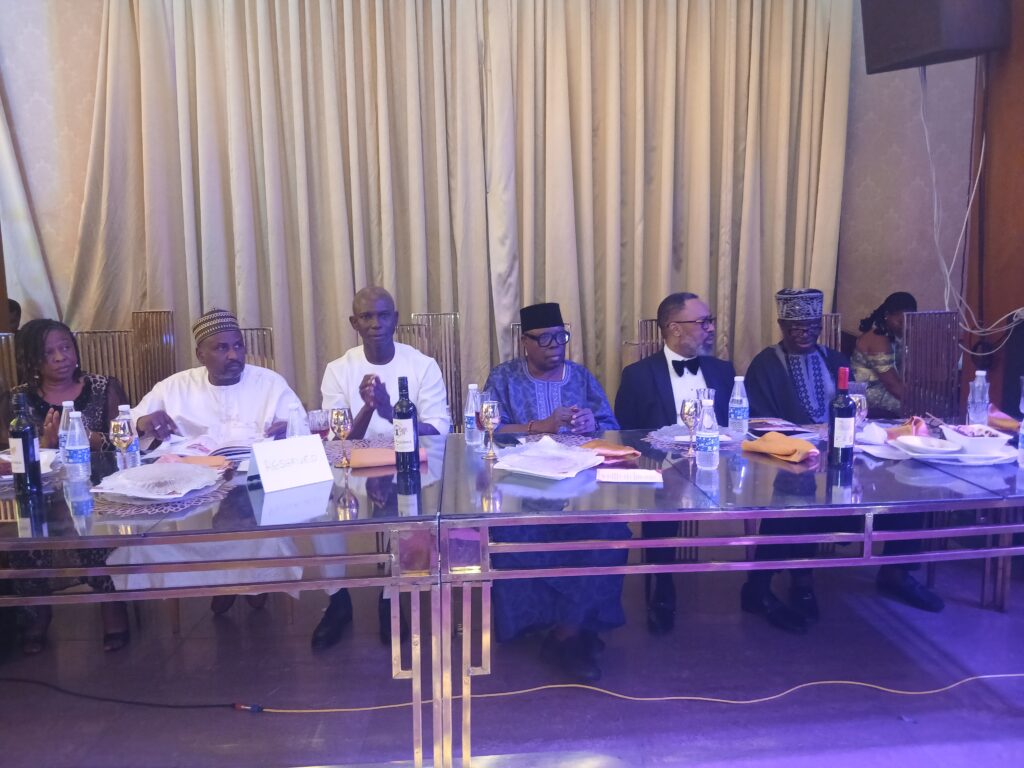
“There is nothing worse than having a port that is not patronised because cargoes cannot move out. Nigeria does not need deep seaports; what we need are international ports,” he argued.
Gwandu’s intervention highlighted a critical debate about whether Nigeria should prioritize deep sea facilities or focus on building well-connected international ports with efficient hinterland logistics.
On his part, the former NDDC Managing Director, Timi Alaibe emphasized the Gulf of Guinea as a strategic zone requiring sustained investment. “We must move from rhetoric to action, and this requires collaboration between the Federal Government and private partners,” he said.
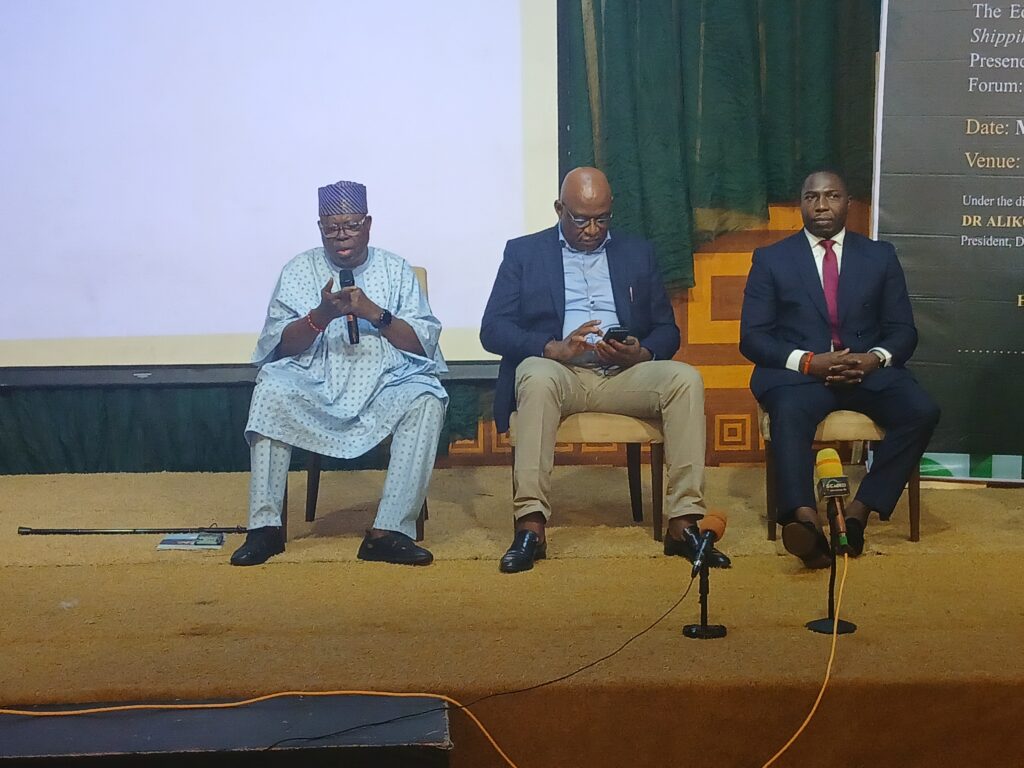
L-R: Prince Olayiwola Shittu, Barr. Temisan Omatsaye and another industry chieftain at a panel session during the event
Bayelsa State Governor Douye Diri, represented by Dr Faith Zibs, used the forum to showcase the proposed Agge Deep Seaport. With 120km of coastline and proximity to international shipping routes, Diri described Agge as a transformational project capable of catalyzing industrialisation and regional trade.
Convener, Elder Asu Beks explained that the forum had been years in the making, stressing the urgency of developing deep sea port capacity to stop Nigerian cargoes from being diverted to neighbouring countries. He commended President Tinubu for creating the Ministry of Marine and Blue Economy but urged him to sign the NPERA Bill to empower the Nigerian Shippers’ Council as regulator.
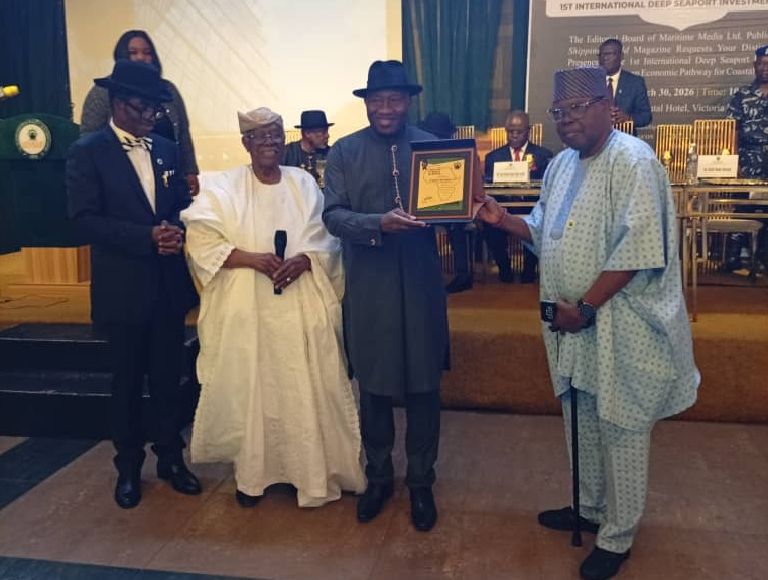
Former President of Nigeria, Goodluck Jonathan (2nd from right) celebrates his award with Former President of Association of Nigerian Licensed Customs Agents (ANLCA) Prince Olayiwola Shittu, while Chief Bode George and Elder Asu Beks watched.
“When you give me a vehicle, you have to release the key to me,” Beks said pointedly, underscoring the need for regulatory empowerment to match institutional creation.
The forum underscored a consensus that Nigeria must modernize its ports system to remain competitive in global trade. Jonathan’s historical warning, George’s call for decentralization, Gwandu’s pragmatic caution, Alaibe’s push for action, and Diri’s ambitious vision all converged on one message: which that Nigeria’s maritime future depends on urgent, coordinated action.
The highlight of the event was the presentation of awards to deserving individuals, including former President Jonathan and former President of Association of Nigerian Licensed Customs Agents (ANLCA) Prince Olayiwola Shittu, among others.







NPA Congratulates ANLCA on 72nd Anniversary, Reaffirms Support for Port Modernisation

Afeni Lands at FOU Zone ‘A’ in Acting Controller Capacity

NPA Mulls Specialised Fishing Port to Deepen Nigeria’s Blue Economy

Industry Stakeholders Applaud ANLCA at 72nd Anniversary Celebration

Port Regulation Critical To Fisheries, Blue Economy – NPERA DG, Akutah

ANLCA @ 72: FG, Stakeholders Laud Association’s Leading Role in Trade Facilitation

Apapa Customs: Comptroller Mu’azu Takes Over, Pledges Strict Revenue Integrity And Seamless Trade

Stakeholders Demand Immediate Action To Convert Nigeria’s $1 Trillion Blue Economy Potential Into Reality

Afeni’s Parting Query: Why Evade Duty on a ₦417m Range Rover?

ANLCA@72: As All Roads Lead to Marriott Hotel lkeja

MARCON Set To Host Conference On Sustainable Fishing In Lagos

Fire Incident: Western Marine Customs Debunk Media Exaggerations
ANLCA Board is intact, cannot be wished away by anybody’-Elochukwu

B-R-E-A-K-I-N-G: Effedua, Rector MAN Oron, Resigns

EFCC’s Probe: Okowa Plots Sheriff’s Removal Despite London Accord
Customs Trains ANLCA Members, Others on B’Odogwu Portal

NPA’s Alleged Executive Management Fight: The Half Truth & Truth
ANLCA Board Election: Know Your Candidates
‘Why We Launched B-Odogwu Pilot Scheme With Webb Fontaine Still Running’ – Adeniyi

Onyemekara Promoted GM, Appointed NPA’s New Spokesperson

Nigeria Customs: Trust, Competence And The Oramalugo Factor

‘Rush To Break News Can Lead To Brush With Cybercrime’- Police

Kebbi Is Hub of Hard Drugs Smuggling In Northern Region’ – Oramalugo

Apapa Customs Collects ₦161b On B’Odogwu Platform In 3 Weeks