…Demands Probe of CVFF
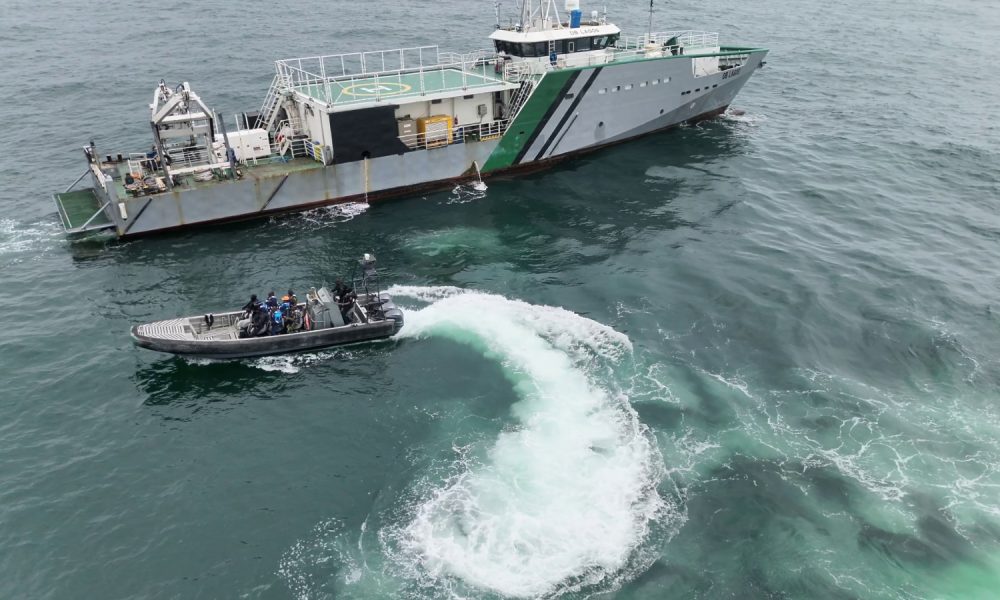
BY EGUONO ODJEGBA The recent remarks by Gerard Levy, Chief Executive Officer of RTCOM Defense, may have reignited debate over Nigeria’s twin maritime security architectures: the Nigerian Navy’s Falcon Eye and NIMASA’s Deep Blue Project. In an exclusive interview, Levy dismissed comparisons between the two initiatives, stressing that they serve entirely different mandates and cannot be measured on the same scale. Levy described Falcon Eye as “an independent, nationwide Command, Control, and Multi-Sensor Intelligence Fusion infrastructure” designed to provide real-time maritime domain awareness....
BY IBRAHIM NASIRU During the recent Day of the Seafarer celebrations, a major policy bombshell dropped that sent shockwaves through the maritime industry. The Nigerian Maritime Administration and Safety Agency (NIMASA) announced a massive 150% wage increase for local seafarers. By integrating international maritime standards into local contracts, the government is finally attempting to address a long-standing injustice: the systemic underpayment of the men and women who keep our maritime trade afloat. On paper, it looks like an incredible victory for labour and a massive step forward for the thousands of young cadets who have gone through the Nigerian Seafarers Development Programme (NSDP). But as any seasoned observer of Nigerian policy knows, a wage increase on paper means absolutely nothing if you do not possess a job to earn it. The uncomfortable reality is that a 150% salary boost is completely useless if local shipping companies are priced out of the market, or if foreign vessels continue to dominate our territorial waters. Nigeria passed the Coastal and Inland Shipping (Cabotage) Act way back in 2003 with a very clear, patriotic objective: domestic coastal trade was supposed to be reserved strictly for Nigerian-owned, Nigerian-built, and Nigerian-crewed vessels. It was designed to build local capacity and ensure that our wealth stayed within our borders. Yet, over two decades later, the spirit of that law is routinely violated every single day. The maritime sector has structural friction that cannot be solved by simply adjusting a salary scale. The biggest culprit here is the infamous cabotage waiver system. For years, international shipping lines have exploited regulatory loopholes to secure endless ministerial waivers. These waivers allow foreign-flagged ships with entirely foreign crews to operate freely in our domestic waters, moving cargo between Lagos, Onne, and Port Harcourt. They claim that local capacity does not exist, using that excuse to completely bypass local seafarers. As...
…As Gov. Diri Advocates Stronger Coastal State Action BY KESIENNA SHEPHERDS The Minister of Marine and Blue Economy, Dr Adegboyega Oyetola, has called for stronger collaboration...
BY FUNMI ALUKO The story of Apapa Port is the story of Nigeria’s economic heartbeat. Every day, thousands of containers pass through its gates, carrying goods...
… As NIMASA Launches Seafarers’ Discharge Book Portal At 2026 Seafarers’ Day BY GBOGBOWA GBOWA Stakeholders in Nigeria’s maritime sector have called for stronger protection, improved...
BY IBRAHIM NASIRU When the World Bank and S&P Global recently released the 2025 Container Port Performance Index (CPPI), the headlines understandably erupted in celebration. For Tin Can Island and Apapa to land in the global Top 20 for performance gains is undoubtedly a historic milestone. Yet, for seasoned maritime analysts and industry stakeholders, a glaring question remains: what about the rest of Nigeria’s coastlines? While the satellite data accurately captures a localized turnaround in the Lagos pilotage districts, it simultaneously masks a stark regional imbalance. The narrative of Nigerian maritime modernization cannot begin and end in Lagos. To truly turn the tide, the conversation must expand to the Eastern Corridor encompassing Onne Port, Port Harcourt Port, Calabar Port, and Warri Port. The fundamental issue is that the World Bank’s CPPI relies strictly on automated vessel AIS data tracking. It registers a win when ship turnaround times shrink at a berth, but it completely shuts out the structural and geographical deficiencies that prevent large vessels from even sailing into Eastern waters in the first place. Modern deep sea shipping lines require drafts starting at 15 meters. While multi-billion naira investments and natural depths allow Lagos and the expanding Lekki Deep Sea Port to receive mega-vessels, Calabar Port remains severely hindered by an un-dredged channel hovering around a shallow 6 to 7 meters. Port Harcourt suffers from similar shallow constraints. Without aggressive, patriotic capital dredging projects, the devils in the details ensure that these regional Ports remain underutilized, regardless of how much digitization is deployed on paper. It is easy for policymakers to announce massive financial interventions. Critics are entirely right to point out that the Federal Government’s massive Port modernization plans must yield measurable metrics on the ground, not just political headlines. However, recent data shows that commercial viability is waiting to be unlocked. In overall cargo throughput metrics, Onne Port has consistently proven that the Eastern flank possesses massive economic power when given the operational room to breathe. The roadmap for greenfield developments like the Ibom deep seaport and others exists, but real execution under the African Continental Free Trade Area (AfCFTA) framework will be the ultimate judge of these investments. The current operational reality forces an unnatural economic bottleneck. Importers in the South-East and South-South regions frequently clear their goods in Lagos, only to transport them across hundreds of kilometers of volatile highways back to Eastern markets. This layout drives up logistics expenses, completely wiping out the macro efficiencies celebrated in recent National Bureau of Statistics (NBS) trade surplus figures. The next institutional hurdle for the Managing Director of the NPA, Dr. Abubakar Dantsoho, and the Minister of Marine and Blue Economy, Adegboyega Oyetola, is the implementation of a unified, cooperative Port development strategy. This requires more than just launching an electronic call-up system; it demands a deliberate re-alignment of tariff structures that actively incentivizes shipping consortia to divert traffic to regional hubs. Ultimately, a Port system is only as strong as its weakest link. Celebrating the World Bank validation of Apapa and Tin Can is fair, but treating it as a nationwide victory is premature. Until the institutional bottlenecks, channel depths, and security challenges of the Eastern Corridor seaports are solved with the same urgency applied to Lagos, Nigeria’s maritime sector will continue running on half its cylinders. True maritime competitiveness is not won by building an elite logistics island in one state, but by unlocking the full economic potentials of the nation’s entire coastline. Chief Ibrahim Nasiru, a Public Affairs Analyst writes from Abuja