Business Maritime
The Fish They Steal, The Fish We Import

The Tragedy of Nigeria’s $1 Billion Blue Economy
BY EGUONO ODJEGBA
Nigeria is a strange country. We export crude oil and import fuel. We export cocoa and import chocolate. We sit on mountains of solid minerals and import finished products made from them.
Now comes perhaps the most absurd irony of all: we may be importing fish harvested from our own waters. When President of Dangote Group, Alhaji Aliko Dangote, disclosed that Nigeria spends about $1 billion annually importing fish despite vast marine and inland water resources, he probably intended to provoke conversations around aquaculture investment, infrastructure and food security.
Instead, he inadvertently opened the lid on one of the least discussed leakages in Nigeria’s maritime economy. The question that followed from stakeholders was both simple and explosive:
Are Nigerians paying foreign vessels to sell back fish caught in Nigerian waters?
If the answer is even partially yes, then Nigeria’s fish import dependency is not an economic accident. It is a business model. The Trawlers Know the Way Home.
According to maritime operators familiar with fishing activities in Nigerian waters, many foreign industrial trawlers arrive equipped not merely to fish but to operate floating factories.
On arrival, they catch, process, package, freeze, and then trans-ship. And somewhere down the trade chain, those same products find their way into Nigerian markets as imported fish. The allegation has circulated within maritime circles for years.
Nobody appears shocked by it anymore. What shocks industry watchers and many operators is the official silence surrounding it. One maritime stakeholder recounted intercepting a vessel carrying branded packaging materials allegedly intended for onboard fish processing and informing relevant authorities, only for the matter to quietly disappear into bureaucratic darkness.
The files probably still exist somewhere. Nigeria specializes in files.
Enforcement in Nigeria often means looking away, while officials speak confidently about reforms. Digital licensing, automation, electronic monitoring, surveillance architecture, integrated systems, dashboards, platforms, port community systems, maritime single window system.
The vocabulary of reform is always impressive, while the outcomes are often less so. The vocabulary of reforms are not just expensive, they are crafted to caught attention and to entertain.
In practical terms however, a fishing license, whether printed on paper or displayed on a tablet, cannot chase illegal trawlers through Nigerian waters. Software does not board vessels, algorithms do not seize catches, nor dashboards prosecute offenders. Only real time enforcement does. And enforcement begins where compromise ends.
The uncomfortable truth is that Nigeria does not suffer from a shortage of regulations but from a surplus of interests benefiting from non-enforcement; and official gloss over and indifference, seemingly from the very top.
Those feeling that the blue economy may somewhat have built on selective blindness may not be wrong after all. The Federal Ministry of Marine and Blue Economy was launched amid high expectations and ambitious projections. These expectations include jobs creation, industrialization, food security, export earnings., investment inflows, and economic diversification. And the language was inspiring. The ocean, we were told, would become Nigeria’s next frontier of prosperity.
But blue economy rhetoric cannot coexist comfortably with foreign poachers apparently treating Nigerian waters as open-access supermarkets. No nation develops a fisheries economy while watching its fish stocks migrate directly from its waters into foreign balance sheets.
No country builds maritime manufacturing while surrendering raw materials at sea, and no serious blue economy strategy survives without maritime sovereignty.
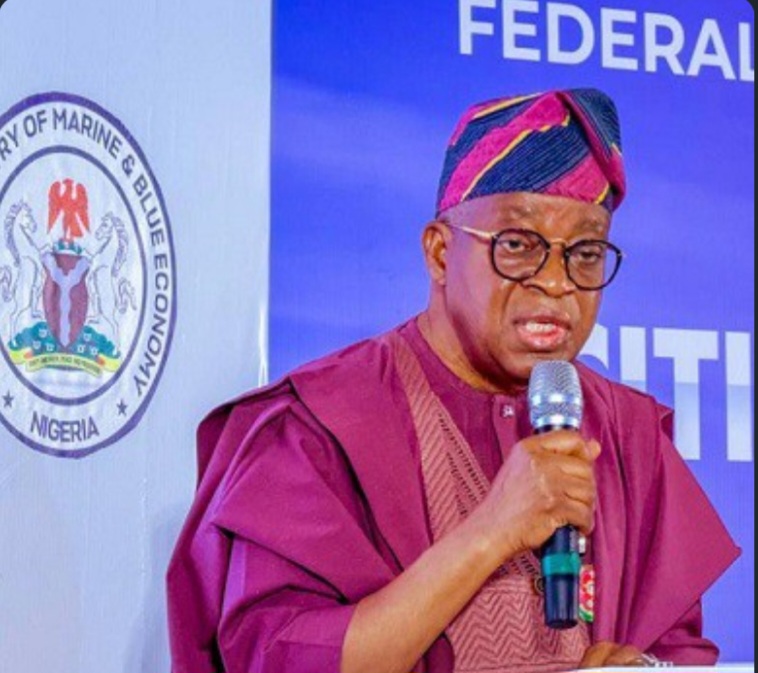
The minister of marine and blue economy, Dr. Adegboyega Oyetola and his men must understand that the first responsibility of a coastal state is control; effective control. Without control, policy is literature.
Nigeria has seen similar movie before with crude oil theft. For years Nigerians were told that surveillance systems existed, and officials were always quick to showcase centres of satellites, monitoring facilities, and other complements of security architectures.
Yet crude was disappearing in industrial quantities, such that everybody could see the theft literally walking. Few appeared capable of stopping it or even willing to stop it. Unless Oyetola and his men gets serious, the fishing sector risks becoming a maritime version of the same tragedy.
The only difference is that crude while travels through pipelines, fish swims; and the real import is corruption. Let us be clear, the estimated annual $1 billion fish import bill is only the visible cost.
The invisible costs are larger, most of which has been enumerated. They include jobs that never exist in-country, fishing communities pushed deeper into poverty, domestic processors starved of supply, cold-chain investments abandoned, foreign exchange drained, weakened food security and delayed maritime industrialization.
Every container of imported fish arriving at Nigerian ports must now raise uncomfortable questions. Could this have been harvested locally? Could Nigerians have caught it, processed it, stored it, transported it, sold it, and exported it?
If the answer is yes, then what Nigeria imports is not merely fish but the consequences of governance failure. A country buying back its own wealth.
Dangote was right, Nigeria should not be spending a billion dollars importing fish. Perhaps, the bigger scandal is that the country may be spending scarce foreign exchange buying back wealth extracted from its own territorial waters. And if this possibility does not trigger outrage, then perhaps Nigerians have become too accustomed to economic absurdities.
The real challenge before the Federal Ministry of Marine and Blue Economy is therefore not digitization which it celebrated recently. It is not another stakeholder engagement, not another policy framework or another glossy presentation on investment opportunities.
The challenge is simpler and infinitely harder: Who controls Nigeria’s waters? Until that question receives an honest answer, the blue economy risks becoming another colourful phrase floating above dark waters. And the fish they stole may remain the fish we import.








NIMASA Unveils National Innovation Hackathon, Open Young Innovators Por

Ogun 1 Customs Intercepts N417m Range Rover

Operator Raises Alarm Over Foreign Control, Cartelisation of Maritime Supply Chain

Tin-Can Customs Generates ₦137.298bn in August

DG NIMASA, Mobereola Reasserts Cabotage Implementation Key To Maritime Development

Tribute to a Colossus: The Eternal Legacy of Alhaji Bamanga Tukur (1935–2026)

Stakeholders To Re-Examine Blue Economy Imperatives

ANLCA@72: From Founders’ Dream to Indispensable Pillar of Nigeria’s Port Economy

ANLCA’s 72nd Anniversary: NECOM Reels Out Programme, Says Peace Worth Celebrating

US Coast Guard, Nigeria and the Politics of a Maritime Victory

Wasiu, Seme ANLCA Chairman Calls for Review of Vehicle Restriction

Seme-Krake: Nigeria, Benin Launch Joint Assessment to Revive One-Stop Border Post

ANLCA Board is intact, cannot be wished away by anybody’-Elochukwu

B-R-E-A-K-I-N-G: Effedua, Rector MAN Oron, Resigns

EFCC’s Probe: Okowa Plots Sheriff’s Removal Despite London Accord
Customs Trains ANLCA Members, Others on B’Odogwu Portal

NPA’s Alleged Executive Management Fight: The Half Truth & Truth
ANLCA Board Election: Know Your Candidates
‘Why We Launched B-Odogwu Pilot Scheme With Webb Fontaine Still Running’ – Adeniyi

Onyemekara Promoted GM, Appointed NPA’s New Spokesperson

Nigeria Customs: Trust, Competence And The Oramalugo Factor

‘Rush To Break News Can Lead To Brush With Cybercrime’- Police

Kebbi Is Hub of Hard Drugs Smuggling In Northern Region’ – Oramalugo

‘Our Trade Security Is More Protected Under B’Odogwu’ – Daniyan