
Business
Anani: Giving Adeniyi’s Security Agenda a Fighting Chance

BY EGUONO ODJEGBA

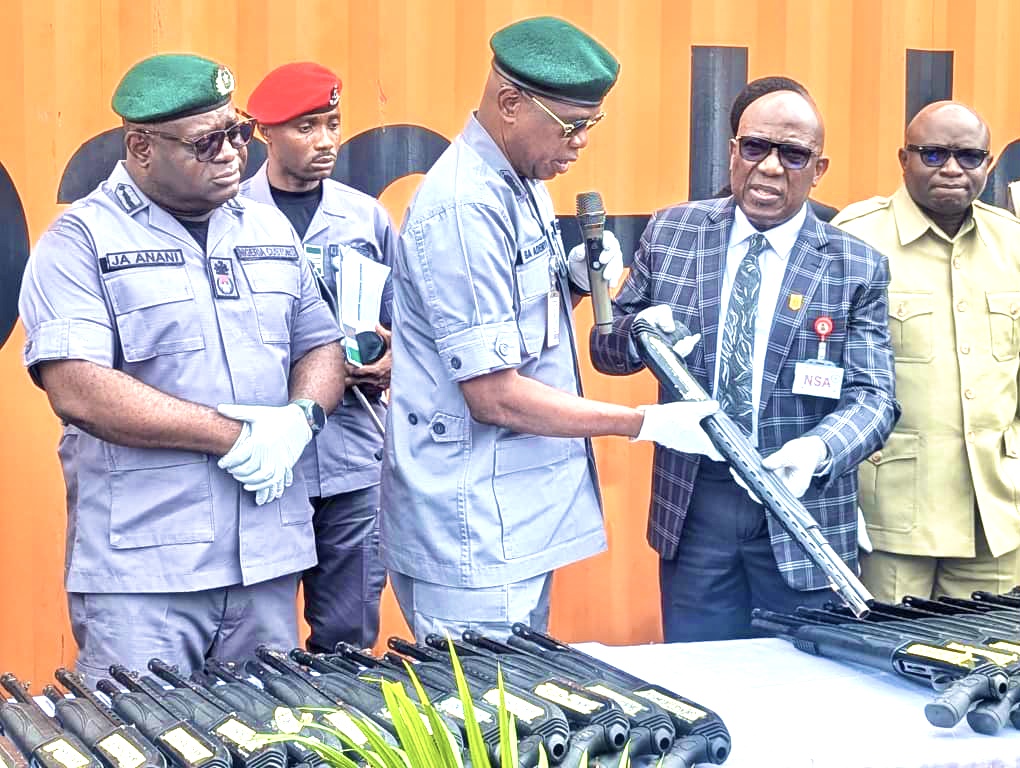
Comptroller Joe Anani
While the handover of 399 rifles and a large cache of firearm components by the Nigeria Customs Service (NCS) to the National Centre for the Control of Small Arms and Light Weapons (NCCSALW) may have been presented as a routine enforcement milestone, but developments surrounding the seizure points to something much bigger.
How a focused Customs Area Controller is turning port intelligence into national security dividends, and in addition, the emergence of the Tin Can Island Port Command as an increasingly important frontline of Nigeria’s national security architecture.
At the centre of that story is the Customs Area Controller, Comptroller Joseph Anani. The significance of Anani’s role is not simply that the weapons were intercepted under his watch. More importantly, the development offers a window into the kind of command leadership required to translate Comptroller-General of Customs Bashir Adewale Adeniyi’s reform agenda from policy statements into measurable operational outcomes.
For a Service whose traditional mandate is associated principally with revenue collection, trade facilitation and anti-smuggling operations, the discovery of 399 rifles, alongside 89 frames, 80 charging handles, 579 trigger groups and 25 locking lugs, demonstrates the increasingly strategic character of Customs enforcement.
And for Anani, the development places him squarely within that evolving narrative. More so, the Tin Can seizure illustrates how intelligence, cargo profiling, documentation, risk management, port security and inter-agency collaboration can converge to stop a potentially devastating consignment before it reaches the wider society.
That is precisely where the leadership of a Customs Area Controller becomes critical, which also brings us to the subject matter of the Anani factor, beyond seizures and revenue collection and administration. The temptation in reporting major Customs seizures is often to concentrate on the monetary value of the goods intercepted or the dramatic quantity of contraband recovered.
But the 399 rifles demand a different perspective. Weapons are not ordinary contraband. Every rifle stopped at the point of entry potentially represents a weapon denied to a criminal network, terrorist organisation, bandit group, kidnapping syndicate or other violent actors.
Consequently, the effectiveness of the Tin Can Island Port Command cannot be measured only by the number of containers examined or seizures recorded. It must also be assessed by its capacity to identify what should not enter the country in the first place.
That is where Anani’s leadership becomes particularly instructive. His comments during the handover were revealing. Rather than treating the seizure as an isolated Customs victory, he situated it within the broader architecture of arms control, stressing the importance of inter-agency cooperation, strict adherence to the law and proper custody and accounting of seized weapons.
That posture is significant, being that it suggests a commander who understands that the work does not end when Customs intercepts a prohibited consignment. The real security chain begins with detection, continues with seizure, documentation, investigation and prosecution, and ultimately requires the secure custody, profiling and lawful disposal of recovered weapons.
In that chain, Tin Can Customs is the first major gatekeeper, which brings us quickly to yet another important factor: Adeniyi’s confidence in the Tin Can leadership.
There is also a broader institutional dimension to Anani’s performance. The Customs Service under Adeniyi has increasingly projected an image of a modern enforcement institution in which technology, intelligence and risk management are deployed to make interventions more precise.
The Tin Can seizure fits neatly into that philosophy. Adeniyi himself attributed the interception to the Service’s modernisation programme and improved risk-management tools, which allow officers to identify high-risk consignments without physically examining every container.
That approach represents a fundamental departure from indiscriminate inspection. It is about knowing where to look, what to look for and why a particular cargo deserves scrutiny. For a port as strategically important and commercially busy as Tin Can Island, that distinction is crucial.
The command must facilitate legitimate trade while remaining sufficiently alert to prevent criminal elements from exploiting the same channels. That balancing act requires more than enforcement zeal. It requires competent command leadership.
The CGC’s decision to entrust such a strategic port command to Anani therefore assumes greater significance against the backdrop of the seizure. His role in the episode reinforces the impression of a commander operating within, rather than outside, the CGC’s larger operational philosophy.
Again, this brings us to Tin Can as a national security gatekeeper. The Tin Can Island Port is not merely another Customs formation; it is more than that. As the second major maritime gateway, its cargo profile and operational volume make it particularly vulnerable to attempts by criminal networks to conceal prohibited goods within legitimate international trade.
That makes vigilance at the command a matter of national consequence. The discovery of the rifles therefore represents more than a successful examination of a suspicious consignment. It is evidence that the port’s security architecture can produce actionable results when intelligence, technology, profiling and human vigilance work together.
And this is where the Anani story becomes compelling. A commander can inherit sophisticated technology and enforcement instruments, but technology alone does not guarantee results. There must be the discipline to trust intelligence, the professional capacity to interrogate cargo documentation, the courage to intervene when red flags emerge and the institutional discipline to ensure that the evidence chain remains intact.
The 399 rifles suggest that these elements are increasingly coming together at Tin Can; which signposts yet another critical nexus in national wellbeing, as the focus does not terminate at revenue concerns but projects national security as shared national responsibility.
For decades, Customs performance has often been judged predominantly through revenue figures. While the metric remains important, the changing security environment has expanded the meaning of Customs responsibility.
The ports are now critical points in the national fight against illicit arms trafficking, narcotics, financial crime, smuggling and other transnational criminal activities. In that context, a Customs commander’s scorecard cannot be reduced to revenue and seizure figures alone.
It should also encompass how effectively the command protects the integrity of the national border while facilitating legitimate commerce, and redefines the role of the NCS in in the context of national assignment.
Anani’s Tin Can tenure is beginning to acquire that broader complexion. His participation in the handover and his emphasis on lawful custody, accountability and inter-agency partnership demonstrate an understanding that Customs enforcement must connect seamlessly with the work of specialized security institutions.
The subsequent transfer of the weapons to NCCSALW is itself part of that process. The Centre, operating under the Office of the National Security Adviser, provides the specialized framework for the custody, profiling, management and eventual destruction or lawful disposition of recovered illicit weapons.
That institutional handoff prevents a seizure from becoming an end in itself. Instead, it turns interception into a continuing national-security process.
Interestingly, the Tin Can episode also provide an interesting insight into the Adeniyi leadership model. The CGC has repeatedly emphasised professionalism, technology, intelligence-led enforcement, inter-agency collaboration and the protection of national economic and security interests.
Those objectives can only succeed when Area Controllers entrusted with strategic formations understand the vision and possess the competence to operationalize it. From all indications, Anani fits that mould.
His relevance is not necessarily about being the loudest commander or producing the most sensational headline, rather, it is the capacity to keep his command focused on the operational priorities of the Service and to ensure that enforcement outcomes feed into the larger national agenda.
The 399 rifles have consequently become more than a seizure statistic. They have become a practical demonstration of what can happen when port intelligence, documentation, risk management, officer vigilance and inter-agency cooperation converge under focused command leadership.
But the real test will extend beyond the seizure and handover; with further expectations. The authorities must now follow the trail behind the consignment to unravel who ordered the weapons, who financed them; and who was the intended recipient?
The outcome of such incisive investigation should also indicate how the documentation pass through the international supply chain and interrogate the possible facilitators. And are there other consignments or networks connected to the attempted importation?
Those questions belong to the wider investigative and prosecutorial chain, and their answers could transform the seizure from a successful interception into a major intelligence breakthrough.
That is also why the professional handling of the seizure at Tin Can matters. For Anani, the assignment is no longer simply about stopping prohibited goods at the port. It is about ensuring that the command remains an effective link in a much larger national security chain.
In an era when criminals increasingly exploit legitimate trade corridors, Customs officers at the maritime gateway are effectively standing on the frontiers of national security. The Tin Can Island Port Command, under Anani, has just demonstrated that it understands the assignment.
And in the broader scheme of Adeniyi’s Customs reform agenda, that may ultimately prove to be one of the most important measures of Anani’s command: not merely how much Customs revenue he helps generate or how many seizures he records, but how effectively the port under his watch helps keep dangerous networks, weapons and illicit trade away from Nigerian streets.
For a country confronting terrorism, banditry, kidnapping and violent crime, that is no small responsibility. It is, in fact, a national assignment, which Comptroller Joe Anani’s Tin Can Command appears increasingly prepared to carry.










Nigeria Customs Mulls Reviews of Complaints Arising from Recruitment

Edo-Delta Journalists Forum Challenges Political Leaders on Regional Development

Nnadi Urges Nigerian Importers to Shift from Finished Goods to Manufacturing

WMD: Oyetola Recommit to Unlock CVFF Pursuant to Indigenous Operators Financing

Customs FOU Zone ‘A’ Hands Over Seized ₦511.4m Pharmaceuticals, Illicit Drugs to NDLEA, NAFDAC

Oyetola Unveils NPERA, Corporate Logo Amid Quiet Enthusiasm

Nigeria, Benin Urged to Deploy Culture and Traditional Diplomacy to Defuse Border Tensions

Nigeria’s Ports: How Foreign Capital Took the Dinner, While Indigenous Businesses Got the Crumbs (3)

FOU Zone A, Police, Army, DSS, Others Strengthen Security Alliance Ahead of Elections

Nigeria’s Ports: How Foreign Capital Took the Dinner, While Indigenous Businesses Got the Crumbs (2)

Former Senatorial Candidate, Hajia Nike AbdulRahman Dumps NDC, Defects to APC

Nigeria’s Ports: How Foreign Capital Took the Dinner, While Indigenous Businesses Got the Crumbs

ANLCA Board is intact, cannot be wished away by anybody’-Elochukwu

B-R-E-A-K-I-N-G: Effedua, Rector MAN Oron, Resigns

EFCC’s Probe: Okowa Plots Sheriff’s Removal Despite London Accord

Customs Trains ANLCA Members, Others on B’Odogwu Portal

NPA’s Alleged Executive Management Fight: The Half Truth & Truth

ANLCA Board Election: Know Your Candidates
‘Why We Launched B-Odogwu Pilot Scheme With Webb Fontaine Still Running’ – Adeniyi

Onyemekara Promoted GM, Appointed NPA’s New Spokesperson

Nigeria Customs: Trust, Competence And The Oramalugo Factor

Onyeka Makes History As Tin-Can Customs Hit ₦16.4bn A Day

‘Rush To Break News Can Lead To Brush With Cybercrime’- Police

Kebbi Is Hub of Hard Drugs Smuggling In Northern Region’ – Oramalugo