
Analysis
Oshoba: The Intelligence Man’s Quiet Revolution at Nigeria’s Busiest Port

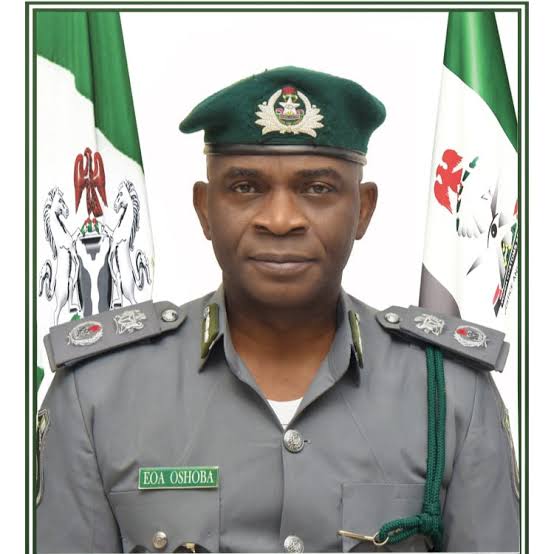
BY EGUONO ODJEGBA
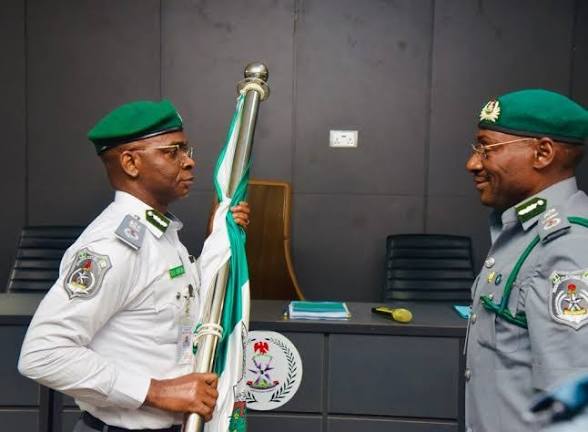
Oshoba, left, with his predecessor, ACG Babatunde Olomu fsi, a quintessential, result getting customs chief, during the handover ceremony.
When Comptroller Emmanuel Oluwadare Oshoba assumed the reins of the Apapa Area Command of the Nigeria Customs Service in September 2025, he inherited perhaps the most demanding operational theatre in the Service.
It was a command where revenue, trade facilitation, enforcement, technology and stakeholder pressure converge almost every working day. But Oshoba did not arrive as a conventional field commander. His professional profile had been shaped substantially by years of working around the intelligence and headquarters architecture of the Nigeria Customs Service.
Before his deployment to Apapa, he had served as Controller in Risk Management and Special Duties at Customs Headquarters and, most significantly, as Controller in charge of the Customs Intelligence Unit (CIU).
That background may well explain the distinctive character of his administration at Apapa, believed to be slowly but unavoidably drawing to a close. For an officer whose career has involved studying risks, interpreting intelligence, managing institutional challenges and responding to problems emanating from the field, Apapa represents less a new territory than a much larger operational laboratory.
And the evidence of the past months suggests that Oshoba has approached the assignment with the mindset of an intelligence operative: watch the system, identify the leakage, understand the risk and intervene where it matters most.
His first major signal came almost immediately. Within about 24 hours of assuming office, Apapa Command recorded a daily revenue collection of ₦20.1 billion, surpassing the previous ₦18 billion record. It was an early indication that the new Controller understood the extraordinary revenue potential embedded in the command.
By the end of 2025, Apapa had generated ₦2.93 trillion, representing a 24.32 per cent increase over its 2024 collection.
But revenue has not been Oshoba’s only metric. His leadership appears to be built around a four-way balance: revenue optimisation, intelligence-led enforcement, technology-driven clearance and disciplined stakeholder engagement.
That balance is particularly important at Apapa, where the interests of Customs, terminal operators, shipping lines, freight forwarders, importers, exporters, manufacturers and government agencies frequently intersect, and sometimes collide.
Oshoba’s response has been to repeatedly push his officers towards professionalism and responsiveness while simultaneously warning that enforcement cannot be sacrificed on the altar of speed.
In May 2026, for instance, he directed officers to intensify interventions across terminals to block revenue leakages while ensuring timely cargo clearance. He was emphatic that delays by officers, including at the exit gates after cargo has been duly cleared, would not be tolerated.
That position reveals perhaps the central philosophy of the Oshoba administration: Customs must be firm without becoming an obstacle to legitimate commerce.
It is a delicate line to walk. The Apapa stakeholder community does not merely expect higher revenue. It expects predictability. Importers want transparency. Customs agents want faster processes. Terminal operators require operational coordination. Manufacturers want fewer delays and lower transaction costs. Government expects revenue and border protection.
Meanwhile, the public expects Customs to stop prohibited imports, protect national security and prevent economic sabotage. Oshoba’s intelligence background appears particularly relevant in this last area.
The Command’s enforcement profile under his watch has included joint operations and intelligence-led interventions. In July 2026, Customs and the National Drug Law Enforcement Agency (NDLEA) intercepted 4,143.5 kilogrammes of Cannabis Indica concealed in a 40-foot container alongside imported vehicles, with the seizure valued at more than ₦26.5 billion.
Earlier, a joint Customs-NDLEA operation intercepted 347.5 kilogrammes of cannabis concealed inside an imported Toyota Sienna. Such seizures reinforce the impression of an administration that is increasingly leaning towards intelligence, inter-agency cooperation and targeted enforcement rather than random disruption of legitimate trade.
There is also a technological dimension. From his first public engagements at Apapa, Oshoba identified the ongoing Customs modernisation programme and B’Odogwu platform as critical to the future of the port, calling for stronger stakeholder collaboration to deepen the gains of digitalisation.
This is significant because technology, from the stakeholder’s perspective, is valuable only when it produces measurable improvements in cargo release, transparency and predictability.
The real test of Oshoba’s leadership, therefore, will not be the number of records broken or seizures announced. It will be whether the Apapa ecosystem becomes more predictable for legitimate trade while becoming increasingly hostile to revenue fraud, smuggling and deliberate non-compliance.
That was the expectation stakeholders quietly placed on his desk. His headquarters and CIU experience may have given him an unusual advantage: haven spent much of his career seeing Customs operations from the other side of the field, where intelligence reports, operational problems, risk assessments and institutional responses converge.
At Apapa, he had the opportunity to translate that knowledge into practical field outcomes. Therefore, the question is no longer whether Oshoba understood the Customs system, it is whether he has done enough restructuring, remodeling and groundwork to make the system work better for everyone who depends on Apapa.
Interestingly, the port users agrees that Oshoba has built a new work environment and culture that guarantees sustainable growth for government and stakeholders, alike. Ultimately, this is the most enduring measure of the Oshoba era.
In all of these, Oshoba relied on his special team that consists of very competent, focused, trusted principal officers of impeccable character. They are the co-efficient drivers of growth in the Command, with Oshoba leading the mandate.
They include the Deputy Comptroller Admin – DC Henry Eromobor, Deputy Comptroller Revenue – DC A Udoh, Ag DC Compliance – AC Ismail Mohammed, Deputy Comptroller Enforcement – DC Ibrahim Danjuma, OC Gate – DC Olufemi Kukoyi, Staff Officer General- AC Abubakar Usman, Team Manager CIU – AC Femi Otiko, DC Valuation – DC Abdullahi Mohammed, DC Post Clearance Audit – DC Aisha Yinusa, and Command Public Relations Officer – CSC Isah Sulaiman.





Former Senatorial Candidate, Hajia Nike AbdulRahman Dumps NDC, Defects to APC

Nigeria’s Ports: How Foreign Capital Took the Dinner, While Indigenous Businesses Got the Crumbs

How Anani’s Tin Can Command Intercepted a ₦3.6 Billion Illicit Drug Shipment

Ibrahim, Ogun 1 Customs New Sheriff Unveils Strength Beneath His Quiet Mien

Logistics Synergy: NPA Advances Integration of ICDs Under New Reform Agenda

Teamwork, Discipline, Central to Our Enforcement Mandate —Jonah Charges Customs Marine Operatives

How the UAE-Nigeria Partnership Can Transform Our Ports

Cross River, FTZ Customs Gets New Impulse

CGC Adeniyi Signs Anti-Corruption Documents, Activates ICRAM Steering Committee

Nigeria Customs Marks Breast Cancer Awareness Month in Abuja

NIMASA To Host Webinars on Automation of Nigerian Ship Registry

NPA Moves To Cut Export Bottlenecks, Targets Forex Inflows
ANLCA Board is intact, cannot be wished away by anybody’-Elochukwu

B-R-E-A-K-I-N-G: Effedua, Rector MAN Oron, Resigns

EFCC’s Probe: Okowa Plots Sheriff’s Removal Despite London Accord
Customs Trains ANLCA Members, Others on B’Odogwu Portal

NPA’s Alleged Executive Management Fight: The Half Truth & Truth

ANLCA Board Election: Know Your Candidates
‘Why We Launched B-Odogwu Pilot Scheme With Webb Fontaine Still Running’ – Adeniyi

Onyemekara Promoted GM, Appointed NPA’s New Spokesperson

Nigeria Customs: Trust, Competence And The Oramalugo Factor

‘Rush To Break News Can Lead To Brush With Cybercrime’- Police

Kebbi Is Hub of Hard Drugs Smuggling In Northern Region’ – Oramalugo

Apapa Customs Collects ₦161b On B’Odogwu Platform In 3 Weeks