
Maritime
The NIJ MMCJD vs Maritime Media Backward Integration

BY EGUONO ODJEGBA
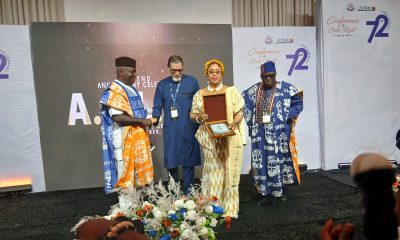
Last week, the Comptroller General of Customs, Adewale Adeniyi, received a Fellowship Award from the Nigerian Institute of Journalism in recognition of his professional achievements and contributions to national development. A special convocation ceremony was held to mark the investiture, underscoring the significance of the honour.
Perhaps, it couldn’t have happened for less, obviously for a man of letters, a public relations expert, a communicator per excellence, an indefatigable administrator, and a mobile communication encyclopedia all rolled into one.
Bashir Adewale Adeniyi, Ph.D., was deserving of the honour by every measure. He has always cherished his professional background as a communicator and consistently sought to support fellow media practitioners in building capacity.
It was therefore not surprising when the Customs boss announced plans to support the establishment of a modern multimedia and resource centre, widely reported as the Multi Media Centre for Journalism Development (MMCJD), to enhance practical training for students.
Speaking on the project, Adeniyi explained that after a needs assessment, a two‑storey building would be constructed to house a radio station, editing suites, production suites, and facilities integrating multimedia components such as audio, video, animation, text, and images.
It is to be recalled that earlier in 2024, Nigerian Maritime Journalists (NMJ) later renamed Network of Nigerian Maritime Journalists (NNMJ), an umbrella body of various maritime media industry beat associations, honoured Adenyi with the “iconic Maritime Personality of the Year 2024”; which grand ceremony was held at the Lagos Airport Hotel. The group comprise of Maritime Reporters Association of Nigeria (MARAN), League of Maritime Editors (LOME), Shipping Correspondents Association of Nigeria (SCAN), Association of Maritime Journalists of Nigeria (AMJON), Maritime Journalists’ Association of Nigeria (MAJAN), Online Media Association of Nigeria (OMAN), Congress of Nigerian Maritime media Practitioners (CONMMEP); and few individual practitioners dubbed ‘nonaligned’.
At that event, Adeniyi urged the fragmented maritime beat associations to unite under a single entity to strengthen their corporate standing, relevance, and collective voice, which he described as a reservoir of strength and authority. He also pledged to leverage his office and goodwill to engage sister agencies such as NPA, NIMASA, and NSC in supporting maritime journalists with capacity building, corporate enhancement, and training.
However, soon after his departure, the associations reverted to their individual trenches, preferring to remain fragmented hustling groups rather than embrace a professional outlook. This self‑imposed backward integration reflects years of infighting and narrow pursuits that led to the proliferation of beat associations. MARAN, in particular, enabled the initial split and has remained recalcitrant, earning the position of chief culprit in this persistent disunity.
Of the seven beat associations listed, MARAN has the distinction of spawning four newer groups, often through in‑house coups engineered by past presidents. The breakaway factions include the League, OMAN, SCAN, and MAJAN. The embarrassing proliferation of maritime media groups, their loss of focus, respect, and dignity, and the general state of unprofessional conduct stem from vaulting ambitions for separatist agendas that promote nothing but professional decadence.
One exception which stood out brightly is Mr. Sesan Onileimon, a former MARAN president, who has consistently pursued programmes and schemes to support maritime media practitioners across board. By providence, he remains a selfless leader who never undermined the association and continues to maintain genuine and impactful relationships with it.
Yet, members and the leadership of the various groups, including MARAN, erected a high wall against Adeniyi’s sincere advice for unification. Many fought against it as though their survival depended on media group politics, which has with time degenerated into a marketplace of intellectual popinjays. This is tragic, because the maritime space is vast and rich, capable of producing some of the most respected and forward‑looking journalists in the world. Instead, the beat has boxed itself into professional infamy, becoming rancorous and unconscionable, barely tolerable to a host of well‑meaning stakeholders.
Having lost its place, the associations now scavenge and harass the industry with pretended initiatives. Stakeholders, rather than responding warmly, now treat these associations as insufferable gangs of losers. Relationships with corporate bodies have become burdensome rather than constructive, as discipline, orderliness, and respect have been abandoned.
The Customs boss’s promise in March 2024 to push the cause of maritime journalists failed because the associations themselves worked for it to fail. While every group operates from rented spaces with, and the maritime media beat has no secretariat to call its own. Membership is defined more by street‑level hustling and morbid existential conduct than by professional conventions, ethics, or restraint. In this beat, everyone is a journalist, correspondent, editor, and media entrepreneur.
For good reasons, corporations struggle to understand the language of seven different media groups reporting one industry, and the confusion has bred disregard and discomfort among public relations managers and their CEOs. The writer, having long ceased to parade as a maritime journalist, finds comfort instead in the discipline and alignment of dockworkers, who operate responsibly under one formidable corporate group, the Maritime Workers Union of Nigeria (MWUN).
While the maritime media has the natural urge to interrogate industry issues, perhaps, now, it is time to look inward into our activities and conduct with courage and intensity, without bias. Until MARAN and its breakaway entities take the bold step to embrace Adeniyi’s advice and lead the struggle for genuine and total unity, they must accept responsibility for the odious atmosphere in which maritime media now operates. While the groups continue to run around insincerely and seeking scapegoats to justify their selfish and deceitful separatist enterprises, the construction of the NIJ MMCJD promised by the Customs boss may well be started, completed, and commissioned before his disengagement in 2027.
The maritime media will continue to grumble and groan about lack of adequate attention both in the area of capacity building, training and personal development upgrade.
In closing, it is instructive to mention that the former Minister of Transportation, Rt. Hon. Rotimi Chibuike Amaechi flew from Abuja to Lagos twice, just to engage maritime journalists on the need to come together under a single body for effective, administrative purposes.
MARAN led the boycott of the unification process, and thereafter, the industry exploded with the further balkanization of beat associations. As at today, one of the earlier three groups, Maritime Reporters Congress of Nigeria (MARCON), alongside MARAN and LOME, which was rested out of respect for the ministerial intervention for the three to collapse into one body, has been resurrected.
Amid this maddening crowd, an agency of government is inundated with media requests of same beat associations numbering ten, and still counting. To say that this level of madness is delusional and peculiar to Nigeria is speaking it the way it is. We have all gone mad.
To address this obvious mental state, we must begin the diagnosis from the source, just so our young practitioners don’t get forever trapped in this state of confusion and the audacious pretense that all is well.







Customs CGC Says ‘The World Is Connected, Not Borderless’

Nigeria Customs Mulls Reviews of Complaints Arising from Recruitment

Edo-Delta Journalists Forum Challenges Political Leaders on Regional Development

Nnadi Urges Nigerian Importers to Shift from Finished Goods to Manufacturing

WMD: Oyetola Recommit to Unlock CVFF Pursuant to Indigenous Operators Financing

Customs FOU Zone ‘A’ Hands Over Seized ₦511.4m Pharmaceuticals, Illicit Drugs to NDLEA, NAFDAC

Oyetola Unveils NPERA, Corporate Logo Amid Quiet Enthusiasm

Nigeria, Benin Urged to Deploy Culture and Traditional Diplomacy to Defuse Border Tensions

Nigeria’s Ports: How Foreign Capital Took the Dinner, While Indigenous Businesses Got the Crumbs (3)

FOU Zone A, Police, Army, DSS, Others Strengthen Security Alliance Ahead of Elections

Nigeria’s Ports: How Foreign Capital Took the Dinner, While Indigenous Businesses Got the Crumbs (2)

Former Senatorial Candidate, Hajia Nike AbdulRahman Dumps NDC, Defects to APC
ANLCA Board is intact, cannot be wished away by anybody’-Elochukwu

B-R-E-A-K-I-N-G: Effedua, Rector MAN Oron, Resigns

EFCC’s Probe: Okowa Plots Sheriff’s Removal Despite London Accord
Customs Trains ANLCA Members, Others on B’Odogwu Portal

NPA’s Alleged Executive Management Fight: The Half Truth & Truth
ANLCA Board Election: Know Your Candidates
‘Why We Launched B-Odogwu Pilot Scheme With Webb Fontaine Still Running’ – Adeniyi

Onyemekara Promoted GM, Appointed NPA’s New Spokesperson

Nigeria Customs: Trust, Competence And The Oramalugo Factor

Onyeka Makes History As Tin-Can Customs Hit ₦16.4bn A Day

‘Rush To Break News Can Lead To Brush With Cybercrime’- Police

Kebbi Is Hub of Hard Drugs Smuggling In Northern Region’ – Oramalugo