
Business
When the Sun Set at Seme: Adenuga’s Emotional Exit


BY EGUONO ODJEGBA
At about 3:00 p.m. on Wednesday, March 18, 2026, the Seme Border post fell unusually silent. Traders paused mid-conversation, clearing agents folded their arms, and even the ever-busy truck drivers and the logistics value chain players slowed their pace. It was not the usual lull of a border crossing; it was the weight of a farewell. Comptroller Wale Adenuga, the amiable and hardworking Customs Area Controller, was handing over the reins of the Nigeria Customs Service (NCS) Seme Command; and the atmosphere was thick enough to break with the thinnest rush of air.
For many, Adenuga’s redeployment to Headquarters was a rude shock. “We thought he was just settling in,” said Ojo a logistics operator who had worked closely with the Command. “In six months, he changed the way we do business here. He made us believe the border could work for everyone, not just a few.”
Rumors swirled that petitions and internal conspiracies had hastened his exit. Some stakeholders whispered about “overfed interests” who felt entitled to the border’s economic lifeline and bristled at Adenuga’s refusal to play by their rules. “Any CAC who doesn’t bend to them must go,” one clearing agent muttered, shaking his head.
Yet, beyond the politics, what lingered was the human touch. Adenuga’s leadership was described not in cold bureaucratic terms but in familial ones. “He made us a family,” said Muba, a community elder. “For the first time, traders, agents, and officers sat at the same table. He listened, even when he disagreed.”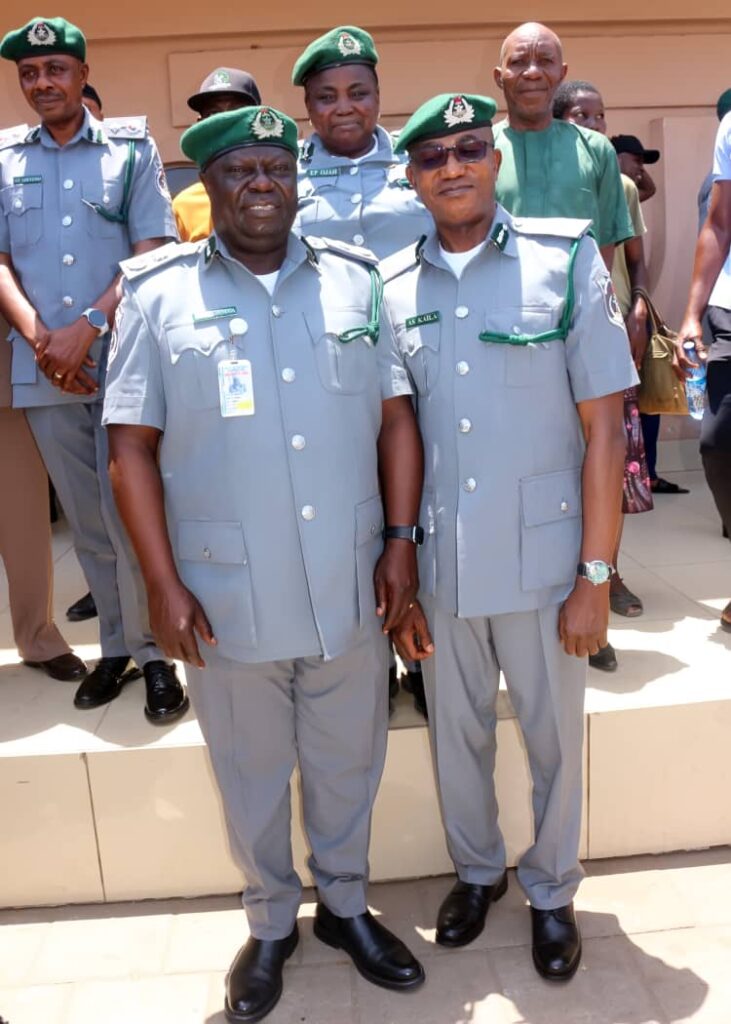
His achievements were tangible: dismantling roadblocks to ease traffic, quadrupling revenue charts, intensifying anti-smuggling operations, and fostering robust stakeholder engagement. But it was the intangible, the sense of belonging, the dignity restored to everyday interactions that stakeholders spoke of with misty eyes.
The handover itself was a study in contrasts. Adenuga, ever the loyal officer, kept his speech brief and calm. “It is the prerogative of the Service to post and redeploy,” he said, urging cooperation for his successor, Comptroller Kaila. His words were measured, but the crowd’s emotions were not.
One Deputy Comptroller broke the decorum, lashing out at “clandestine character assassination” and “backbiting.” Her voice trembled with anger as she asked why officers preferred conspiracies over constructive dialogue. The hall erupted in murmurs , a collective acknowledgment of the silent battles that had played out behind the scenes.
Comptroller Kaila, stepping into the spotlight, carried the burden of expectation. He thanked Adenuga for lifting the Command higher than he met it and pledged to consolidate on areas of strength. “My singular goal is to facilitate legitimate trade, improve compliance, and promote national security,” he assured. Yet, the weight of Adenuga’s legacy hung heavy, like a shadow he must now walk within.
As Adenuga walked out, applause mingled with sighs. Some reached out to shake his hand, others whispered prayers. “Godspeed, sir,” one trader said softly, “and may your path be favored.” The sun dipped lower, casting long shadows across the border station, a fitting metaphor for a leader whose departure left more than administrative gaps; it left an emotional void.
The ceremony ended not with celebration but with a collective sigh — a poignant reminder that leadership, when true and uncommon, leaves behind footprints too deep to erase.
For Seme, March 18 was not just another Wednesday. It was the day the sun set on a chapter of uncommon leadership, and the dawn of uncertainty under a new helmsman.
Uncertainty because the bad eggs, the entitlement guys are still around and the only language they understand is for the rules to bend to serve and favour them. The real tragedy is that the situation is not as much as helpless when those who should know better, appears too uncertain and willing to bend to their whims and caprices.


NIMASA Unveils National Innovation Hackathon, Open Young Innovators Por

Ogun 1 Customs Intercepts N417m Range Rover

Operator Raises Alarm Over Foreign Control, Cartelisation of Maritime Supply Chain

Tin-Can Customs Generates ₦137.298bn in August

DG NIMASA, Mobereola Reasserts Cabotage Implementation Key To Maritime Development

Tribute to a Colossus: The Eternal Legacy of Alhaji Bamanga Tukur (1935–2026)

Stakeholders To Re-Examine Blue Economy Imperatives

ANLCA@72: From Founders’ Dream to Indispensable Pillar of Nigeria’s Port Economy

ANLCA’s 72nd Anniversary: NECOM Reels Out Programme, Says Peace Worth Celebrating

US Coast Guard, Nigeria and the Politics of a Maritime Victory

Wasiu, Seme ANLCA Chairman Calls for Review of Vehicle Restriction

Seme-Krake: Nigeria, Benin Launch Joint Assessment to Revive One-Stop Border Post
ANLCA Board is intact, cannot be wished away by anybody’-Elochukwu

B-R-E-A-K-I-N-G: Effedua, Rector MAN Oron, Resigns

EFCC’s Probe: Okowa Plots Sheriff’s Removal Despite London Accord
Customs Trains ANLCA Members, Others on B’Odogwu Portal

NPA’s Alleged Executive Management Fight: The Half Truth & Truth

ANLCA Board Election: Know Your Candidates
‘Why We Launched B-Odogwu Pilot Scheme With Webb Fontaine Still Running’ – Adeniyi

Onyemekara Promoted GM, Appointed NPA’s New Spokesperson

Nigeria Customs: Trust, Competence And The Oramalugo Factor

‘Rush To Break News Can Lead To Brush With Cybercrime’- Police

Kebbi Is Hub of Hard Drugs Smuggling In Northern Region’ – Oramalugo

‘Our Trade Security Is More Protected Under B’Odogwu’ – Daniyan