Business Focus
A Closer Peep At The UK, Nigeria Ports Financing Deal

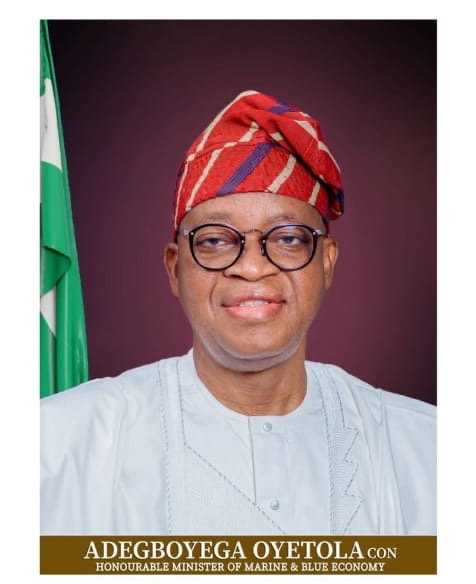
…Did Oyetola Lie About The FG Supposed Modernization of Lagos Ports?
BY EGUONO ODJEGBA
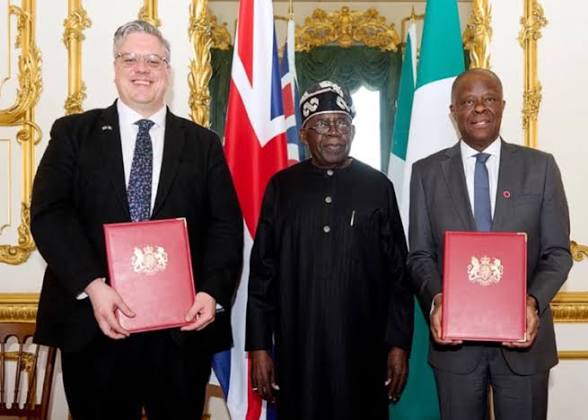
President Tinubu, Finance Minister Wale Edun and his British counterpart, after the signing of the deal
In October 2025, Nigerians were assured by the Minister of Marine and Blue Economy, Adegboyega Oyetola, that the federal government had approved a staggering one billion dollars for the modernization of Apapa and Tin Can Island ports. Speaking at the Chartered Institute of Logistics and Transport Conference, Oyetola declared: “We are working closely with all stakeholders to achieve a paperless, technology driven port environment that enhances efficiency, reduces turnaround time, and curbs corruption.”
The announcement was hailed as a turning point for Nigeria’s maritime sector. Reports at the time suggested that ITB Nigeria, a company owned by Gilbert Chagoury , a businessman with long standing ties to President Bola Tinubu had already secured a $700 million contract for the project, financed through Citibank and backed by UK Export Finance. Afreximbank was also said to be involved, while APM Terminals, operator of Apapa port, proposed an additional $500 million investment.
The minister who was represented by the Managing Director of Nigerian Ports Authority (NPA), Dr. Abubakar Dantsoho explained further that the supposedly ongoing port modernisation drive was aimed at upgrading infrastructure, improving cargo handling efficiency, and expanding capacity to meet global standards.
His words: “We are working closely with all stakeholders to achieve a paperless, technology-driven port environment that enhances efficiency, reduces turnaround time, and curbs corruption.”
“As part of this commitment, the Federal Government has approved a one billion US dollar modernisation project for the Lagos ports, a landmark initiative designed to upgrade infrastructure, improve cargo handling, and expand capacity to meet global standards.
“In addition, the procurement process has commenced for similar modernisation projects at ports outside Lagos, to ensure balanced development across our maritime gateways” he added.
But just six months later, in March 2026, President Tinubu stood beside British Prime Minister Keir Starmer at 10 Downing Street to announce a fresh £746 million agreement to refurbish the same Lagos ports. Tinubu described the deal as “a major milestone in strengthening bilateral trade ties and unlocking critical infrastructure needed to boost Nigeria’s economic competitiveness.”
Finance Minister Wale Edun, who signed the agreement on behalf of Nigeria insisted that the UK backed deal aligned with the administration’s Renewed Hope Agenda. He said it would “mobilise the scale of investment required to stimulate economic activity, generate employment, and reduce poverty across the country.”
To every discerning mind, this contradictionis not only stark but comes across as odd. Nigerians were told in October that one billion dollars had already been approved and committed to the ports. Yet another financing deal of nearly the same value has just been announced, months later, with no explanation of whether the UK arrangement replaced, supplemented, or duplicated the earlier approval.
Analysts think that the overlapping announcements expose a troubling lack of transparency. While the October statement implied that financing was already secured and contracts awarded, the March deal, however, suggested that the government was still shopping for funds, raising suspicions of financial padding and administrative deception.
Did Oyetola mislead President Tinubu into engaging in a ridiculous and questionable adventure, and did Wale Edun failed in properly advising their boss on the implications of a controversial repeat of a dual loan deal? One is as incomprehensible as the other.
Observers point to the recurring role of politically connected contractors and financiers as evidence of patronage. Chagoury’s ITB Nigeria was linked to the first contract, while the UK deal channels hundreds of millions of pounds in supply contracts to British firms. For many Nigerians, the pattern looks less like modernization and more like a financial merry-go-round designed to enrich insiders.
Meanwhile, the ports remain dilapidated and costly as a result, despite the best push in raising productivity, growth and efficiency by the leadership and management of the Nigerian Ports Authority. Businesses continue to suffer from delays, demurrage, and inflated logistics fees, even as billions are announced in seeming overlapping deals.
Until the government clarifies whether the UK financing replaces or duplicates the earlier $1 billion approval, Nigerians are left with one conclusion: they have been misled. The Lagos ports modernization saga, far from being a beacon of reform, appears to be another example of administrative and economic crimes disguised as progress.



Transire Suspension: Customs Faces Industry Pushback as Ibeke Demands Free Zone Performance Audit

Acknowledge Rising Transparency In Nigeria’s Maritime Sector

MAN, NIWA and the Cost of Governing a Blue Economy on ‘Acting’ Mode

ANLCA Kickstarts 72nd Anniversary With Table Tennis Tournament

Babatunde Olomu: Thirty-Five Years of Duty, Discipline and Distinction

Nigeria Customs Backs 2026 World Public Relations Forum

Executors of the Nigerian Blue Economy Architecture

B-R-E-A-K-I-N-G: Customs Clamp Down on 172-Terminals Charged With Abuse of “Transire”

NIMASA in Show- of- Force Display to Stregthen Intelligence-Led Maritime Compliance

New Law Will End Arbitrary Shipping Charges, Enforce Compliance — NPERA Boss

When Customs Commissioned Rehabilitated Eleme Health Facility

ANLCA@72: Making Celebration a New Covenant for Peace, Unity and Professionalism
ANLCA Board is intact, cannot be wished away by anybody’-Elochukwu

B-R-E-A-K-I-N-G: Effedua, Rector MAN Oron, Resigns

EFCC’s Probe: Okowa Plots Sheriff’s Removal Despite London Accord
Customs Trains ANLCA Members, Others on B’Odogwu Portal

NPA’s Alleged Executive Management Fight: The Half Truth & Truth
ANLCA Board Election: Know Your Candidates
‘Why We Launched B-Odogwu Pilot Scheme With Webb Fontaine Still Running’ – Adeniyi

Onyemekara Promoted GM, Appointed NPA’s New Spokesperson

Nigeria Customs: Trust, Competence And The Oramalugo Factor

‘Rush To Break News Can Lead To Brush With Cybercrime’- Police

Kebbi Is Hub of Hard Drugs Smuggling In Northern Region’ – Oramalugo

‘Our Trade Security Is More Protected Under B’Odogwu’ – Daniyan