
Maritime
Osun Gubernatorial: The Oyetola Damning Theatrics About Tinubu’s Endorsement

BY GBOGBOWA GBOWA
There is a new political currency in town ahead of Nigeria’s 2027 general elections, and it is neither manifesto nor ideology. It is endorsement, already made manifest in respect of the governorship election in Osun State, slated for the weekend.
Endorsement, from political parties and pressure groups to traditional institutions, professional associations, community organisations and individual politicians. The rush to publicly endorse President Bola Ahmed Tinubu for a second term has assumed a remarkable dimension.
What ordinarily should be a voluntary expression of political preference has increasingly become a recurring feature of Nigeria’s emerging electoral grammar — sometimes appearing less like persuasion and more like a demonstration of political loyalty.
And somewhere in the middle of this endorsement frenzy, an irony has emerged: in the sense that the louder the endorsements become, the more questions they appear to generate about what they are actually worth.
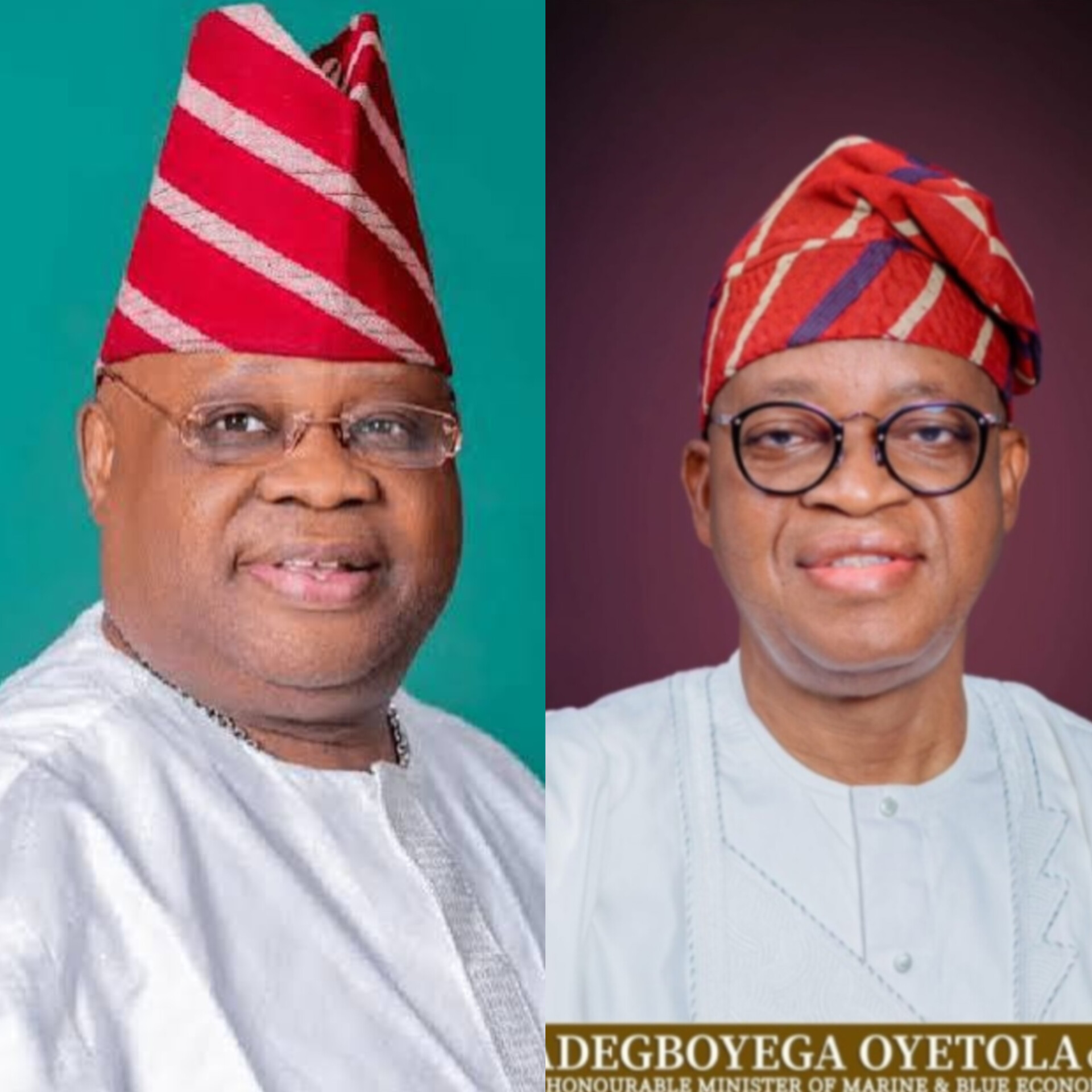
It was against this background that former Osun State Governor and Minister of Marine and Blue Economy, Adegboyega Oyetola, recently delivered what may well be one of the most revealing political observations of the season, albeit unintentionally.
While addressing supporters of the All Progressives Congress (APC) in Osun, Oyetola, intent on malicious shading, he took aim at Governor Ademola Adeleke’s endorsement of President Tinubu, suggesting that Adeleke could endorse Tinubu even a hundred times and still lose the forthcoming governorship election.
On the surface, it was another salvo in the fierce battle for Osun. But beneath the political taunt lies a much bigger question: If an endorsement is incapable of translating into votes, why has it become such a prized political weapon?
That is the paradox Oyetola may have inadvertently exposed. To be clear, Governor Adeleke has, in fact, repeatedly endorsed Tinubu for the 2027 presidential election while maintaining his political identity outside the APC. In March, he again reaffirmed his support for Tinubu, describing him as a leader of the South-West. In June, during the launch of his re-election campaign under the Accord platform, Adeleke again declared his support for Tinubu’s second-term bid.
Yet, according to Oyetola’s argument, none of that presidential endorsement should be confused with an endorsement of Adeleke by the Osun electorate. That distinction is important.
It strips the endorsement phenomenon of some of the political mystique that has surrounded it. For months, Nigerians have watched politicians and organisations line up to endorse Tinubu, sometimes with elaborate ceremonies, resolutions, communiqués and declarations.
The political theatre has been so intense that endorsement has increasingly appeared to carry a value of its own, almost as if publicly identifying with the President has become a form of political insurance.
But elections are not won by resolutions. They are won by voters, and this is where the Oyetola argument becomes unexpectedly instructive and apt; albeit un intentionally.
If Adeleke can endorse Tinubu and still be challenged by the APC for the Osun governorship, then the presidential endorsement cannot automatically be interpreted as an endorsement of the governor making it.
Conversely, if an APC candidate can campaign under the banner of loyalty to Tinubu, that loyalty alone cannot guarantee victory at the state level. The voter remains the missing factor in the endorsement arithmetic.
There is, however, another dimension that cannot be ignored. The politics behind the endorsement. Across the country, the endorsement of Tinubu has become intertwined with the larger realignment of Nigeria’s political structure ahead of 2027.
Politicians who were once firmly rooted in opposition camps have crossed over to the APC. Others have publicly declared support for Tinubu while technically remaining in their original political parties. EFCC identified public treasury looters, rogues standing trials and former state governors finds Tinubu’s endorsement, a security insurance against prosecution.
The phenomenon has generated competing interpretations. Supporters describe it as a rational recognition of Tinubu’s political strength, economic reforms and growing electoral prospects.
Critics, however, see something more transactional, a calculated attempt by politicians and organisations to position themselves favourably within the emerging power structure.
The controversy has been particularly pronounced around governors and political leaders outside the APC. Claims have circulated that some opposition-controlled states were subjected to political pressure to align with the Presidency, with defections and political realignments subsequently following.
Of course, there are schools of thoughts which believe that such claims remain politically contested and should not be treated as established fact without specific evidence.
But the very persistence of the allegation reveals something significant about Nigeria’s political environment: endorsement is no longer perceived merely as a statement of political preference. It is increasingly seen as a declaration of proximity to power.
That perception is perhaps the real story, when endorsement becomes political protection. In a political environment where access to the centre can determine the fortunes of state politicians, contractors, political organisations and influential individuals, an endorsement can become more than an electoral statement.
It can become a signal, a signal of alignment, a signal of loyalty. A signal that the individual or organisation does not intend to be found on the wrong side of the emerging political equation. This is where the endorsement culture becomes potentially dangerous to democratic politics.
If political actors begin endorsing not because they genuinely believe in a candidate’s programmes but because they fear the consequences of withholding support, then endorsement ceases to be a democratic expression.
Ultimately, it becomes a strategy of political survivalism, and that distinction matters. Democracy is supposed to allow citizens and political actors to make choices without fear. The value of an endorsement should therefore come from conviction, not compulsion; from persuasion, not intimidation; and from a genuine assessment of performance rather than an instinct for political self-preservation.
Ironically, it may have taken Oyetola, himself a leading APC figure and one of the principal actors in the Osun political contest some modicum of discomfort to puncture the inflated value being attached to presidential endorsement.
His message, stripped of the partisan rhetoric, was essentially simple: Endorsing Tinubu does not automatically transfer Tinubu’s electoral strength to the person making the endorsement.
That is a powerful proposition. It means Adeleke’s endorsement of Tinubu does not necessarily make Adeleke an APC politician. It does not automatically erase the rivalry between Adeleke and the APC. It does not eliminate the Osun electorate’s right to judge Adeleke on his performance.
And, importantly, it does not mean that those who endorse Tinubu have surrendered their independent political identities. Indeed, Adeleke’s case demonstrates the complexity of the emerging arrangement.
The governor has openly backed Tinubu while remaining politically opposed to Oyetola and the APC in the Osun governorship contest. Perhaps, this is precisely why Oyetola’s argument deserves attention beyond the immediate campaign exchange.
He may have been attacking Adeleke. But in doing so, he may also have exposed the hollowness of treating presidential endorsements as automatic electoral endorsements.
Nigeria may therefore be witnessing the birth of what could be described as an endorsement industrial complex — a political ecosystem in which groups compete to announce their allegiance to the most powerful political figure in the country.
The spectacle is already visible. One organisation endorses Tinubu, another follows, a political caucus issues a communiqué.
A group of professionals stages a solidarity rally, a faction of a political party makes another declaration; and then another group arrives to demonstrate that it supports the President even more strongly.
The race is no longer simply about who supports Tinubu. It increasingly appears to be about who can demonstrate the greatest loyalty to Tinubu. And that is where the political narrative becomes troubling. Because if endorsement becomes a competition in loyalty, then the substantive issues of governance risk being pushed to the background.
It kills the debate and the arguments about security, the competing visions for infrastructure, education, healthcare, industrialisation and poverty reduction.
Where are the measurable benchmarks against which Nigerians should assess the President? An election should not become a referendum on how many people can publicly proclaim loyalty to a political leader.
Oyetola’s most significant contribution to the endorsement debate may therefore be the reminder, perhaps unintended as already aforementioned, repeatedly, that Nigerian voters are not necessarily bound by the political declarations of their leaders.
A governor may endorse a president. A party may endorse a candidate. A traditional ruler may endorse a politician. A professional body may endorse an administration. But on election day, the individual voter still possesses the ballot.
That ballot can affirm the endorsement. It can reject it, or it can ignore it, completely. This is the paradox at the heart of the current Tinubu endorsement phenomenon.
The more endorsements accumulate, the more important it becomes to ask what they actually represent. Are they expressions of conviction? Are they strategic alliances? Are they political insurance? Are they attempts to secure access to power?
Or are they simply the traditional Nigerian political practice of standing close to whoever appears to possess the greatest concentration of power? Perhaps the answer is a little of everything.
But if Oyetola is right that Adeleke could endorse Tinubu a hundred times and still lose Osun, then one lesson deserves to be written boldly across the political landscape:
Endorsement is not a vote. And in a democracy, no amount of political choreography can ultimately substitute for the independent judgment of the electorate.
The 2027 presidential contest may eventually reveal how much electoral value all these endorsements actually contain. Until then, Oyetola’s seemingly partisan jab at Adeleke has inadvertently opened a much bigger question about Nigerian politics:
When did endorsement stop being about conviction and become a strategy for survival?









Nigeria’s Ports: How Foreign Capital Took the Dinner, While Indigenous Businesses Got the Crumbs (2)

Former Senatorial Candidate, Hajia Nike AbdulRahman Dumps NDC, Defects to APC

Nigeria’s Ports: How Foreign Capital Took the Dinner, While Indigenous Businesses Got the Crumbs

How Anani’s Tin Can Command Intercepted a ₦3.6 Billion Illicit Drug Shipment

Ibrahim, Ogun 1 Customs New Sheriff Unveils Strength Beneath His Quiet Mien

Logistics Synergy: NPA Advances Integration of ICDs Under New Reform Agenda

Teamwork, Discipline, Central to Our Enforcement Mandate —Jonah Charges Customs Marine Operatives

How the UAE-Nigeria Partnership Can Transform Our Ports

Cross River, FTZ Customs Gets New Impulse

CGC Adeniyi Signs Anti-Corruption Documents, Activates ICRAM Steering Committee

Nigeria Customs Marks Breast Cancer Awareness Month in Abuja

NIMASA To Host Webinars on Automation of Nigerian Ship Registry
ANLCA Board is intact, cannot be wished away by anybody’-Elochukwu

B-R-E-A-K-I-N-G: Effedua, Rector MAN Oron, Resigns

EFCC’s Probe: Okowa Plots Sheriff’s Removal Despite London Accord
Customs Trains ANLCA Members, Others on B’Odogwu Portal

NPA’s Alleged Executive Management Fight: The Half Truth & Truth

ANLCA Board Election: Know Your Candidates
‘Why We Launched B-Odogwu Pilot Scheme With Webb Fontaine Still Running’ – Adeniyi

Onyemekara Promoted GM, Appointed NPA’s New Spokesperson

Nigeria Customs: Trust, Competence And The Oramalugo Factor

‘Rush To Break News Can Lead To Brush With Cybercrime’- Police

Kebbi Is Hub of Hard Drugs Smuggling In Northern Region’ – Oramalugo

Apapa Customs Collects ₦161b On B’Odogwu Platform In 3 Weeks