
Analysis
Lagos-Calabar Highway: When a Presidential Legacy Project Collides with Accountability (2)

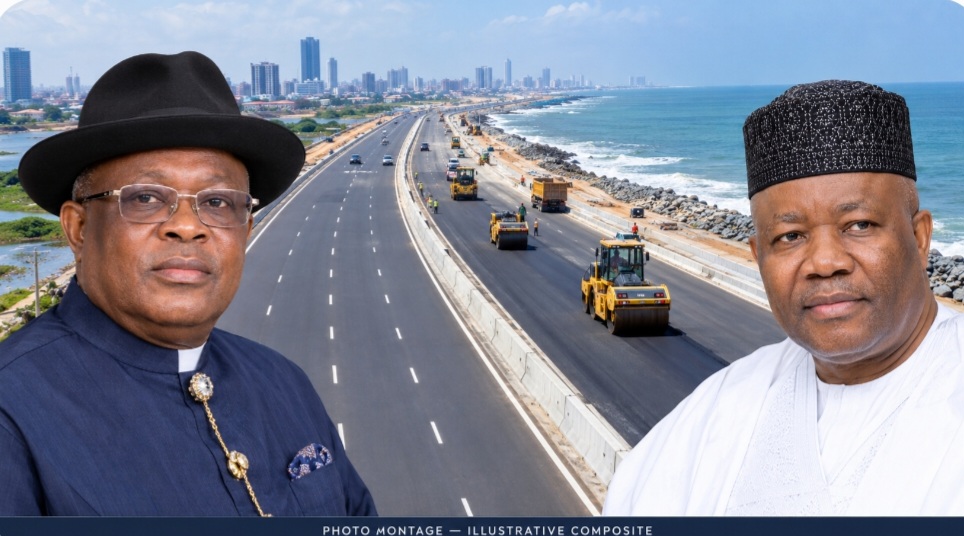
BY EGUONO ODJEGBA
The Lagos–Calabar Coastal Highway was conceived as a signature infrastructure undertaking of President Bola Ahmed Tinubu’s administration, promising improved connectivity and new economic opportunities along Nigeria’s southern corridor.
But the latest controversy surrounding the Ondo–Edo axis has placed a difficult governance question before the Federal Government: how should a government explain substantial changes to a politically prominent project when the public is already concerned about its cost, procurement and impact on existing investments?
The question became more pressing in October 2026 after Minister of Works David Umahi said the government would route part of the highway through the existing East–West Road instead of constructing a new alignment through the originally proposed corridor.
Unarguably professionally tested and competent, for a long while in our political space, this is the first time a professional is being assigned a professional political portfolio; and so far, many agree that Umahi has proven his mettle.
Speaking about the sudden challenge discovered along the initial route and on the new alignment, Umahi cited difficult terrain, unsuitable subsoil and flooding risks. He subsequently clarified that the coastal highway had not been discontinued, insisting that construction was continuing on several sections and that surveying and design work remained underway on others.
The ministry’s clarification is material. It means that describing the entire project as cancelled would misrepresent the available evidence. Yet the distinction between discontinuation and realignment does not resolve the questions about the original plan, the revised route and the decision-making process; as would be shortly examined.
The Problem Is The Quality Of Decision-Making
Large infrastructure projects inevitably encounter technical difficulties. Responsible governments must be prepared to revise designs when engineering evidence warrants it, as has duly been recognized.
But a project publicly promoted as a national legacy undertaking should be supported by equally robust systems of scrutiny. The more politically significant the project, the more important it becomes to demonstrate that professional advice, fiscal discipline and statutory procedures remain decisive.
If the original route encountered geological conditions that substantially altered the engineering calculations, the public deserves to know when those conditions were discovered, what investigations were conducted before construction, and why the original design was considered viable.
If the revision represents a prudent response to new information, the ministry should publish the evidence. If the initial studies failed to anticipate foreseeable conditions, the government should explain how the failure occurred and what safeguards will prevent a recurrence. Neither conclusion should be assumed in advance. This cannot be asking too much in an autocratic government, to mention a democratic, representative system.
Presidential Authority Does Not Replace Institutional Scrutiny
Umahi attributed the directive to use the existing East–West Road to President Tinubu. That explanation places the President directly within the chain of public accountability for the revised route.
A presidential directive may establish policy direction, but it does not eliminate the need for technical documentation, appropriate approvals, transparent procurement and legislative oversight.
The National Assembly has a legitimate role in scrutinizing public expenditure, financing arrangements and the government’s compliance with applicable procurement requirements. Professional engineers must establish whether the alternative route is technically defensible. Environmental authorities must ensure that the relevant assessments and approvals are completed. Public auditors must be able to reconcile expenditure with work delivered.
These safeguards are not obstacles to development. They are what protect a development project from becoming financially or environmentally unsustainable. The House of Representatives’ decision in May 2024 to investigate the procurement process demonstrated that concerns about the contract were already present.
The latest realignment controversy makes it more important to establish what the inquiry and other oversight processes have resolved, and what remains unanswered.
The Politics of Official Certainty
Public confidence can be weakened when government announcements appear definitive but are followed by explanations that alter public understanding of a project’s route, cost or scope.
The problem like already recognized, is not that a minister must never revise an earlier position. New engineering information can justify a change. The problem arises when citizens cannot easily determine which statement reflects the approved project, what has changed and what the consequences are.
A coherent public record should contain the original approved alignment, subsequent variations, the dates and authorities approving them, the reasons for each change and the implications for affected communities and contractors. These must form a consequential part of our database as a country seriously concerned about advancement in all ramifications.
This would allow public debate to move beyond competing political claims and social-media interpretations; in the face of the ensuing reluctance of the mainstream media to do so.
Communities Must Not Become Collateral To Political Ambition
The route controversy has also raised concerns among stakeholders in Ondo’s Ilaje coastal communities, who fear that an inland alignment could deprive them of the direct connectivity and economic opportunities initially associated with the project.
Their concerns deserve a documented response. The government should identify the communities that will be served, those that may be bypassed, and the alternative transport connections available to them.
A road’s success cannot be measured only by its length. It must also be assessed by the accessibility it creates, the businesses it supports and the distribution of its benefits.
The same standard applies to the economic interests affected in Lagos, where beachside enterprises and associated jobs were disrupted by the initial construction corridor.
Accountability Is Not Hostility To Government
A government confident in its engineering, procurement and financing decisions should be willing to submit them to scrutiny. The President and the Ministry of Works should publish a clear, consolidated account of the project, including the approved route, contractual and financing arrangements, expenditure to date, completed work, outstanding sections and reasons for all material design changes.
That disclosure would allow the public to judge the administration’s performance against evidence rather than rhetoric. It bears repeating that the Lagos–Calabar Coastal Highway may yet deliver substantial national benefits.
But its promise does not place it beyond public scrutiny, and its political importance cannot excuse gaps in explanation. The defining test of responsible governance is not whether a government can insist that its project remains intact.
It is whether it can show, transparently and convincingly, that the project is being delivered lawfully, competently and in the public interest.







Again, Customs FOU Zone ‘A’ Rescues Five Live Pangolins in Ogun State

Lagos-Calabar Highway: When a Presidential Legacy Project Collides with Accountability (2)
Lagos-Calabar Highway: Did Nigeria Pay the Price for Inadequate Planning?

ANLCA Airport Crisis: Police Raid Raises Questions Over IGP’s Respect For Court Orders

‘We Arrested Several Vessels Violating Cabotage Trade’ – NIMASA

Customs CGC Says ‘The World Is Connected, Not Borderless’

Nigeria Customs Mulls Reviews of Complaints Arising from Recruitment

Edo-Delta Journalists Forum Challenges Political Leaders on Regional Development

Nnadi Urges Nigerian Importers to Shift from Finished Goods to Manufacturing

WMD: Oyetola Recommit to Unlock CVFF Pursuant to Indigenous Operators Financing

Customs FOU Zone ‘A’ Hands Over Seized ₦511.4m Pharmaceuticals, Illicit Drugs to NDLEA, NAFDAC

Oyetola Unveils NPERA, Corporate Logo Amid Quiet Enthusiasm
ANLCA Board is intact, cannot be wished away by anybody’-Elochukwu

B-R-E-A-K-I-N-G: Effedua, Rector MAN Oron, Resigns

EFCC’s Probe: Okowa Plots Sheriff’s Removal Despite London Accord
Customs Trains ANLCA Members, Others on B’Odogwu Portal

NPA’s Alleged Executive Management Fight: The Half Truth & Truth

ANLCA Board Election: Know Your Candidates
‘Why We Launched B-Odogwu Pilot Scheme With Webb Fontaine Still Running’ – Adeniyi

Onyeka Makes History As Tin-Can Customs Hit ₦16.4bn A Day

Onyemekara Promoted GM, Appointed NPA’s New Spokesperson

Nigeria Customs: Trust, Competence And The Oramalugo Factor

Apapa Customs Collects ₦161b On B’Odogwu Platform In 3 Weeks

‘Rush To Break News Can Lead To Brush With Cybercrime’- Police