
Customs Report
Afeni’s Parting Query: Why Evade Duty on a ₦417m Range Rover?


BY EGUONO ODJEGBA
For Deputy Comptroller Olukayode Afeni, the seizure of a brand-new 2026 Range Rover Sport Autobiography P530, valued at about ₦417 million, was more than another addition to the seizure records of the Ogun I Area Command of the Nigeria Customs Service (NCS).
It was, in many respects, a fitting final statement from an officer whose tenure at the Idiroko border command has increasingly been defined by the difficult balance between aggressive enforcement, revenue protection, trade facilitation and engagement with border communities.
And as he prepared to step out of the command for a more likely higher responsibility, Afeni left the industry with a question that perhaps captured the central irony of the latest seizure.
“Why would somebody be able to buy a vehicle of this magnitude and still be unwilling to pay the duty?”
The question, which he posed while presenting the luxury SUV to journalists at the Command’s headquarters in Idiroko, barely a week ago was rhetorical. But it went to the heart of the enforcement challenge confronting Customs at Nigeria’s land borders.
The 2026 Range Rover Sport Autobiography P530, with a Duty Paid Value (DPV) of ₦417,011,982, was intercepted by his operatives as part of its recent anti-smuggling operations.
For Afeni, the seizure was difficult to reconcile with the value of the vehicle itself. His argument was straightforward: whoever could afford a luxury automobile worth hundreds of millions of naira should have little justification for attempting to circumvent the statutory obligations attached to its importation.
But beyond the rhetoric surrounding the vehicle, the seizure provided a dramatic closing chapter to a period in which the Ogun I Command under Afeni had sought to project itself not merely as an enforcement formation, but as a strategic border command with responsibilities extending from revenue collection to national security.
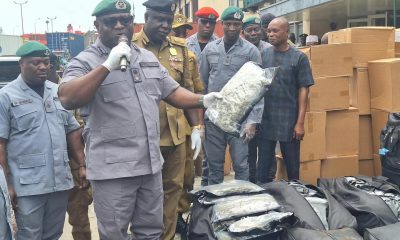
The Range Rover was only one component of that broader enforcement picture. Between August and September 2026, the Command recorded seizures comprising 1,204 bags of foreign parboiled rice, 3,893 parcels of Cannabis Indica weighing approximately 1.878 tonnes, 428 pneumatic tyres, 8,675 litres of Premium Motor Spirit (PMS), 24 bales of second-hand clothing, four sacks of used shoes and 500 litres of diesel.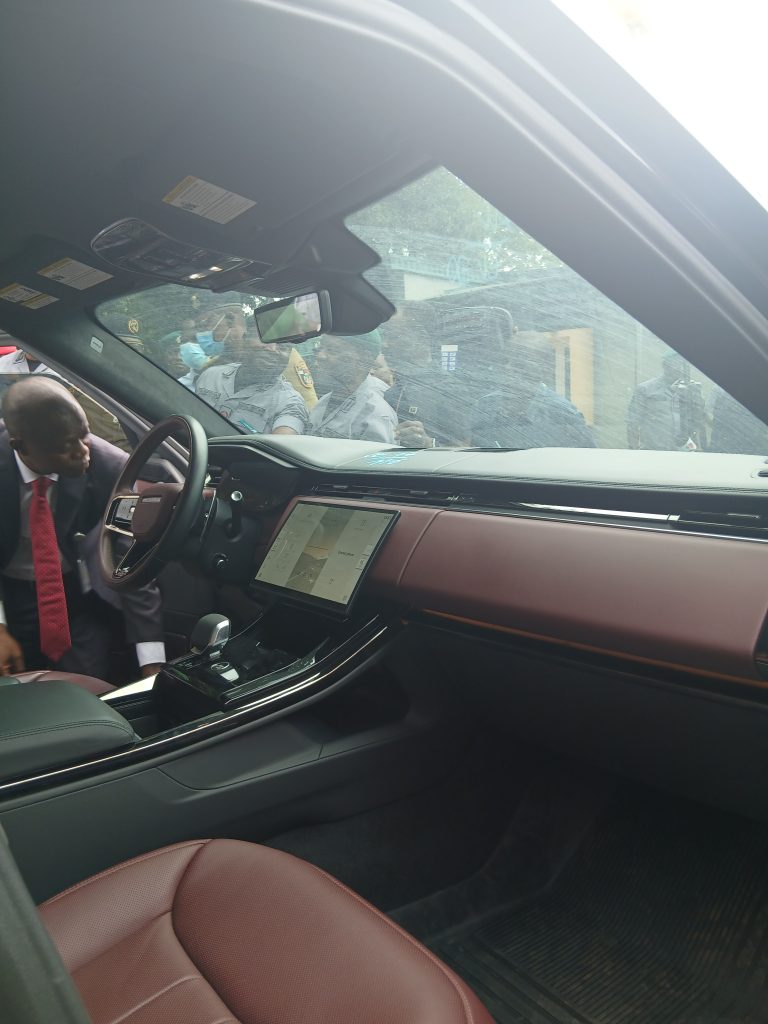
The total DPV of those seizures, excluding the separately highlighted Range Rover figure, was put at ₦2.469 billion. Taken together, the figures offered a snapshot of the range and complexity of the enforcement challenges confronting the Ogun border corridor.
There was the traditional smuggling of rice and petroleum products; prohibited and restricted commodities such as tyres and used clothing; narcotics trafficking; and, increasingly, high-value assets capable of translating customs violations into substantial revenue exposure.
It is in this context that the Range Rover seizure assumes particular significance. Unlike the stereotypical image of border smuggling involving low-value commodities moved in small quantities, the luxury SUV represented a different category of enforcement challenge; one in which a single improperly imported vehicle could carry a customs value running into hundreds of millions of naira.
For Afeni, therefore, the operation was not simply about taking another vehicle off the smuggling route. It was about demonstrating that the border enforcement net must remain capable of detecting sophisticated attempts to evade the country’s import regime, regardless of the value or profile of the commodity involved.
That position also defined the broader operational philosophy he articulated during his stewardship of Ogun I. While insisting that the Command would maintain a “zero-tolerance” posture towards smuggling and economic sabotage, Afeni repeatedly emphasised that legitimate trade remained welcome.
For all purposes and intent, that distinction is very important. The Command, under his watch, sought to combine physical examination and baggage assessment with import and export verification, intelligence-led operations and inter-agency cooperation.
The strategy brought the Command into closer operational collaboration with sister agencies, including the Nigerian Army, Nigeria Police Force, Nigeria Immigration Service and the National Drug Law Enforcement Agency (NDLEA).
The handover of the 3,893 parcels of Cannabis Indica seized during the latest operation to the NDLEA Idiroko Special Command further illustrated that approach.
The battle at the border, in other words, was not being treated solely as a Customs affair. For a corridor as sensitive as Ogun’s, the enforcement responsibility cuts across revenue protection, territorial security, narcotics control, immigration, trade regulation and community relations.
Afeni’s tenure also placed considerable emphasis on the latter. Thus, beyond seizures and revenue, the Command maintained engagement with traditional rulers, youth leaders and border community associations, recognising that sustainable enforcement at a land border cannot depend entirely on physical interception and patrols.
Such engagement was intended to deepen mutual understanding, reduce hostility and encourage cooperation with legitimate border communities.
That broader approach became particularly relevant in a corridor where the economic interests of border residents, legitimate traders and enforcement agencies often intersect and sometimes collide.
Yet, in the midst of all these critical mix, Afeni’s parting message is for all concerned to remain uncompromising on issues of compliance. A hardboiled anti-smuggling czar, he warned that the Ogun I corridor irrespective of who was in control would remain a hostile environment for uncustomed goods and illicit trade.
His words: “Ogun I Command will continue to be a hostile zone for uncustomed goods and illicit trade.”
It was a familiar enforcement refrain, but coming at the point of his departure, it also sounded like a summation of the operational philosophy he brought to the command.
For an officer who has spent the better part of the last several months combining field enforcement with administrative leadership, the Range Rover seizure offered an appropriate final exhibit.
It brought together several elements of the job: intelligence, interception, valuation, revenue protection, regulatory compliance and public accountability.
More importantly, it placed the human dimension of enforcement squarely before the public. A vehicle worth ₦417 million is not an ordinary seizure. It is a reminder that the economics of smuggling and duty evasion have evolved, and that border enforcement must evolve with them.
Afeni’s question, why spend hundreds of millions of naira on a luxury vehicle and then seek to evade the duty attached to it, would definitely linger beyond the seizure itself; which would also serve as his unique body language as he progresses in the Service’s leadership climb.
For the owner of the Range Rover, the answer may now have to be provided within the framework of Customs investigation and the applicable import regulations. For the Ogun I Command, however, the seizure represents another entry in a growing enforcement record.
And for Officer Afeni, it provides a fitting punctuation mark to his stewardship of the Idiroko corridor: an officer stepping out with a major seizure on display, a command record built around enforcement and revenue protection, and an operational footprint that demonstrates why experienced field officers are increasingly being called upon to shoulder responsibilities beyond the routine administration of a border post.
The next assignment, wherever it takes him, will determine the next chapter. But the ₦417 million Range Rover may well be remembered as Afeni’s parting exhibit from Ogun I—and no doubt, his most pointed parting query.





Customs CGC Says ‘The World Is Connected, Not Borderless’

Nigeria Customs Mulls Reviews of Complaints Arising from Recruitment

Edo-Delta Journalists Forum Challenges Political Leaders on Regional Development

Nnadi Urges Nigerian Importers to Shift from Finished Goods to Manufacturing

WMD: Oyetola Recommit to Unlock CVFF Pursuant to Indigenous Operators Financing

Customs FOU Zone ‘A’ Hands Over Seized ₦511.4m Pharmaceuticals, Illicit Drugs to NDLEA, NAFDAC

Oyetola Unveils NPERA, Corporate Logo Amid Quiet Enthusiasm

Nigeria, Benin Urged to Deploy Culture and Traditional Diplomacy to Defuse Border Tensions

Nigeria’s Ports: How Foreign Capital Took the Dinner, While Indigenous Businesses Got the Crumbs (3)

FOU Zone A, Police, Army, DSS, Others Strengthen Security Alliance Ahead of Elections

Nigeria’s Ports: How Foreign Capital Took the Dinner, While Indigenous Businesses Got the Crumbs (2)

Former Senatorial Candidate, Hajia Nike AbdulRahman Dumps NDC, Defects to APC

ANLCA Board is intact, cannot be wished away by anybody’-Elochukwu

B-R-E-A-K-I-N-G: Effedua, Rector MAN Oron, Resigns

EFCC’s Probe: Okowa Plots Sheriff’s Removal Despite London Accord
Customs Trains ANLCA Members, Others on B’Odogwu Portal

NPA’s Alleged Executive Management Fight: The Half Truth & Truth

ANLCA Board Election: Know Your Candidates
‘Why We Launched B-Odogwu Pilot Scheme With Webb Fontaine Still Running’ – Adeniyi

Onyemekara Promoted GM, Appointed NPA’s New Spokesperson

Onyeka Makes History As Tin-Can Customs Hit ₦16.4bn A Day

Nigeria Customs: Trust, Competence And The Oramalugo Factor

‘Rush To Break News Can Lead To Brush With Cybercrime’- Police

Apapa Customs Collects ₦161b On B’Odogwu Platform In 3 Weeks