
Business Maritime
NPERA: Akutah Urge Gradual Transition, Warns Against Draconian Enforcement


BY EGUONO ODJEGBA
The Director General of the Nigerian Ports Economic Regulatory Agency (NPERA), Dr Pius Akutah, has called for strategic leadership, financial sustainability and a gradual, stakeholder-driven implementation of the agency’s new regulatory powers, warning that hasty enforcement could disrupt port operations and undermine confidence in the emerging regulatory framework.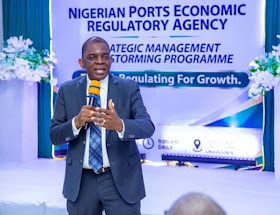
Akutah said the transition from the Nigerian Shippers’ Council (NSC) to NPERA must go beyond a change of name to a fundamental institutional transformation capable of addressing longstanding complaints about high port charges, service failures and the weak competitiveness of Nigeria’s maritime sector.
He gave the charge at the opening of a three-day Strategic Management Brainstorming Programme in Lagos, where management staff gathered to examine the NPERA Act, determine the agency’s institutional structure and establish strategic priorities for its operations.
The programme, themed “Regulating for Growth,” brought together directors, deputy directors and assistant directors to chart a roadmap for the full implementation of the new regulatory framework.
Akutah, who described the transition as already underway following the President’s assent to the NPERA Act, said the agency must exercise its expanded powers with wisdom and allow port operators and other government institutions sufficient time to understand the new requirements and adjust their systems.
“If we don’t give them the time to reset their systems, we are going to be draconian,” he cautioned, urging management staff to avoid aggressive enforcement and confrontational communication at this stage of the transition.
“We don’t have to start writing strong-lettered words. Let us be careful at this moment in our dealings with these people,” he said, noting that stakeholders were already apprehensive about the emergence of the new regulator.
He maintained that the objective was not to create friction with existing institutions but to establish an effective regulatory system through consultation, cooperation and a clear understanding of the agency’s statutory responsibilities.
“Wisdom is profitable. So, we have to continue to apply this law with wisdom and also carry them along so that everybody is with us on the same stage as we progress,” Akutah said.
He further clarified that policy communication would remain the responsibility of the Minister of Marine and Blue Economy, Dr Adegboyega Oyetola, CON, stressing that the agency must operate within the established policy framework while engaging stakeholders on implementation.
The NPERA chief executive said the transition required a new institutional mindset, stronger operational processes and deliberate planning to ensure that the agency’s expanded regulatory mandate translates into measurable improvements across the port industry.
He charged management staff to build a financially sustainable, professionally driven, technologically enabled and operationally efficient regulator, warning that without adequate financial strength, NPERA would struggle to sustain reforms, deploy technology and deliver effective economic regulation.
“Without financial sustainability, the Agency cannot drive reforms, deploy technology or sustain effective regulation of the nation’s port sector,” he said.
Akutah urged participants to identify sustainable revenue streams, improve operational efficiency and pursue value creation while ensuring continuity in service delivery and protecting the interests of the workforce.
He also stressed the need for a clear succession plan to guarantee institutional stability beyond the tenure of the present leadership, describing management staff as critical to the agency’s long-term success.
The brainstorming session, he explained, would examine the legal and institutional frameworks underpinning NPERA, including its organisational structure, organogram, the relationship between the board, management and staff, and the functions and operational systems to be carried forward from the former Shippers’ Council.
He said the exercise would also clarify the responsibilities of stakeholders under the new regulatory regime and mark the beginning of the work of the Transition Implementation Committee.
Akutah identified the immediate priorities as preventing regulatory gaps, strengthening stakeholder confidence, protecting the workforce and establishing a clear framework for the agency’s operations.
He disclosed that both the Ministry of Marine and Blue Economy and NPERA had established transition implementation committees to facilitate the smooth adoption of the new regulatory framework.
The DG/CEO said the new law was designed to address persistent complaints about service failures and the high cost of doing business at Nigerian ports, adding that the agency had begun internal activities to tackle the challenges and would engage stakeholders on its regulatory plans.
He emphasised that NPERA’s expanded mandate includes investigation and enforcement powers, which would require stronger institutional and legal capacity, particularly as the agency prepares for possible litigation arising from the implementation of the Act.
The agency’s legal department, he said, must be adequately prepared to handle disputes that may arise as the new regulatory framework takes effect.
Akutah also disclosed that the National Assembly had invited the agency to brief lawmakers on its activities since the President assented to the NPERA Act about three months ago.
According to him, the legislature is particularly interested in how the new regulatory regime would translate into reduced port charges, lower business costs and cheaper goods for consumers.
He said the agency would outline its progress and further implementation steps during the engagement with lawmakers. The NPERA chief executive reiterated that the agency would be judged by its ability to deliver on its statutory mandate, promote efficiency, encourage competition and create an enabling environment for sustainable growth in the port industry.
The transition, he said, must ultimately establish a credible and effective regulator capable of improving service delivery and strengthening Nigeria’s position as a competitive maritime and trade hub.












NPERA: Akutah Urge Gradual Transition, Warns Against Draconian Enforcement

Customs Takes War on Smuggling to TV as ‘Novara’

Nwala Moves to Turn Customs Command into Engine of Trade, Revenue Growth

How Quiet Grace, Steel Resolve and Record Results Crowned Joseph Anani Acting ACG

Two Customs Officers’ Secure Key WCO Technical Appointments, International Accreditation

Blue Economy: South-South Governors Face Investment Blueprint Challenge

Waterways Transportation: How State Neglect Turned Cheapest Transit Into Luxury

Customs New Intakes Training Put On-hold As Service, FCC Furthers Consultation
WPRF 2026 Delegates Left Nigeria Highly Impressed – Adeniyi

Seme: How Acting ACG Abdullahi Shuaibu Kaila Redefined Border Grit and Revenue Velocity

2027: South-South Governors Under Fire Over Neglect of Vast Blue Economy Potentials

Nigeria, Russia Strengthens Customs Cooperation on Trade Facilitation, Information Exchange

ANLCA Board is intact, cannot be wished away by anybody’-Elochukwu

B-R-E-A-K-I-N-G: Effedua, Rector MAN Oron, Resigns

Onyeka Makes History As Tin-Can Customs Hit ₦16.4bn A Day

EFCC’s Probe: Okowa Plots Sheriff’s Removal Despite London Accord

FOU Zone A Intercepts Drugs Worth Over ₦5.5Bn

Customs Trains ANLCA Members, Others on B’Odogwu Portal

NPA’s Alleged Executive Management Fight: The Half Truth & Truth

Again, Apapa Port Command Intercepts Cannabis Indica Worth ₦26.5b

ANLCA Board Election: Know Your Candidates

Apapa Customs Collects ₦161b On B’Odogwu Platform In 3 Weeks

‘Why We Launched B-Odogwu Pilot Scheme With Webb Fontaine Still Running’ – Adeniyi

Customs, NAFDAC, Strengthen Inter-Agency Ties with Landmark ₦20.5bn Drug Bust in Onne