Business Maritime
Policy Interventions Key to Nigeria’s Maritime Future — Capt. Warredi

By KESIENNA SHEPHERDS
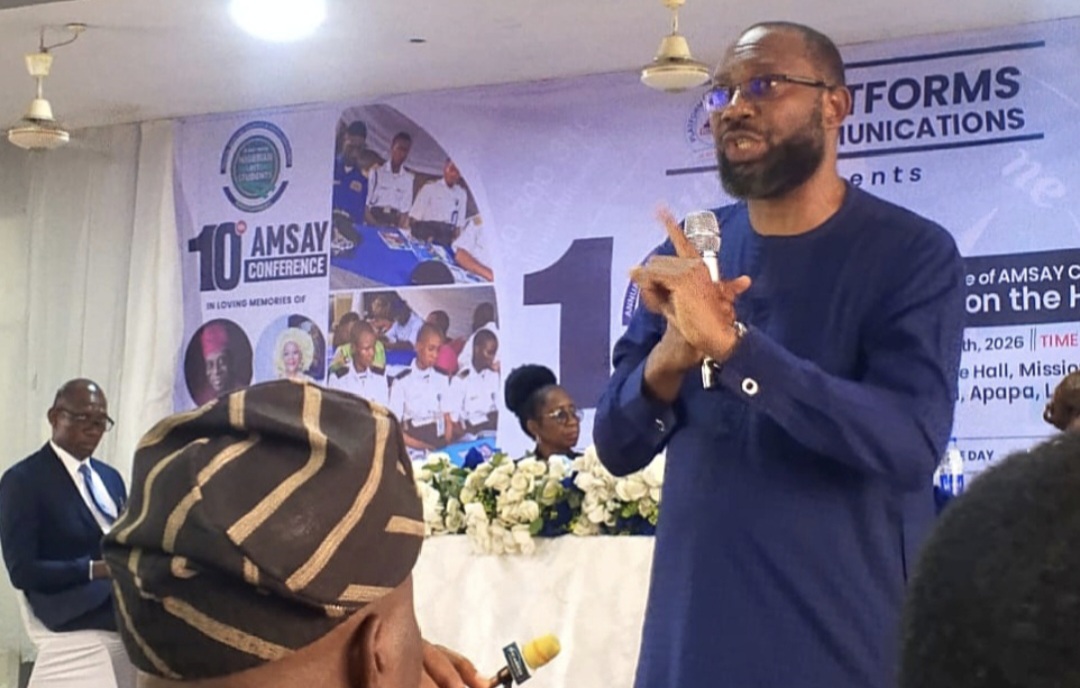
Nigeria’s maritime industry risks falling further behind global competitors unless urgent policy interventions are implemented to address deep-rooted structural challenges, the Executive Director of Operations and Technical, Tantita Security Services Nigeria Limited (TSSNL), Captain Warredi Enisuoh has warned.
Speaking at the 10th AMSAY Conference organised by Platform Communications, on the theme: “A Decade of AMSAY Conference: Eyes on the Horizon”, Enisuoh identified infrastructure deficits, regulatory weaknesses, environmental risks, skills shortages, and financial constraints as critical barriers stifling Nigeria’s maritime growth. He stressed that without decisive reforms, Nigeria’s participation in global trade and maritime security will remain fragile.
Enisuoh underscored the strategic importance of ship ownership, noting that nations with strong fleets enjoy both economic and defense advantages. “While some countries can convert cargo ships into warships within an hour, Nigeria lacks such privileges due to its absence of indigenous fleets,” he said, warning that this gap undermines national security and economic resilience.
He pointed to China as a model, highlighting how the Asian giant’s dominance in carrying its own cargo strengthens both its maritime capacity and defense posture. Nigeria, by contrast, remains dependent on foreign carriers, leaving its trade vulnerable and its seafarers disadvantaged.
Despite improvements in maritime security, Enisuoh lamented that Nigerian seafarers continue to face unemployment and certificate discrimination in the global shipping market. He attributed this to limited indigenous shipping capacity and insufficient international recognition of Nigerian maritime certifications. He urged the government to pursue mutual certificate recognition agreements with leading maritime nations to expand employment opportunities for Nigerian professionals.
To correct Nigeria’s course, Enisuoh recommended a suite of policy initiatives, including:
-Integrated planning to align national maritime goals with global standards.
-Infrastructure investment in ports, shipyards, and logistics hubs.
-Institutional reforms to strengthen regulatory oversight and eliminate inefficiencies.
-Education and training to build a skilled workforce and enhance certificate recognition.
-Technology adoption to modernize operations and improve competitiveness, and
-Sustainability measures to mitigate environmental risks and align with global green shipping standards.
The erudite maritime security expert noted that building indigenous shipping capacity is not merely an economic necessity but a matter of national survival in an increasingly volatile global environment.
“Nigeria must act quickly to correct its course and align with global best practices in maritime security and logistics,” he said.













Customs CGC Says ‘The World Is Connected, Not Borderless’

Nigeria Customs Mulls Reviews of Complaints Arising from Recruitment

Edo-Delta Journalists Forum Challenges Political Leaders on Regional Development

Nnadi Urges Nigerian Importers to Shift from Finished Goods to Manufacturing

WMD: Oyetola Recommit to Unlock CVFF Pursuant to Indigenous Operators Financing

Customs FOU Zone ‘A’ Hands Over Seized ₦511.4m Pharmaceuticals, Illicit Drugs to NDLEA, NAFDAC

Oyetola Unveils NPERA, Corporate Logo Amid Quiet Enthusiasm

Nigeria, Benin Urged to Deploy Culture and Traditional Diplomacy to Defuse Border Tensions

Nigeria’s Ports: How Foreign Capital Took the Dinner, While Indigenous Businesses Got the Crumbs (3)

FOU Zone A, Police, Army, DSS, Others Strengthen Security Alliance Ahead of Elections

Nigeria’s Ports: How Foreign Capital Took the Dinner, While Indigenous Businesses Got the Crumbs (2)

Former Senatorial Candidate, Hajia Nike AbdulRahman Dumps NDC, Defects to APC
ANLCA Board is intact, cannot be wished away by anybody’-Elochukwu

B-R-E-A-K-I-N-G: Effedua, Rector MAN Oron, Resigns

EFCC’s Probe: Okowa Plots Sheriff’s Removal Despite London Accord
Customs Trains ANLCA Members, Others on B’Odogwu Portal

NPA’s Alleged Executive Management Fight: The Half Truth & Truth
ANLCA Board Election: Know Your Candidates
‘Why We Launched B-Odogwu Pilot Scheme With Webb Fontaine Still Running’ – Adeniyi

Onyemekara Promoted GM, Appointed NPA’s New Spokesperson

Nigeria Customs: Trust, Competence And The Oramalugo Factor

Onyeka Makes History As Tin-Can Customs Hit ₦16.4bn A Day

‘Rush To Break News Can Lead To Brush With Cybercrime’- Police

Kebbi Is Hub of Hard Drugs Smuggling In Northern Region’ – Oramalugo