
Analysis
Maritime Justice and the Cost of Trade


What Did the 18th Judges’ Seminar Leave on the Table?
A post-seminar appraisal of Nigeria’s maritime jurisprudence against emerging IMO, WTO and UNCITRAL standards.
BY EGUONO ODJEGBA
The 18th International Maritime Seminar for Judges, held in Abuja from July 22 to 24, 2026, provided another important platform for the Nigerian judiciary and maritime stakeholders to examine the legal foundations of the country’s maritime economy.
Organised by the Nigerian Shippers’ Council (NSC) and the National Judicial Institute (NJI), the seminar brought together senior judicial officers, maritime administrators, lawyers, arbitrators and industry stakeholders, with discussions focusing on faster admiralty justice, alternative dispute resolution, digital shipping, autonomous vessels, port regulation and inter-agency cooperation.
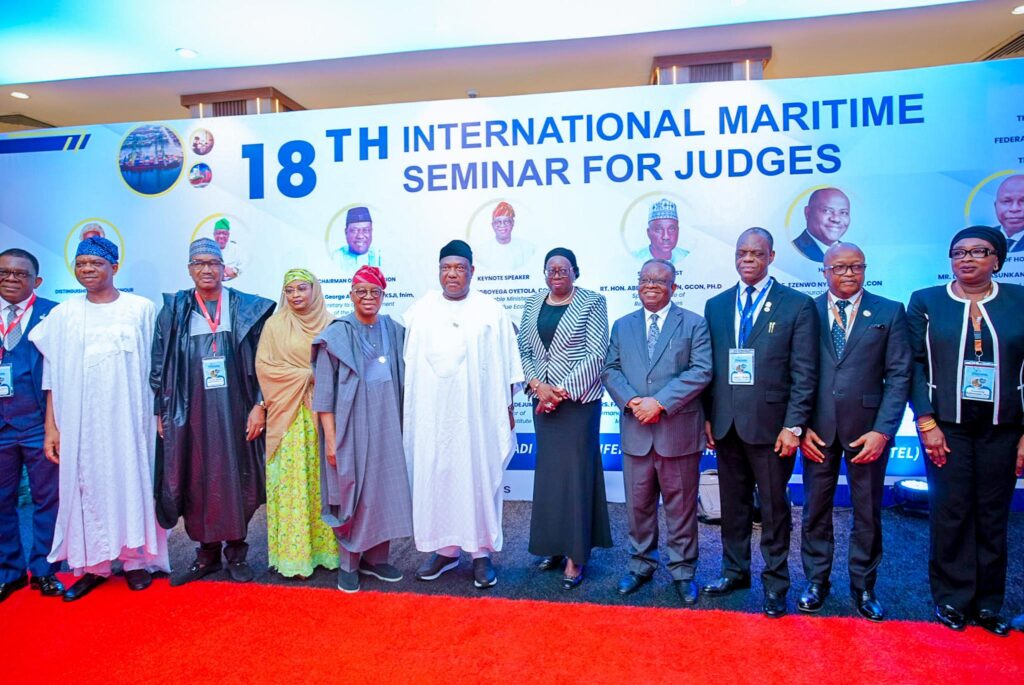
L-R: Executive Secretary/CEO of Nigerian Shippers’ Council (NSC), Dr. Pius Akutah; Deputy Chief Whip of the House of Representatives, Hon. Ibrahim Ayokunle Isiaka; Chairman of NSC Governing Board, Dr. Ibrahim Shehu Shema; Permanent Secretary, Federal Ministry of Marine and Blue Economy, Mrs. Fatima Mahmood; Minister of Marine and Blue Economy, Dr. Adegboyega Oyetola; Secretary to the Government of the Federation, Senator George Akume; Chief Justice of Nigeria, Justice Kudirat Kekere-Ekun, and other dignitaries at the 18th International Maritime Seminar for Judges organised by the Nigerian Shippers’ Council and the National Judicial Institute in Abuja, on Wednesday.
The interventions were timely. But viewed against the pace of change in international shipping and trade facilitation, the seminar also raises a broader business question: Is Nigeria’s maritime jurisprudence evolving quickly enough to support the country’s ambition to become a competitive regional maritime and logistics hub?

L-R: Secretary to the Government of the Federation, Senator George Akume (left) and the Minister of Marine and Blue Economy, Dr. Adegboyega Oyetola, at the 18th International Maritime Seminar for Judges organised by the Nigerian Shippers’ Council and the National Judicial Institute in Abuja, on Wednesday.
The question is significant because maritime justice is not isolated from the business of shipping. A delayed judgment can mean a detained vessel; a detained vessel can disrupt cargo schedules; cargo delays generate demurrage and storage charges; prolonged detention can cause cargo deterioration and financing losses. Ultimately, the cost is transferred through the supply chain to businesses and consumers.
The emerging international framework therefore suggests that the quality of maritime justice should be measured not only by how quickly courts dispose of cases, but also by how effectively the legal system reduces uncertainty and transaction costs in maritime commerce.
Beyond Faster Admiralty Justice
The Chief Justice of Nigeria, Justice Kudirat Kekere-Ekun, and the Minister of Marine and Blue Economy, Adegboyega Oyetola, both stressed the importance of timely and specialised maritime justice.
That is fundamental. But Nigeria’s maritime jurisprudence must now move from a predominantly dispute-resolution orientation towards a broader trade-facilitation and commercial certainty framework.
The IMO’s Maritime Autonomous Surface Ships (MASS) Code, which took effect on July 1, 2026, is an indication of how rapidly maritime regulation is changing. The international conversation now extends beyond conventional questions of collision and seaworthiness to software, remote operations, cybersecurity, artificial intelligence, data integrity and human oversight.
Nigeria’s courts will eventually have to determine liability where an autonomous vessel’s navigation system fails, where a cyberattack causes a collision, or where responsibility is divided between a shipowner, remote operator, software provider and equipment manufacturer.
These questions require more than conventional admiralty principles. They require a deliberate national framework for technology-driven maritime jurisprudence.
Digital Cargo Documentation and The Law
Digitalisation presents another major area for legal development. The Minister’s reference to electronic bills of lading and blockchain-enabled cargo documentation was particularly relevant. However, the business implications go beyond the acceptance of electronic records as evidence.
The bill of lading is a commercial instrument that can represent control over cargo and facilitate its transfer and financing. As shipping moves from paper to digital records, Nigerian law must clearly determine what constitutes possession, transfer, endorsement and control of an electronic transferable record.
UNCITRAL’s Model Law on Electronic Transferable Records provides an international framework for electronic equivalents of documents such as bills of lading and warehouse receipts.
Nigeria’s maritime legal system therefore needs to consider whether existing legislation sufficiently accommodates electronic transferable records, cross-border digital documentation and electronic signatures. Without such clarity, Nigerian businesses may continue to depend on foreign legal regimes and dispute-resolution centres for transactions that are ultimately connected to Nigerian cargo.
The Maritime Single Window and Agency Accountability
Perhaps one of the most important issues arising from the NSC’s presentation is the relationship between inter-agency coordination and legal accountability. NSC Executive Secretary, Dr Pius Akutah, rightly identified poor coordination among Customs, NPA, NIMASA, SON, NAFDAC and security agencies as a source of cargo delays, damage, demurrage and storage costs.
The international benchmark is already moving in this direction. The IMO’s Maritime Single Window became mandatory in 2024, while the WTO Trade Facilitation Agreement promotes electronic processing, risk management, border-agency cooperation, pre-arrival processing and faster release of goods.
Nigeria’s challenge, therefore, is not simply to encourage agencies to cooperate. The legal system must determine what happens when failure to cooperate causes economic loss.
If Customs places a hold on cargo for an extended period, while terminal storage and shipping-line detention charges continue to accumulate, who ultimately bears the cost? If one agency’s intervention prevents a container from being released despite compliance with the requirements of another agency, what remedy is available to the cargo owner?
These questions deserve clearer jurisprudential treatment because they directly affect the cost and competitiveness of Nigerian trade.
Demurrage And the Economics of Delay
Demurrage, detention and storage remain among the most contentious commercial issues in Nigeria’s port system. A more mature maritime jurisprudence should distinguish between delay caused by an importer, shipping line, terminal operator, government agency, port congestion, digital-system failure or court process.
The essential principle should be predictable allocation of responsibility. Where a cargo owner is responsible for delay, contractual charges may be justified. But where the delay is demonstrably caused by regulatory intervention or an institutional failure outside the cargo owner’s control, the legal system should provide clear remedies. This is not simply a contractual matter. It is a cost-of-trade issue.
Reducing avoidable demurrage and storage liabilities can improve the competitiveness of Nigerian ports just as effectively as physical infrastructure investment.
Port Economic Regulation and Competition
The discussion around the proposed Nigerian Port Economic Regulatory Agency (NPERA) Bill is therefore particularly important. Nigeria’s port concession regime requires a clear legal balance between government, terminal operators, shipping companies, cargo interests and other service providers.
Investors require regulatory certainty, but port users equally require protection against arbitrary charges, discriminatory treatment and abuse of market power. A modern port economic regulatory framework should therefore address tariffs, competition, access to infrastructure, service standards, concession obligations, transparency, investor protection and effective appeal mechanisms.
The issue should not be whether terminal operators or port users are protected at the expense of the other. The objective should be fair competition and predictable commercial relationships.
Cargo Liability and Multimodal Transportation
The internationalisation of logistics also demands a review of Nigeria’s cargo-liability jurisprudence. A container may arrive from Asia through Lagos and continue by road or rail to an inland destination. If the cargo is damaged somewhere along that journey, the legal questions can become complicated.
Which carrier is liable?
Which limitation regime applies?
Where did the loss occur?
Which court has jurisdiction?
How should a through bill of lading be interpreted?
These issues become increasingly important as Nigeria develops its ports, inland dry ports, rail connections and regional trade corridors. The Rotterdam Rules, developed under UNCITRAL to modernise the legal framework for international carriage of goods wholly or partly by sea, provide an important reference point. Nigeria signed the convention in 2009 but has not ratified it.
The continued fragmentation of cargo-liability rules is an issue that merits renewed legislative and judicial consideration.
Arbitration, Finance and Investor Confidence
The seminar’s emphasis on alternative dispute resolution is also significant. If Nigeria wants to attract international shipping companies, investors, insurers and financiers, it must make its maritime arbitration environment commercially competitive.
That includes effective emergency relief, enforcement of awards, interim measures, vessel arrest in support of arbitration, recognition of foreign awards and predictable treatment of arbitration clauses in shipping contracts.
The same principle applies to maritime finance. Investors and banks need confidence in the enforceability of ship mortgages, maritime liens, judicial sales, insurance claims and other maritime security interests.
A weak enforcement environment increases financing risk and, consequently, the cost of shipping.
Environmental, Cyber and Blue-Economy Jurisprudence
The Minister’s warning that decarbonisation and the expanding blue economy will create new disputes is also significant. Nigeria’s emerging offshore energy, aquaculture, seabed resources and coastal tourism sectors will require legal certainty over environmental liability, marine spatial use, offshore installations, pollution, alternative fuels and coastal-community interests.
Cybersecurity should receive similar attention. As ports, vessels, cargo documentation and regulatory processes become digital, cyber incidents can directly affect cargo and commercial continuity. Nigerian jurisprudence will increasingly need to deal with ransomware, electronic fraud, compromised bills of lading, AIS manipulation, cyber insurance and liability for digital infrastructure failures.
A Practical Post-Seminar Agenda
The 18th Seminar should therefore be followed by a practical programme involving the judiciary, NSC, Federal Ministry of Marine and Blue Economy, National Assembly and industry stakeholders.
Priority areas should include:
A comprehensive review of maritime legislation and obsolete provisions.
Specialised and expedited maritime case-management procedures.
Clear principles for government-caused cargo delays and resulting charges.
Legal recognition and enforcement of electronic bills of lading.
A national legal framework for autonomous and remotely operated ships.
Standards for digital maritime evidence and cybersecurity.
Judicial guidelines for Customs and regulatory cargo disputes.
A coherent framework for port economic regulation and competition.
Modernisation of Nigeria’s multimodal cargo-liability regime.
Strengthening maritime arbitration and enforcement of awards.
Review of Nigeria’s position on the Rotterdam Rules.
Clearer jurisprudence on maritime insurance, liens, mortgages and judicial sale.
Environmental and blue-economy dispute frameworks.
Stronger legal protection for seafarers and the human element.
An annual assessment of maritime justice, measuring case duration, cargo disputes, vessel arrests, enforcement and the commercial impact of judicial delays.
From Maritime Justice to Trade Competitiveness
The 18th International Maritime Seminar has reinforced the importance of specialised maritime justice. But its larger opportunity is to redefine the relationship between law and trade competitiveness.
Nigeria does not merely need courts capable of resolving maritime disputes. It needs a legal environment in which disputes are resolved quickly, regulatory decisions are predictable, cargo moves efficiently and investors can assess risk with confidence.
The IMO is advancing autonomous shipping and digital maritime administration. The WTO is promoting trade facilitation through simplified border procedures, electronic processing and agency cooperation. UNCITRAL is developing legal frameworks for digital commercial documents and modern carriage of goods.
Nigeria must therefore ensure that its maritime jurisprudence does not remain anchored to the disputes of yesterday while the commerce of tomorrow moves elsewhere.
The real measure of success should ultimately be simple:
Can a shipowner, cargo owner, financier or investor conduct business through a Nigerian port with confidence that the law is clear, the regulator accountable, the courts responsive and the cost of delay predictable?
That is the point at which maritime justice ceases to be merely a legal service and becomes what it ought to be — an essential component of Nigeria’s trade infrastructure and blue-economy competitiveness.











Oyetola Unveils NPERA, Corporate Logo Amid Quiet Enthusiasm

Nigeria, Benin Urged to Deploy Culture and Traditional Diplomacy to Defuse Border Tensions

Nigeria’s Ports: How Foreign Capital Took the Dinner, While Indigenous Businesses Got the Crumbs (3)

FOU Zone A, Police, Army, DSS, Others Strengthen Security Alliance Ahead of Elections

Nigeria’s Ports: How Foreign Capital Took the Dinner, While Indigenous Businesses Got the Crumbs (2)

Former Senatorial Candidate, Hajia Nike AbdulRahman Dumps NDC, Defects to APC

Nigeria’s Ports: How Foreign Capital Took the Dinner, While Indigenous Businesses Got the Crumbs

How Anani’s Tin Can Command Intercepted a ₦3.6 Billion Illicit Drug Shipment

Ibrahim, Ogun 1 Customs New Sheriff Unveils Strength Beneath His Quiet Mien

Logistics Synergy: NPA Advances Integration of ICDs Under New Reform Agenda

Teamwork, Discipline, Central to Our Enforcement Mandate —Jonah Charges Customs Marine Operatives

How the UAE-Nigeria Partnership Can Transform Our Ports

ANLCA Board is intact, cannot be wished away by anybody’-Elochukwu

B-R-E-A-K-I-N-G: Effedua, Rector MAN Oron, Resigns

EFCC’s Probe: Okowa Plots Sheriff’s Removal Despite London Accord

Customs Trains ANLCA Members, Others on B’Odogwu Portal

NPA’s Alleged Executive Management Fight: The Half Truth & Truth
ANLCA Board Election: Know Your Candidates
‘Why We Launched B-Odogwu Pilot Scheme With Webb Fontaine Still Running’ – Adeniyi

Onyemekara Promoted GM, Appointed NPA’s New Spokesperson

Nigeria Customs: Trust, Competence And The Oramalugo Factor

‘Rush To Break News Can Lead To Brush With Cybercrime’- Police

Kebbi Is Hub of Hard Drugs Smuggling In Northern Region’ – Oramalugo

Onyeka Makes History As Tin-Can Customs Hit ₦16.4bn A Day