
Business Maritime
Nnadi Urges Nigerian Importers to Shift from Finished Goods to Manufacturing

Warns of AfCFTA’s Potential Threats Should Nigeria Fail To Embrace Local Production
BY KESIENNA SHEPHERDS
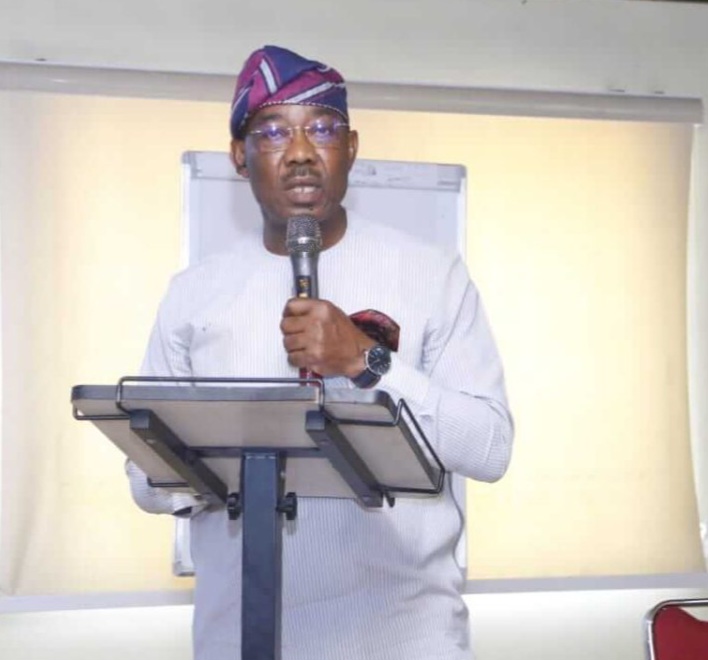
A retired Deputy Comptroller General of Customs, Dera Nnadi mni, has urged Nigerian importers to pivot from importing finished products to sourcing raw materials for local assembly, manufacturing, and export across the continent.
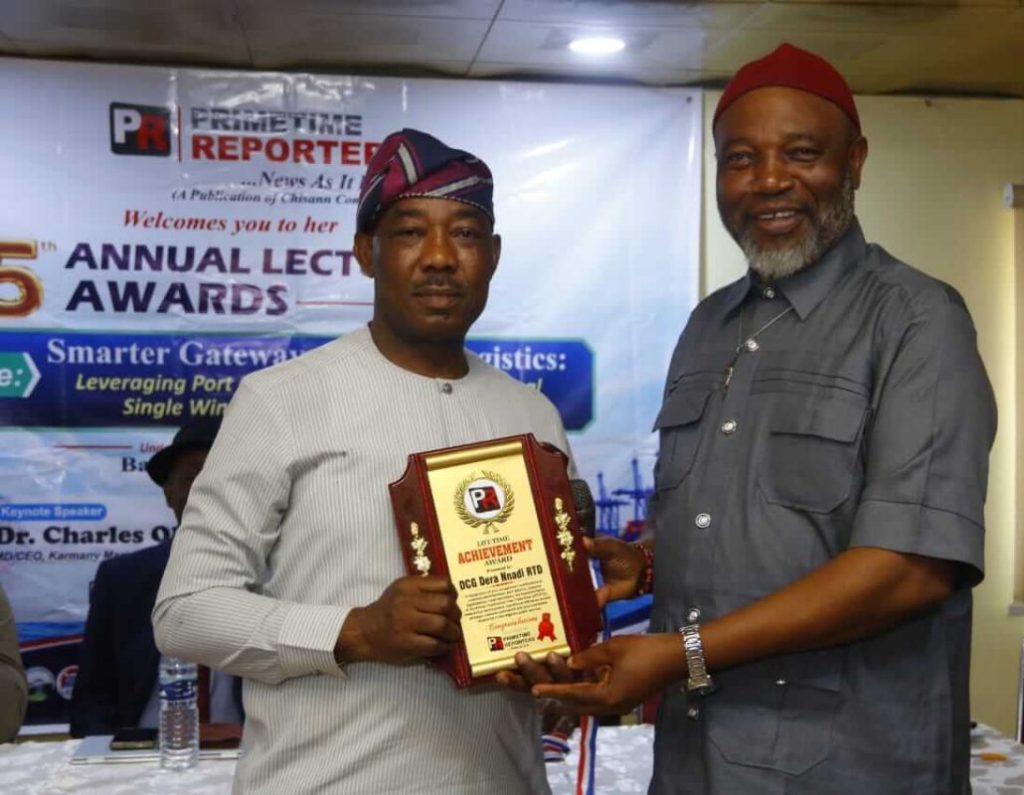
Photo Caption 2: Dr. Eugene Nweke, Head of Research, Sea Empowerment Research Centre (right) presenting the Lifetime Achievement Award to DCG Dera Nnadi (Rtd) at the event on Thursday.
Nnadi warned that Nigeria’s continued reliance on foreign finished goods could undermine the businesses of local importers, freight forwarders, and clearing agents as the African Continental Free Trade Area (AfCFTA) reshapes trade dynamics across Africa.
He made the call while delivering a presentation at the 5th Annual Lecture and Awards Ceremony organized by Primetime Reporters at the Rockview Hotel, GRA, Apapa, Lagos.
According to Nnadi, Nigerian traders must anticipate shifts in regional trade patterns and reposition their operations to remain competitive in the evolving African market. He explained that goods produced within African nations that satisfy AfCFTA’s rules of origin and local-content requirements will enjoy preferential tariff treatment, making them significantly more attractive to importers than products sourced from outside the continent.
“If I import from China, I will pay duty. If I import from an African country, I am not paying duty,” Nnadi noted, highlighting the direct implications of the trade agreement for local operators.
He challenged freight forwarders and clearing agents to critically evaluate the long-term viability of their current business models:
“Will you still remain in business if importation is done through our African brother’s economy, where duty will not be paid for goods imported?” he asked.
Nnadi disclosed that strategic discussions had already been held with the Anambra State Government, a major commercial hub with substantial import volume on preparing traders for the emerging continental market structure. The goal, he explained, is to transition traders away from importing finished goods toward importing raw materials, assembling products locally, and exporting to other African markets.
He emphasized that this transition should be treated as a national strategic priority over the next five years to position Nigerian businesses to maximize AfCFTA opportunities. The retired Customs Chief maintained that Nigeria possesses the intrinsic potential to become a regional manufacturing and export hub rather than remaining an import-dependent economy, stressing the need to fully leverage the country’s waterways and trade infrastructure to support regional commerce.
Reflecting on national trade facilitation efforts, Nnadi commended the Federal Government for sustaining key initiatives aimed at improving the business climate. He cited the ratification of the World Trade Organization’s (WTO) Trade Facilitation Agreement, the establishment of the Port Community System, and the ongoing rollout of the National Single Window as critical milestones.
Recalling his early involvement in advancing trade reforms alongside key stakeholders, including the National Single Window Secretariat, Nnadi expressed optimism about the trajectory of the maritime sector. While acknowledging that the journey is incomplete, he affirmed that steady progress is being made.
“We’ve not gotten to where we want to be, but the fact remains that we are making steady progress,” he said.
Addressing broader global trends, Nnadi urged maritime practitioners to pay closer attention to environmental emissions and the transition to green logistics. He highlighted environmental sustainability as a vital component of modern global trade that must be integrated into operational priorities at Nigeria’s sea, air, and land entry and exit points.
His remarks directly aligned with the event’s central theme, which focused on creating smarter gateways and greener logistics through the Port Community System and National Single Window.
Nnadi, who recently retired after 35 years of service in the Nigeria Customs Service, shared that he now acts as a trade, maritime, and customs consultant for Port Protocols Nigeria Limited, remaining actively committed to sector growth.
During his address, he commended the keynote speaker, Dr. Charles Okorefe, Managing Director of Kamany Marine Services Limited, describing him as a long-standing associate and recommending his book, A Piece of Shipping, to attendees.
Nnadi’s insightful presentation was capped with a formal honour where he was presented with the ‘Lifetime Achievement Award in Customs Administration and Trade Facilitation’ by Primetime Reporters in recognition of his decades of service and contributions to the industry.
The event brought together maritime regulators, government representatives, port operators, and industry leaders to discuss trade efficiency, port automation, and the sustainable future of Nigeria’s maritime domain.
Photo Caption 2: Dr. Eugene Nweke, Head of Research, Sea Empowerment Research Centre (right) presenting the Lifetime Achievement Award to DCG Dera Nnadi (Rtd) at the event on Thursday.
Photo Caption 3: Dr. Eugene Nweke, Head of Research, Sea Empowerment Research Centre, decorating Nnadi with the Medal of Honor during the ceremony.












Nnadi Urges Nigerian Importers to Shift from Finished Goods to Manufacturing

WMD: Oyetola Recommit to Unlock CVFF Pursuant to Indigenous Operators Financing

Customs FOU Zone ‘A’ Hands Over Seized ₦511.4m Pharmaceuticals, Illicit Drugs to NDLEA, NAFDAC

Oyetola Unveils NPERA, Corporate Logo Amid Quiet Enthusiasm

Nigeria, Benin Urged to Deploy Culture and Traditional Diplomacy to Defuse Border Tensions

Nigeria’s Ports: How Foreign Capital Took the Dinner, While Indigenous Businesses Got the Crumbs (3)

FOU Zone A, Police, Army, DSS, Others Strengthen Security Alliance Ahead of Elections

Nigeria’s Ports: How Foreign Capital Took the Dinner, While Indigenous Businesses Got the Crumbs (2)

Former Senatorial Candidate, Hajia Nike AbdulRahman Dumps NDC, Defects to APC

Nigeria’s Ports: How Foreign Capital Took the Dinner, While Indigenous Businesses Got the Crumbs

How Anani’s Tin Can Command Intercepted a ₦3.6 Billion Illicit Drug Shipment

Ibrahim, Ogun 1 Customs New Sheriff Unveils Strength Beneath His Quiet Mien

ANLCA Board is intact, cannot be wished away by anybody’-Elochukwu

B-R-E-A-K-I-N-G: Effedua, Rector MAN Oron, Resigns

EFCC’s Probe: Okowa Plots Sheriff’s Removal Despite London Accord

Customs Trains ANLCA Members, Others on B’Odogwu Portal

NPA’s Alleged Executive Management Fight: The Half Truth & Truth
ANLCA Board Election: Know Your Candidates
‘Why We Launched B-Odogwu Pilot Scheme With Webb Fontaine Still Running’ – Adeniyi

Onyemekara Promoted GM, Appointed NPA’s New Spokesperson

Nigeria Customs: Trust, Competence And The Oramalugo Factor

‘Rush To Break News Can Lead To Brush With Cybercrime’- Police

Kebbi Is Hub of Hard Drugs Smuggling In Northern Region’ – Oramalugo

Onyeka Makes History As Tin-Can Customs Hit ₦16.4bn A Day