
Business Focus
Lagos-Calabar Highway: Did Nigeria Pay the Price for Inadequate Planning?

BY EGUONO ODJEGBA
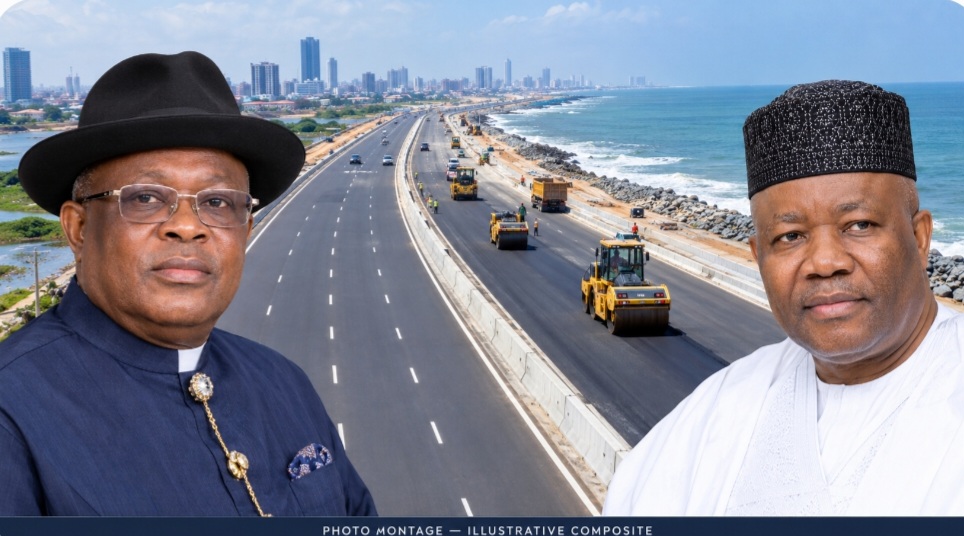
The Federal Government’s decision to redirect part of the Lagos–Calabar Coastal Highway towards the existing East–West Road has reopened a fundamental question about one of Nigeria’s most ambitious infrastructure projects.
How could a project of this magnitude advance to construction before the government encountered terrain conditions it now describes as extraordinarily difficult?
The controversy is not about whether Nigeria needs modern highways. Improved connectivity across the southern states could reduce transport bottlenecks, support trade, strengthen logistics and stimulate tourism, real estate and coastal enterprise.
The issue is whether the project’s planning, costing and execution arrangements adequately anticipated the technical and financial challenges that such an undertaking would inevitably encounter.
In October 2026, Works Minister David Umahi explained that sections of the proposed Ondo alignment crossed deep pits and areas with unsuitable subsoil conditions, making construction on the original route substantially more difficult and expensive. He said the government had opted for a detour and subsequently disclosed President Bola Tinubu’s directive to use the existing East–West Road for the continuation towards Edo State.
The government has since rejected claims that the entire coastal highway has been abandoned, maintaining that the original 750-kilometre project remains intact. However, its explanations have not eliminated the need for an independent accounting of the decisions that produced the route controversy.
The central question is not whether engineers can redesign a road. It is whether the redesign reveals risks that should have been identified before major commitments were made. At this point, Umahi as a key ally of President Tinubu who must seriously be interested in his boss’ re-election, is expected to show political sagacity and official decorum in telling Nigerians what they must know.
This is not the time to shadow box the opposition parties and the media for asking the critical questions and seeking clarity. The presidency and his ministry belong to Nigeria, and the hitherto error of talking down on Nigerians must cease; because Umahi must answer the necessary questions.
Where Was The Original Engineering Intelligence?
The Federal Government’s explanation raises questions about the sequence of feasibility studies, geological investigations, route selection, environmental assessments and contractual commitments.
Let us be clear, difficult terrain is not unusual in major highway construction. Nor does encountering unsuitable soil automatically establish negligence or incompetence. Geological conditions may be more complex than anticipated, and responsible engineers must sometimes revise their designs.
But the more consequential the project, the greater the importance of demonstrating that the initial investigations were sufficiently robust. BusinessDay newspaper reported on October 13 that the realignment had renewed scrutiny of procurement, engineering assessments and environmental reviews, particularly whether the original studies adequately accounted for the technical challenges now being cited by the ministry.
The government should therefore publish a comparative engineering assessment showing the original route, the revised alignment, the geological evidence behind the decision and the reasons alternative construction methods were rejected or considered uneconomical.
Without such documentation, Nigerians are left to accept official explanations without the information required to independently assess them. This option dispossesses Nigerians of the right to have a clear understanding of what those they elected into office to represent them are doing.
What Is The Real Financial Exposure?
The highway has been presented as a multitrillion-naira national infrastructure investment. Consequently, even a technically justified alteration must be accompanied by a clear financial explanation.
How much was committed to surveys, land preparation, earthworks and other activities along the affected corridor? What work remains useful under the revised alignment? What expenditure, if any, has become stranded? Will the change increase or reduce the overall project cost? How will it affect construction schedules, financing obligations and future maintenance expenditure?
These are questions, not established findings of financial loss. Their answers require contracts, certificates of work completed, payment records, variation orders and independent engineering assessments.
The government’s stated intention to avoid technically unsuitable terrain could ultimately produce savings. Conversely, inadequate initial planning, if established, could mean that avoidable redesigns and duplicated work have imposed additional costs on the public. Thus, only a documented comparison can determine which outcome applies.
Procurement Scrutiny Cannot Be Wished Away
The contract awarded to Hitech Construction Company Nigeria Limited, associated with the Chagoury Group, has attracted questions about procurement procedures, financing and the relationship between the contractor’s owners and the President.
In May 2024, the House of Representatives directed its Committees on Public Procurement and Works to investigate the contract procurement process. The controversy included concerns about the use of an engineering, procurement, construction and financing arrangement and the transparency of the project’s financial commitments.
Whereas it must be stated that those concerns do not, by themselves, establish corruption or illegality, equally, it must be said loudly that official assurances cannot substitute for disclosure of the applicable approvals, contractual terms, financing structure and evidence of compliance with the law.
Under the circumstances, the government owe it a duty to publish the relevant records, subject to lawful protections for genuinely confidential information, and explain the basis for the project’s costs and any subsequent variations.
Value For Money Must Be Measurable
The coastal highway should be judged not by its political visibility, the volume of concrete poured or the number of kilometres announced, but by its final cost, durability, safety, economic benefits and contribution to national development. As of last week, concerns about reported rise in road crashes within the completed section of the road bothering Lagos through Epe end has become very concerning. A major expressway of this type is expected to have sufficient engineering and traffic safety measures in place to mitigate excessive speed and to control traffic, generally.
The point being made is that a public infrastructure audit should establish the baseline cost and schedule, reconcile expenditure with completed work, assess the revised route and identify responsibility for avoidable failures if any are found.
Nigeria cannot afford to confuse ambition with accountability. The proper response to an engineering challenge is not to conceal it, dismiss public questions or assume that a presidential legacy project is beyond scrutiny.
If the redesign is sound, the evidence should vindicate it. If shortcomings in the original planning are identified, the government must explain the lessons, the financial implications and the corrective measures.
Nigerian taxpayers deserve more than an assurance that the highway remains on course. The taxpayers deserve proof that the route, the contract and the money are being managed in the public interest.








Lagos-Calabar Highway: Did Nigeria Pay the Price for Inadequate Planning?

ANLCA Airport Crisis: Police Raid Raises Questions Over IGP’s Respect For Court Orders

‘We Arrested Several Vessels Violating Cabotage Trade’ – NIMASA

Customs CGC Says ‘The World Is Connected, Not Borderless’

Nigeria Customs Mulls Reviews of Complaints Arising from Recruitment

Edo-Delta Journalists Forum Challenges Political Leaders on Regional Development

Nnadi Urges Nigerian Importers to Shift from Finished Goods to Manufacturing

WMD: Oyetola Recommit to Unlock CVFF Pursuant to Indigenous Operators Financing

Customs FOU Zone ‘A’ Hands Over Seized ₦511.4m Pharmaceuticals, Illicit Drugs to NDLEA, NAFDAC

Oyetola Unveils NPERA, Corporate Logo Amid Quiet Enthusiasm

Nigeria, Benin Urged to Deploy Culture and Traditional Diplomacy to Defuse Border Tensions

Nigeria’s Ports: How Foreign Capital Took the Dinner, While Indigenous Businesses Got the Crumbs (3)
ANLCA Board is intact, cannot be wished away by anybody’-Elochukwu

B-R-E-A-K-I-N-G: Effedua, Rector MAN Oron, Resigns

EFCC’s Probe: Okowa Plots Sheriff’s Removal Despite London Accord
Customs Trains ANLCA Members, Others on B’Odogwu Portal

NPA’s Alleged Executive Management Fight: The Half Truth & Truth

ANLCA Board Election: Know Your Candidates
‘Why We Launched B-Odogwu Pilot Scheme With Webb Fontaine Still Running’ – Adeniyi

Onyeka Makes History As Tin-Can Customs Hit ₦16.4bn A Day

Onyemekara Promoted GM, Appointed NPA’s New Spokesperson

Nigeria Customs: Trust, Competence And The Oramalugo Factor

Apapa Customs Collects ₦161b On B’Odogwu Platform In 3 Weeks

‘Rush To Break News Can Lead To Brush With Cybercrime’- Police