Business Maritime
Nigeria’s Port Revenue Quadruples as Non-Oil Exports Rise 25%

…Dantsoho Declares Reform Gains At World Ports Conference
BY EGUONO ODJEGBA
Nigeria’s maritime sector is recording significant gains from the President Bola Ahmed Tinubu led Federal Government’s economic reform agenda, with revenue generated across the nation’s ports quadrupling and non-oil exports rising by 25 per cent within the last two years, the Managing Director of the Nigerian Ports Authority (NPA), Dr Abubakar Dantsoho, has disclosed.
The development, according to Dantsoho, signals growing resilience in the Nigerian economy, reflecting not only improved port efficiency and increased cargo throughput but also an expanding contribution from the manufacturing and agricultural sectors to the country’s international trade.
He attributed the impressive performance to the Federal Government’s reform initiatives, improved operational efficiency at the seaports and sustained collaboration between the NPA, private terminal operators and international maritime partners.
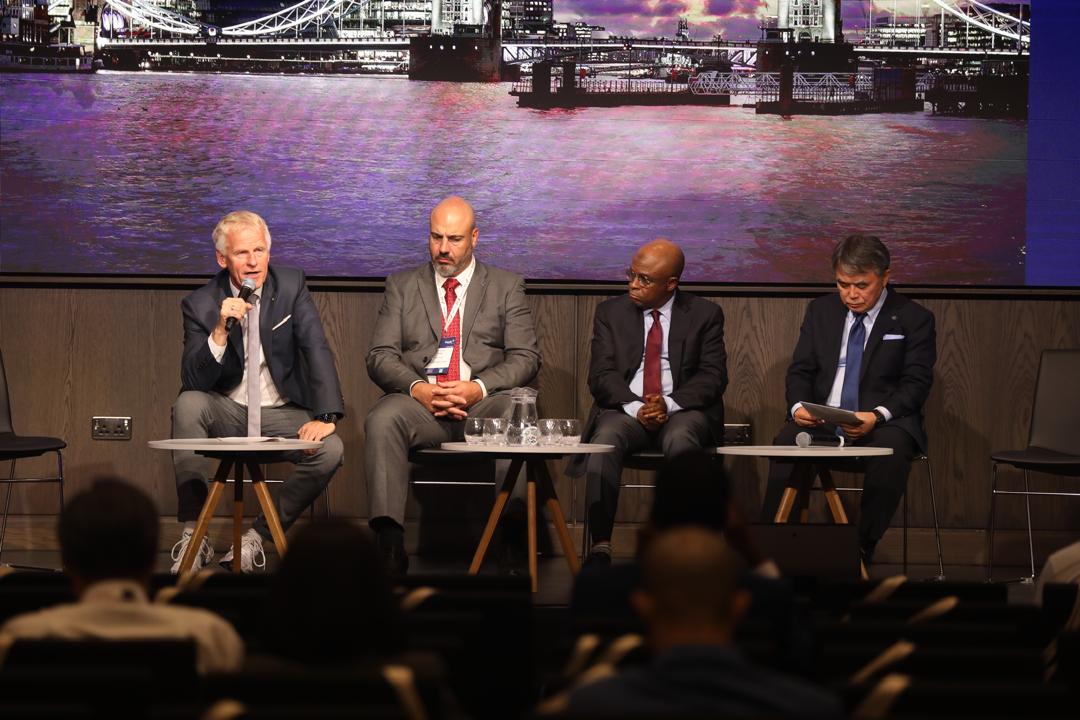
Dantsoho made these disclosures while speaking at the ongoing Annual World Ports Conference in London, organised by the International Association of Ports and Harbours (IAPH), where he highlighted Nigeria’s emerging position as a stronger maritime and trade destination in Africa.
According to him, the 25 per cent growth in exports over the past two years is particularly significant because it extends beyond the traditional dominance of crude oil and gas to include manufactured goods and agricultural commodities, such as cocoa and cashew.
He noted that the increasing export volumes reflect the growing capacity of Nigeria’s productive sectors and the positive impact of improved port operations on the country’s trade competitiveness.
“Statistically, the exports from Nigeria in the last two years have increased by 25 per cent. And these are exports that are not mainly only oil and gas. In terms of oil and gas, like I mentioned, we are doing fantastically around that, but then also in other areas of manufacturing and agriculture, raw materials like cocoa, cashew and all that.
“Volumes have increased, and that is to the credit of the partnership that we have between ourselves and the major terminal operators, APM Terminals,” he said.
For the NPA chief, the figures represent more than an improvement in port statistics; they point to the gradual strengthening of Nigeria’s capacity to generate foreign exchange, diversify its export earnings and deepen its participation in regional and global supply chains.
To sustain the momentum, Dantsoho said the Authority had introduced measures to improve the quality and international acceptability of Nigerian export commodities, particularly through the establishment of Export Processing Terminals across the country.
He disclosed that about four such facilities had been established in collaboration with terminal operators, the Nigeria Customs Service (NCS) and other relevant government agencies to ensure that export cargoes undergo the necessary processing and quality checks locally before shipment.
The initiative, he explained, is designed to minimise avoidable delays, eliminate standards-related complications at destination markets and strengthen confidence in Nigerian exports.
“We have got about four of those in Nigeria where we collaborate with the terminal operators, with the Nigeria Customs Service and other agencies that have a stake, so that everything regarding the processing of the cargo for export is done locally, so that by the time it is exported out of Nigeria, there will not be issues regarding standards,” he added.
On the opportunities presented by the African Continental Free Trade Area (AfCFTA), Dantsoho said Nigeria was increasingly positioning itself to take advantage of the expanding African market, supported by the economic reforms of the present administration.
He maintained that the reforms were strengthening investor confidence and creating a more favourable environment for trade, investment and economic cooperation among African countries.
He cited growing economic engagement between Nigeria and Morocco as an example of the opportunities available through stronger intra-African trade, particularly in manufacturing and emerging industries.
“Nigeria’s economy is very strong now because of our president’s reforms, which everyone can testify is attracting investors to the country. So because of that, we are leading other African countries to ensure that we export or trade within ourselves in a free and fair manner.
“So between, for example, Nigeria and Morocco, there’s a lot of exchange of ideas because Morocco is now a hub for manufacturing of electric cars and other smaller cars,” he said.
Dantsoho also pointed to Nigeria’s improved performance in global port rankings as further evidence that the reform process was yielding measurable results.
He disclosed that two Nigerian ports featured among the top 20 in the latest global port rankings by the World Bank, attributing the achievement to improved operational efficiency, technology adoption and strategic collaboration with international port operators.
He said the NPA was determined to consolidate the gains by strengthening its relationships with major maritime players, particularly in Morocco and South Africa, while deepening technology-driven port management.
“This is the result of hard work and efficiency, because we are collaborating efficiently. And so we have identified that this is getting us a lot of good results. It’s result-oriented, it’s technology-based. So we are going to continue to consolidate on the relationship we have with major players in Morocco and South Africa,” he said.
Further underscoring the gains, the NPA Managing Director said the quadrupling of port-generated revenue and increased cargo volumes were clear indications of the impact of improved collaboration and operational efficiency across the nation’s maritime gateways.
Speaking from the perspective of his additional responsibility as President of the Association of Ports in West and Central Africa, Dantsoho said Nigeria’s port performance compared favourably with developments across the region.
He explained that the association’s shared performance-monitoring dashboard provides useful comparative data on port operations across member countries, enabling the NPA to assess Nigeria’s progress against regional benchmarks.
According to him, while other African maritime economies, including Tanzania and Kenya, are also recording improvements, Nigeria’s recent performance reflects the benefits of a deliberate drive towards greater efficiency and stronger institutional partnerships.
He stressed the need to sustain the reform momentum, warning against complacency and any operational setbacks capable of undermining the progress already achieved.
On infrastructure expansion, Dantsoho disclosed that the Federal Government was planning a $1 billion investment in the expansion and modernisation of Apapa Port, Lagos, to accommodate rising cargo volumes, improve operational capacity and strengthen Nigeria’s competitiveness as a regional maritime hub.
He said the NPA was working with private-sector partners, including APM Terminals, to mobilise the required investment for the ambitious project.
The proposed modernisation is expected to address the growing infrastructure demands of Nigeria’s busiest port complex while providing additional capacity to support the country’s expanding trade requirements.
Beyond physical infrastructure, the NPA chief identified digital transformation as another critical pillar of the Authority’s strategy to improve port efficiency and facilitate trade.
He disclosed that the NPA had entered into a partnership with a Singaporean firm to develop a National Single Window system, while another partnership with a company from Abu Dhabi was being pursued for the development of a Port Community System.
Both initiatives are expected to strengthen information exchange, improve coordination among port stakeholders, simplify trade documentation and reduce operational bottlenecks associated with cargo clearance.
Dantsoho also emphasised the importance of business-to-business partnerships among private-sector operators, describing them as essential to building a more efficient, technology-driven and globally competitive port system.
For Nigeria, the combination of rising port revenue, expanding non-oil exports, increased cargo volumes and planned infrastructure investments presents an encouraging outlook for the maritime sector and the broader economy.
More importantly, the emerging performance suggests that the country’s ports are increasingly evolving beyond their traditional role as cargo gateways into strategic instruments for economic diversification, foreign-exchange generation, industrial growth and regional trade integration.
As Nigeria seeks to strengthen its position under AfCFTA and compete more effectively for international trade flows, the challenge will be to sustain the current momentum, translate infrastructure and digital investments into measurable productivity gains and ensure that the benefits of port reforms extend across the wider economy.









Beyond Revenue Milestones: Mu’azu Drives Reforms, Hits Off With Stakeholder Collaboration

ANLCA Unity Project: Beyond Convenient Narratives and Selective History

AFRIDEX 2026: NIMASA Unveiled Newly Acquired Tactical Assets for Deep Blue Project

Nigeria’s Port Revenue Quadruples as Non-Oil Exports Rise 25%

ADVERTORIAL

Afeni Raises Alarm Over Drug Menace, Election Violence Over Machetes, Cannabis Seizures

Ibrahim Holds High-Level Bilateral Security Meeting With Benin Republic Customs, Police

Sula Royal Debuts as Igbogbo’s First One-Stop Lifestyle Destination

Nigeria Customs Shines At 2026 WCO Global Event With Smart Digital Transformation

Nigeria Customs Move to Neutralise Online Scams, Fake News with AI Data Tracking

CVFF: A Tale of Two Truths in Institutional Dissonance

NNMJ Unity Conference: Oyetola, Omatseye, Akabogu to Re-examine Maritime Sector Reforms

ANLCA Board is intact, cannot be wished away by anybody’-Elochukwu

B-R-E-A-K-I-N-G: Effedua, Rector MAN Oron, Resigns

EFCC’s Probe: Okowa Plots Sheriff’s Removal Despite London Accord
Customs Trains ANLCA Members, Others on B’Odogwu Portal

NPA’s Alleged Executive Management Fight: The Half Truth & Truth

Onyeka Makes History As Tin-Can Customs Hit ₦16.4bn A Day
ANLCA Board Election: Know Your Candidates
‘Why We Launched B-Odogwu Pilot Scheme With Webb Fontaine Still Running’ – Adeniyi

Apapa Customs Collects ₦161b On B’Odogwu Platform In 3 Weeks

Onyemekara Promoted GM, Appointed NPA’s New Spokesperson

Nigeria Customs: Trust, Competence And The Oramalugo Factor

Kebbi Is Hub of Hard Drugs Smuggling In Northern Region’ – Oramalugo